[Lisandro Martin]
Good morning, everyone, and good afternoon and good evening to those connecting online. My name is Lisandro Martin. I'm the Director for Outcomes at the World Bank Group. This week we have discussed the World Bank Group targets: AgriConnect, M300, Water Forward. We have called them transformational, and we have explained what that means: scale, systems, and long-term outcomes. But there is one other reason why these targets are transformational, because they make us transparent, and transparency is the most transformational force in development. When your goals are transparent, you have no excuses and you have to deliver. So, transparency eliminates the laziness of explanation, and it actually replaces it with a discipline of progress. To discuss this, I'm joined on stage by Rémy Rioux, the CEO of the Groupe Agence Française de Développement and the President of Finance in Common Summit (FICS). Rémy, welcome.
[Applause]
[Lisandro Martin]
Rémy, we have a tough— here, I stole it. We have a tough international context: no money, no trust, and high expectations. Why is transparency important in this context?
[Rémy Rioux]
First, good morning, everybody. Thank you, Lisandro, for the invitation. It's my last day, the last Spring Meetings as the CEO of AFD. I'm particularly pleased to close it with you, to close it to discuss impact and transparency, and to close it in the atrium. It cannot be better than with all of you. We elevated AFD during this decade as the first partner of the World Bank Group in a number of co-financed projects, so we are really doing it together. We're in a very different context than the one in 2015, of course, and we all know that. In France, AFD, myself, we were viciously attacked by the far right, and with a lot of figures, a lot of elements. And probably we have to admit we have to be better equipped to answer and make the case for international cooperation and development. So that's where transparency, impact measurement, and data are so important. For a long time, we only expressed ourselves through one figure, which is the amount of ODA, or two, share of ODA per GNI, which is probably, let's admit it, a little bit not enough. It's not enough. What the World Bank is doing with other MDBs, other public development banks joining around impact is so important. At AFD, we created a corporate result framework, an impact framework, closely aligned with your scorecard. We have 17 of the 22 indicators that are common. We can add them up, and that's the way we measure our results. We will soon, next week, put on the website our impact portal, so the public will have all this information and hopefully question us, challenge us, have a discussion that is deeper, that is richer than the one we had to face twice last year. But of course, it's not only about transparency, it's not only about accountability, it's also about effectiveness, it's also about results, it's also about what we believe in. It's about changing the life of people, of our clients, our partners. But transparency is very important.
[Lisandro Martin]
Very clearly, Rémy, transparency is critical because once you make progress visible, you immediately face a second question: where are we going? And I think often we try to do too much, and if we try to do everything, we actually deliver nothing. So, direction is not really a luxury. Direction is something very important for development. My question to you, Rémy, is how do you set direction in a context where everything seems absolutely urgent?
[Rémy Rioux]
It's a timely question. Well, this decade that just ended was really about restarting, expanding ambition and international cooperation. Remember, it started with, with the Paris Agreement. I was one of the negotiators. Climate was the main driver for a decade, social coming immediately afterward, and the economy, of course. And the SDGs were the way we phrased it in 2015. So maybe with this ambition, we went a bit in many directions, let's say. And time has come to measure what we did, success and also failure, or where the results were not what we were thinking. And good news, for 10 years we've worked on this. Again, in my experience at AFD, we set in 2014, a bit before the SDGs, an internal procedure which is called the Sustainable Development Analysis and Opinion. Now we have internally rated, following 7 dimensions, about 2,000 projects we financed. We are doing, like the World Bank, a bit of a one AFD group, so we asked our two subsidiaries, Proparco for the private sector and Expertise France for technical cooperation, to also have their own quality filter so that we can certify the whole portfolio. Actually, you were mentioning the discipline. The discipline comes from the financial market. Because we are issuing now about two-thirds of our bonds following this methodology, which brings internal discipline on the quality of projects. Now, our next step is to aggregate all this data and better measure what we are good at and where maybe we should let other institutions and focus on where best results are obtained. That's for the measurement, and then the other issue on direction is targets. I like the way Ajay, you, the World Bank think about it, and I like the idea that we would have collective targets. Because if each and every development institution sets its own— not only its own indicators, but also its own target. I mean, cooperation, system thinking, we will lose it. We are part of Mission 300. We are part of AgriConnect. You mentioned Water Forward. I like the idea that the KPIs attached to these vast ambitious initiatives are bigger than what the World Bank alone can achieve. It's a bit of an invitation for others to adopt similar targets and contribute to a common goal. At least that's the way we are prepared to contribute from France with AFD.
[Lisandro Martin]
That resonates a lot with me, Rémy, because nowadays, we have learned a lot about how outcomes actually behave. And outcomes do not just happen; they have to be made to happen. You have to be intentional about outcomes. And one of the things that we know is that outcomes are not delivered by intensity, but actually, by consistency, by maintaining the same direction over time and the same clarity across countries and across priorities. From our perspective at the World Bank, once you have the direction clear and you start being transparent about progress, a lot of pieces that seem to be behaving on their own come together. This is what we are seeing with the targets. You talked this week about M300, Water Forward and AgriConnect. These are not targets on their own. They are a system. They become a system that is interconnected to deliver the most important outcome that the World Bank Group is supporting clients to deliver, and that is jobs. So, one single outcome, jobs, that is being supported by a multiplicity of targets. Every target, from energy to water to agriculture to finance to digital, have one single overarching goal, and that is to help clients to deliver more and better jobs across the world. I'm going to take you to jobs, not surprisingly, Remy. I know you spent the week here going to many meetings like me, and the diagnostic is clear. Nobody disagrees. We have a job crisis. But what can we do collectively, Rémy, to really help face that crisis and solve the problem?
[Rémy Rioux]
I will not go into the substance. Of course, 600 million young people in Africa, very close to France, searching for a job in the next 25 years. Huge, massive opportunity, huge challenge as well. At the same time, Europe, as you know, is losing 50 million workers for the same time span. So, I really believe that demographics will be another very, very powerful driver for international cooperation. Probably it’s time for all of us to measure that, but look at the way it popped up in the public debate in Europe. Suddenly, I mean, suddenly a few weeks ago. It gives me hope that we have a strength here. Now, beyond the issue itself, the question is, do we need one single measure of success for all of us to rally? We have the indicators, we have the initiatives with their counting targets. Do we have to agree on one? This is what you did somehow between MDBs. CO2 emission, if I may, was this main objective target for the last decade, and it was really instrumental. There were many social benefits attached to CO2 emission reduction. But we know the pushback. We know probably we aligned our institution with the Paris Agreement, meaning CO2 emission reduction is part of all our activities. I see the point in setting a new collective goal, which will be around demographics, which will be about around people, which will be around job. If for the community, this is the right one, I think it's important. The work should go, of course, beyond MDBs. MDBs are our global regional platforms, AAA, a lot of capacities, knowledge. It's extremely important, but you know, we launched— I'm chairing an initiative called Finance in Common, FiCS. It was launched 5 years ago with a very, very simple idea: please embark the other public development banks, national especially public development banks, sometimes subnational, because this is where part of the legitimacy is, and for sure this is where the bulk of the financial system lies. 550 of us, 2.5 trillion existing investments every year. And of course, these institutions are at the heart of their country platforms, of their national fabric, and there's a collective interest in turning the whole system in the right direction and of course, towards way more quality and green job creation. Then, yes. I take your point. We could have a discussion started by the World Bank and the MDBs in the wider circle of all PDBs. You know them, BNDES in Brazil, KfW in Germany, PT SMI in Indonesia, DBSA in South Africa, the China Development Bank, Caisse des Dépôts et Consignations in France, which is the oldest in the world, established in 1816, which is the place where the experience of development of France has accumulated. If you want to know the way we did it, success and failures, ask my CDC colleagues. They know. They know sometimes better than governments changing because this is an institution. And we know in the current turmoil how much we need institutions and institutions joining forces, talking the same language, being transparent, somehow opposing fragmentation, geopolitical tensions. Well, a bit like what we did several times in history. Remember, all these institutions were born— The World Bank was established in summer 1944. I mean, it was still wartime. And all UN agencies, all regional MDBs were established at the peak of the Cold War. Somehow, we're back in maybe in similar times. We have to reframe, reset, strengthen our institutional capacity individually, do our homework, but also collectively. And I'm pretty confident this is what's happening already. And Finance in Common could be the forum, the place to have this discussion altogether.
[Lisandro Martin]
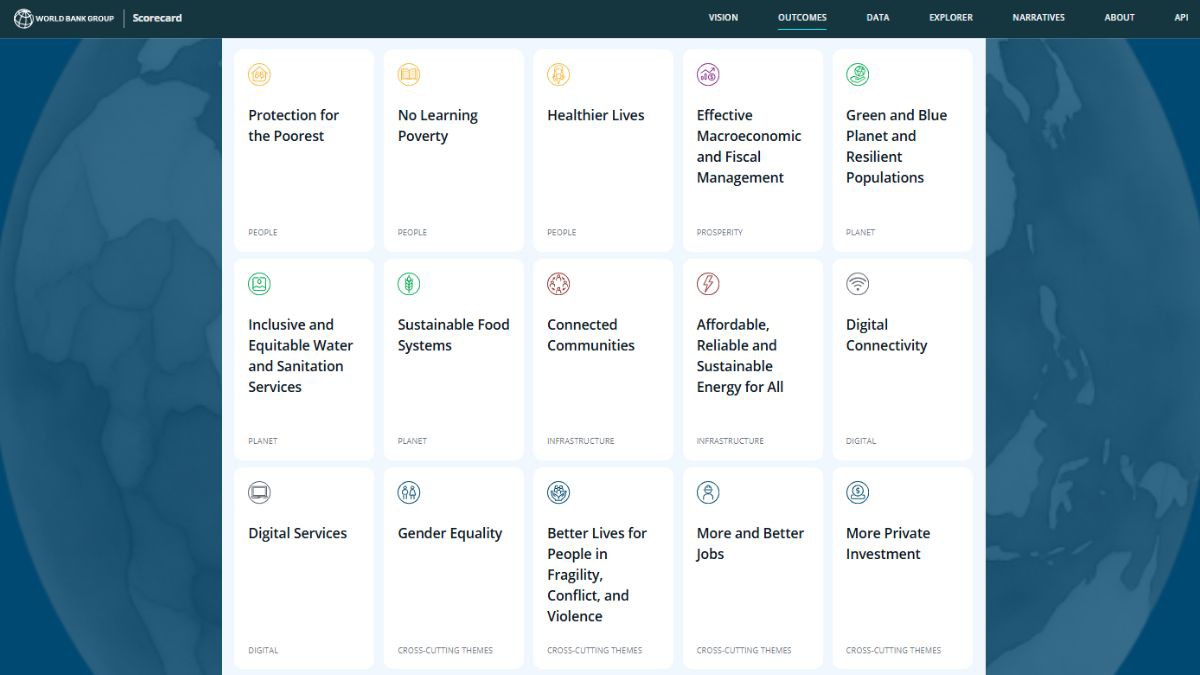
Thank you, Rémy. You emphasized one of the points that I normally emphasize, which is that measurement provides direction. It's not a technical exercise, it's actually an exercise in delivery. You highlighted something that I'll emphasize again, which is that yesterday we announced that together 12 Multilateral Development Banks have agreed on embracing a single way of going about measurement of our impact on jobs. And that is very consequential because over time that will mean that our actions will actually be delivered with the same focus and the same direction. You may start by measuring, but you finish with outcomes and you finish with realities changing. I think it's a very, very important step. In our conversation, Remy, we have said that in order to solve the jobs challenge, we need everybody to work together. We need collective action, we need collective measurement, we need collective accountability. And this is why in the World Bank Group, around 2 years ago, we moved from 152 priorities to 22 priorities. And we think that right now we're moving from 22 priorities to 1 priority. And that priority can be jobs. But that priority is also trust because in the current environment, there is no more consequential outcome than trust. And this is about trust that we are delivering the right goals, that we are measuring them honestly and transparently, and we will actually deliver on them. For that, today we are launching a new tool that we call the Target Map. And what is the Target Map? It's a single platform, a single place where anybody can access and transparently in real time you can know where the World Bank Group is in delivering its goals. And this is quite consequential because it is the first time that an international financial institution makes their progress towards targets available in real time with no sugarcoating whatsoever. I think the main achievement of the Target Map is not the rigor, it's actually the elimination of any excuses, the elimination of any caveats. It's just putting data where data is, reflecting the reality of what we are delivering. Let me show you what the Target Map is.
[Video begins]
[Narrator]
We don't need just better data, we need a better way to analyze it, act on it. Because when information is siloed across email threads and spreadsheets, it's hard to know what's moving, what's stuck, and where to move. That's why we built the Outcomes Target Map. One place to see progress across the World Bank Group's outcome targets and steer it. It starts with a simple overview. Where we stand, target by target, at a glance. Then you can go deeper. Each target has a page so teams can explore progress in detail. And at project level, you can drill down to the indicators behind the numbers with every project, mapped to the targets it supports. And if you want to check the data yourself, downloadable files make the data easy to validate, share, and build on. Because better visibility leads to better decisions. Outcomes Target Map. All targets, one direction.
[Video ends]
[Lisandro Martin]
I hope you'll click on the website very soon, and I hope you take away from the discussion here that transparency, direction, trust, and accountability are all words that are very connected and at the center of the job’s agenda. It's not only about a technical solution, it's about changing our behaviors to do what matters and to report on them transparently and in real time. Thank you for being with us, and this is the last event of the week on the targets, and I hope you enjoyed it. Thank you, Rémy, for being with us.
[Rémy Rioux]
Thanks a lot.
[Applause]