Global AI & Digital Summit – Closing the Gap

- ABOUT THE EVENT
- FAQ
GO TO: SPEAKERS
As AI reshapes labor markets worldwide, developing countries face a critical question: will it widen opportunity or deepen inequality? Join the conversation with public- and private sector leaders on how AI can strengthen development and create jobs, and on the role governments and innovators play in making this happen.
[Mark Tetto]
Good morning, everyone. [Says a few words in Korean]
I'm excited to welcome you to Day 2 of the 3rd Global AI and Digital Summit, which this year is co-hosted by the World Bank Group with the Republic of Korea's Ministry of Finance and Economy and Ministry of Science and ICT. Whether you were here yesterday or are joining us for the first time today, either in person or online, I know there are many of you online as well, we are very glad to have you. I'm Mark Tetto, Master of Ceremonies. And this session, Closing the Gap: The Promise of Artificial Intelligence in Developing Economies, is being livestreamed around the globe to viewers. Yesterday, the World Bank Group launched its new Digital and AI Implementation Plan. It sets concrete targets for digital connectivity and services in developing countries and provides a blueprint for reaching them. It focuses on digital access, affordability, usability, and AI preparedness and adoption. Today we turn from the plan to practice. Over the next hour, we'll explore how practical AI can raise productivity, help businesses to grow and create more and better jobs. We're honored to have Nobel laureate Michael Kremer, the World Bank Group's new Chief Economist and one of the world's most foremost development economists, speaking about AI and its applications for development. We will also hear from the World Bank Group's Managing Director and Chief Knowledge Officer, Paschal Donohoe, along with government ministers and private sector leaders on what AI can do to advance economic opportunities and jobs. We want to leave you with this event energized with ideas to make AI work for people in developing countries. Now, let's start the program by welcoming our first speaker, Michael Kremer. We welcome you to the stage. Please give a warm round of applause for Michael Kremer.
[Audience applause]
[Michael Kremer]
Great. Thank you. The Bank's broad AI and digital strategy includes making digital access and devices more affordable, promoting AI readiness, and harnessing the power of small AI. This has the potential to increase productivity in the private sector, create more and better jobs, and radically improve the quality of government services in sectors such as health and education. Today, I'm going to discuss some insights from the World Development Report and some of my own ideas on how international institutions and governments can work with the private sector to make digital tools more useful and promote AI readiness. I'll focus on small AI. As Ajay said during the Annual Meetings, small AI tools not requiring infrastructure or large amounts of compute can help farmers improve yields, teachers tailor instruction, and health workers make better informed decisions. Or entrepreneurs reach out to new customers. I'm going to flesh out one of those examples, which has already reached more than 50 million smallholder farmers, and use it to illustrate 3 principles. First, the need for complementary investments to make AI useful for specific applications in low- and middle-income countries. Second, the value of integrating technology. By this, I mean integrating technology, human, and management systems within firms or governments. Third, the need for independent public standards, benchmarks, and on-the-ground trials to inform procurement systems, requiring piloting and testing in real-world conditions to inform procurement processes for AI solutions. Let me turn to the example of weather forecasts. Billions of people worldwide depend on rain-fed agriculture. Weather in the tropics typically involves rainy and dry seasons, and farmers have to time their planting to the arrival of the rainy season. If they plant too late, they miss part of the growing season and sacrifice yields. If they plant too soon and a dry spell follows, their seeds will fail to germinate creating catastrophic financial losses. Changing rainfall patterns are making it harder to rely on traditional knowledge of when to plant. A half-dozen randomized controlled trials find that when farmers have access to accurate scientific weather forecasts, they change their agricultural decisions, increasing incomes and reducing the risk of catastrophic job losses. Financial gains vary by context, but a reasonable estimate is that the financial benefits can outweigh the costs of developing and delivering forecasts by 100 to 1 or more. AI is now creating a revolution in weather forecasting, improving accuracy, increasing prediction lead times, and speeding model runs 80,000-fold, allowing models to run on a desktop rather than a supercomputer. Moreover, many of the best models are open access. That creates the potential to democratize access and develop tailored forecasts for specific applications, such as tropical agriculture. However, most existing global AI weather models were not designed for tropical agricultural contexts. They were designed to predict variables like daily temperatures, but not whether the rainy season is about to start and whether it's safe for farmers to plant. This year, the Indian government created a model that combined their own physics-based model with open-access AI models and a statistical model. The combined model beat any individual model in accuracy and lead times. A precursor open-access version of the model predicted an abnormal pause in the progression of the Indian monsoon in 2025, that was not predicted by any other model to which farmers had access. The Indian government also piloted and conducted A/B tests of messages to farmers, and that proved critical to boost message comprehension. Finally, they developed systems for integrating data across ministries and levels of governments, sending geographically differentiated messages by SMS, voice, and AI chatbots to more than 50 million farming families. A randomized controlled trial varying the intensity of dissemination gives a sense of the impact. Forecasts were sent by SMS in all areas, but in some areas, forecasts were also communicated through audio messages. Preliminary findings suggest a point estimate of an 8.5% increase in farmers' profits from the audio messages. Based on this and other data, the Indian government is planning to add forecasts at other critical times in the agricultural season. Building on an open access system allows India to avoid lock-in to any one vendor and to continuously improve the system every year, taking advantage of the rapid development of AI weather forecasting technology. Moreover, because the underlying approach was on open access, Ethiopia was able to use its own data to create a model suited to their needs and sent messages to hundreds of thousands of farmers in a pilot this year. I think this example illustrates that AI can create huge potential social benefits, but that for some applications, particularly for public services or for applications serving smallholder farmers or small businesses in low- and middle-income countries, it's important to supplement commercial incentives with investment by governments, philanthropy, or international organizations to produce the needed products. The experience also offers some important implementation lessons. First, achieving impact requires combining scientific and technological expertise, human-centered design and A/B testing, and intensive work to integrate with government systems. Third, the Indian government needed to select the right model. While there were multiple good open access models for some purposes, none on their own forecast the phenomenon of most importance to farmers. Many startups and NGOs make strong claims about the predictive power of their models, but often with no real backing. This creates a race to the bottom, with firms incentivized to make stronger claims rather than to invest in improving their model. This also makes policymakers suspicious and limits adoption of AI forecasts. There's a famous economics paper which uses the example of secondhand cars to illustrate what happens when sellers have an incentive to disguise low-quality products and buyers can't easily tell high from low quality. You get what's called a market for lemons. And the whole market can collapse due to lack of trust. I think this is part of the reason we haven't already seen more scale-up of AI technology for development. Just as frontier AI models have various benchmarks, we need systematic independent standards to help judge AI tools for public services. Without systematic standards, there's a risk that tools are chosen based on marketing rather than quality. Procurement guidelines often focus on price or other things that can be easily measured. And of course, it's cheaper to create a bad product rather than a good one. We recently issued a working paper proposing some basic principles of what transparent, fair, and appropriate benchmarks would look like for weather forecasts and how to address issues like overfitting and cherry-picking. Standards and systems for real-world evaluation could be built into procurement systems, creating a race to the top in which developers are motivated to constantly improve quality. One could imagine similar standards for education, technology, health, or business software. Support for real-world testing and evaluation could be built into procurement systems, creating this race to the top. In summary, adoption of AI by firms and governments in LMICs offers tremendous potential. There are important supporting roles for tech companies, nonprofits, philanthropy, and international institutions. Tech companies are already producing incredible models. Some nonprofits have created great tools, but as I've discussed, incentives to create really high-quality tools and adapt them to local contexts are still too weak. International institutions such as the Bank can work with others to help develop standards for what good tools look like, help test tools, and of course provide resources to support governments and others to procure at scale as part of larger packages to support investments in fields such as agriculture, health, and education. This creates a source of demand for high-quality tools, so we move from an equilibrium where there's a proliferation of low-quality tools and it's hard for governments to know what to procure, to an equilibrium in which producers are competing to generate high-quality tools. International institutions like the Bank are well placed to contribute to this process. The World Bank Group has decades of experience working with governments and firms in LMICs. Our operational teams have trusted relationships with a range of ministries and firms and can work with others in helping develop standards. And of course, the Bank has strong evaluation and research capacity for testing the impact of AI tools and executing A/B tests to help generate general lessons for the field. I focused on the case of AI weather forecasts, but by putting all these elements in place, we can launch a flywheel to scale small AI software to boost productivity, create more and better jobs, and improve government services, and enable governments to improve accountability and transparency. AI systems can provide consulting services to businesses, reduce delays in court administration, use satellite data to identify potholes, reduce corruption by automatically administering driving tests, reducing opportunities for corruption and improving safety, provide teachers with individualized coaching, and help community health workers provide better care. Thank you.
[Audience applause]
[Mark Tetto]
Michael, thank you again so much for sharing your insights with us. We've heard a lot about AI over the past two days, and we know the positive impacts it can have on developing countries. But what's the thinking behind this? What's the evidence? The fact is a lot of research has gone into understanding how developing countries can best benefit from AI. The World Bank Group's 2026 World Development Report has a message that is both practical and ambitious. Developing countries do not need to build trillion-dollar all-purpose models to benefit from AI, but also importing AI tools is also not enough. So, what should developing countries do? We are lucky to have with us Gaurav Nayyar, Director of the World Development Report 2026, here to tell us what the World Development Report says. Gaurav, we have many people here and also in our online audience anxious to hear from you, so please come up to the stage.
[Audience applause]
[Gaurav Nayyar]
Thank you, Mark. Professor Michael Kremer is a hard act to follow. So, I asked AI how to make my presentation memorable. Unsurprisingly, AI suggested that I use AI to reimagine my slides, which I did, but made sure to fact-check it. So, any remaining hallucinations that you see are entirely mine. AI is in the global headlines every day and at the top of our social media feeds. Yet most of what we hear, read, and see about AI is largely in the context of advanced economies. The World Bank Group's World Development Report for 2026 articulates a story of AI for the more than 6 billion people that live in low- and middle-income countries around the world. This perspective is important because perceptions around AI are different across the world. The share of people that are more concerned than excited about AI is much larger in advanced economies compared to developing economies, from around 51% in the US and 50% in Italy to about 24% in Kenya and 19% in India. In delineating the salience of AI for the development process, the World Development Report makes 3 points: on impact, on strategy, and on policy. On impact, AI's impacts in developing economies are likely to be quite different than those in advanced economies, and these impacts can be best understood when we think of AI as a general-purpose technology that increases the capabilities of people, is concentrated in the way it's produced, at least at the frontier, and the complements that are needed to make the technology work in practice. In terms of strategy, most developing economies cannot afford to invest billions of dollars to train large AI models from scratch. Yet AI is context-specific, and simply importing AI tools from abroad may not always work. That's why emphasizing adapting AI to local contexts is what should be the centerpiece. And lastly, on policy, governments around the world are budget-constrained, and therefore the need of the hour is to make cost-conscious choices as enablers, users, and regulators of AI. As enablers, to focus on the foundational investments that can diffuse small, practical AI applications. As users, to scale up those AI solutions that work in the delivery of public services, and as regulators to start with voluntary standards and existing regulations to build trustworthy AI. So first, on impact. In principle, AI is a technology that can raise the capabilities to do complex thinking tasks, analytical tasks, cognitive tasks. These capabilities tend to be in shorter supply in developing economies and can often take a generation or two generations to build. AI can plug this gap on a compressed timescale and can help do in a decade what would otherwise have taken a century. Take the example of medical imaging. High-income countries have over 100 times as many radiologists per person as there are in low-income countries. In fact, in low-income countries, on average, there is only 1 radiologist per 1 million people. AI is already beginning to make a difference. In Bangladesh, for example, AI-generated medical imaging increased the number of patients screened for diabetic retinopathy by around 40% per day. There are many such other examples on how AI is improving the delivery of public services, from agricultural extension to judicial services, to tax administration. Interestingly, while the hype that we hear is about the use of language models and generative AI for frontline service delivery, this is not where the action is today. 4 in 5 AI solutions procured by governments around the world are for back-office tasks. In lower-income countries, the leading use cases are predictive analytics and decision support, geospatial intelligence, early warning systems, and smart agricultural practices. Moreover, 78% of these AI solutions procured by governments use more traditional predictive AI or machine learning models, and only 8% use generative AI models. That's why predictive AI at the back end of public services is where the immediate potential lies today to scale up AI use. The risk of job disruption is also less imminent today in developing countries. In high-income countries, about 14% of jobs today are susceptible to being automated by AI. This number falls to the low single digits in lower-middle-income countries and is close to zero in low-income countries. So today, AI is much more likely to complement or augment people in developing countries rather than displace or substitute them. This is the good news, but the capabilities of AI are accessed through a value chain that is characterized by a lot of concentration. 13 of the 17 leading publicly listed AI companies in the world are headquartered in only 2 economies: in the US and in China. And this is true across all layers of the AI value chain, from compute to data centers and from models to applications. However, AI sovereignty is not necessarily the answer to navigate the dependency risks that come with this concentration, because that is a very expensive and resource-intensive process. The estimated capital expenditure of the leading AI hyperscalers in the world at more than $750 billion in 2026 is actually larger than the entire economy of many countries around the world. That's why developing countries can navigate the dependency with interoperability instead, preserve a menu of options to choose from and not get locked into a single vendor or supplier. The bigger risk comes from the lack of complements. Without the foundational infrastructure, skills, or institutions, AI's benefits are likely to be slow to take off. These complements typically lag the most in low-income countries, where less than half of the population has access to electricity, while only 1 in 4 people are connected to the internet. In this way, AI's capabilities, concentration, and complements give us a framework to think about AI's impacts as they will unfold in developing economies around the world. Now, on to strategy. What should developing countries do? The World Development Report offers a clear framework: adopt and adapt, then advance. Advancing the AI frontier is relevant for only a few countries in the world with sufficient resources and capabilities. Adopting the AI that is available in the market is the much more logical starting point, but not enough. Not enough because AI is a technology somewhat unique that learns from data, and data must reflect local languages, local needs, and local conditions. That is why adapting AI to local contexts is what can help developing countries strike the right balance. Lastly, onto policy. How can governments as enablers, users, and regulators of AI implement this strategy of adopting and adapting AI solutions? On governments as enablers, everyone in the room would agree that the digital complements matter for AI— access to affordable compute, local language data. But perhaps what is left out in the conversation is the fact that the analog complements might matter even more. 1 in 4 businesses across several developing economies in the world cite the lack of knowledge, information, or awareness as the reason they don't use AI solutions today. 1 in 4 businesses in developing economies also cite cost as a barrier to adopting AI solutions. And this is in sharp contrast to the US, where only 1 in 50 businesses cite cost as a factor. So, the lack of knowledge and the lack of access to finance remain major hurdles. On governments as users of AI, today we live in a world of AI pilots, AI experiments, AI use cases, but use does not equal impact. And today, we have little reliable information on what AI solutions work and why. We found around 10,000 studies of AI-based interventions in healthcare, but only 17 of these almost 10,000 studies meaningfully tried to assess the impact of AI in low-resource settings. So, governments, as users of AI, must embed monitoring and evaluation into their procurement frameworks and scale up the AI pilots that are working. Lastly, governments as regulators of AI. We know AI comes with many risks, both unintended if the data informing the AI solution are not appropriate or intended where malicious actors can deliberately use AI to cause social harm, such as with cyberattacks and with deepfakes. These risks are reflected in the fact that around 40% of digital agencies in developing countries around the world, compared to only 10% in high-income economies, cite the lack of relevant policies, guidelines, frameworks, or standards as a constraint to adopting AI tools. The good news is that countries and governments can use voluntary standards and existing laws and regulations as a starting point to build trustworthy AI. There are more than 800 voluntary standards that are already published or under development around AI. And where these standards fall short, perhaps like in the case of cyberattacks and cybersecurity, countries can rely on existing laws and regulations to safeguard against these risks. Over time, of course, countries must identify the regulatory gaps that emerge as the technology evolves and also begin to plug in those gaps, but with the spirit of international cooperation to ensure that rules and regulations around AI do not get fragmented. In summary, the report has 3 main messages. Be optimistic because AI can do in a decade what would otherwise have taken a century. But don't stop there and hope for the best. Be strategic, emphasize adapting AI to local contexts. And be pragmatic, with budget constraints, make cost-conscious choices as enablers, users, and regulators of AI. You can find the full report, the report's overview, as well as the report's main messages online. And for those of you who would like to venture beyond PDFs, you can also talk to the WDR2026 Companion to query the report. Thank you very much for listening.
[Audience applause]
[Lively music]
[Mark Tetto]
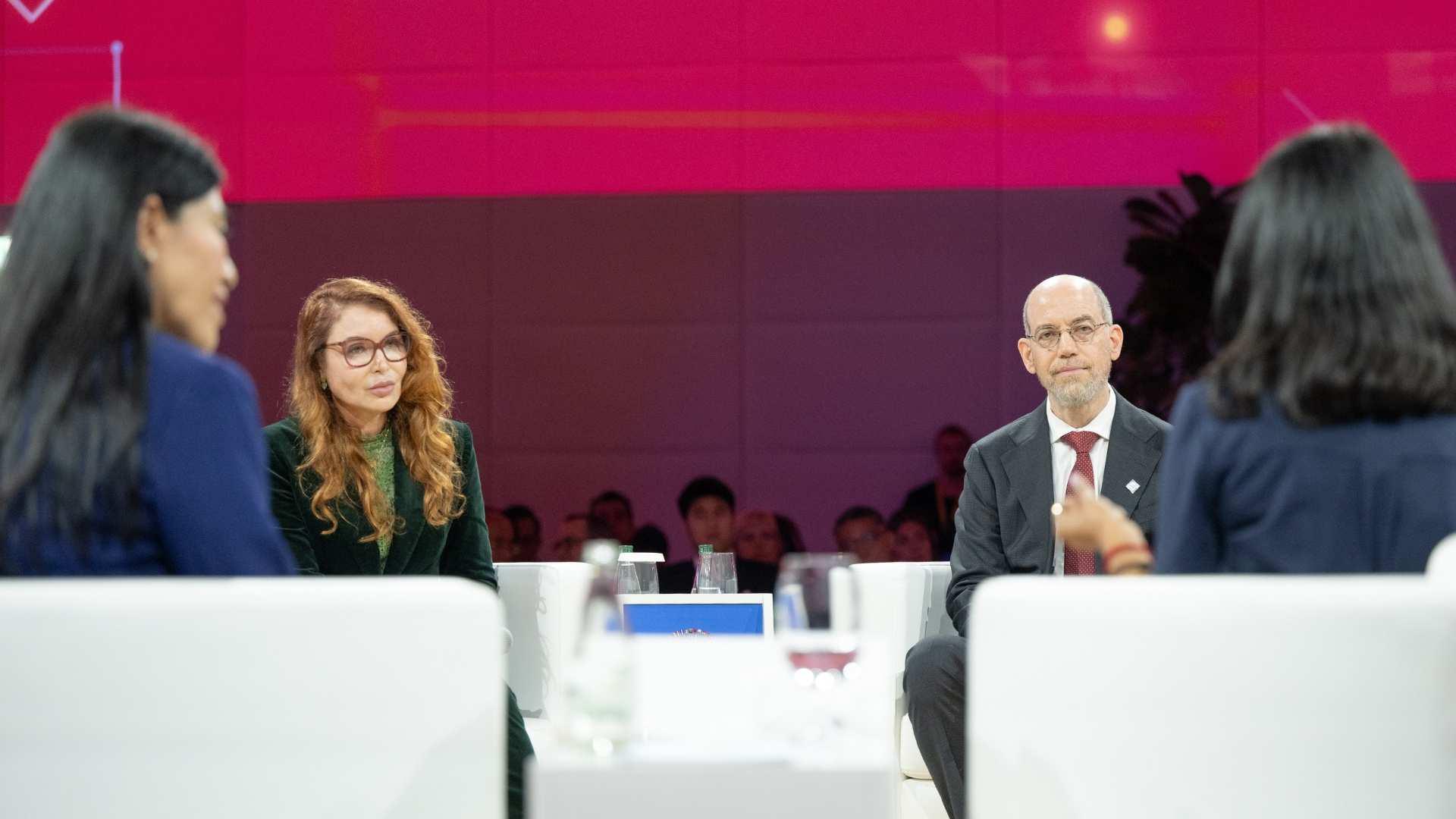
Thank you again, Gaurav, for bringing the contents of the World Development Report to life for us with your engaging and compelling presentation. The next part of today's event is being led by the World Bank Group with Paschal Donohoe. Paschal is a Managing Director and the Chief Knowledge Officer of the World Bank Group. He is also the former Finance Minister of Ireland. Paschal is a keen commentator on how to move from theory into action, and like so many of us, he is now focused on where AI can fill gaps in expertise, boost productivity, and improve delivery of services. He will be speaking with an expert and distinguished minister and a private sector AI innovator and leader. The focus will be on what AI is already accomplishing, what more can be done, and what support is needed to ensure future benefits are shared. Allow me to welcome up our moderator, Paschal, to the stage. And also, Paschal, as you come up together with our esteemed guests, Cina Lawson, Minister of Public Service Efficiency and Digital Economy and Transformation of Togo, and Darlington Akogo, Chief Executive Officer at minoHealth AI Labs and KaraAgro AI. Could our guests please join us on the stage?
[Audience applause]
[Paschal Donohoe]
Good morning, ladies and gentlemen. It is a great privilege to have the opportunity to participate in this summit and also to be joined in this discussion by two such distinguished guests. Before we get into dealing with the important themes of the morning, I just want to extend a great word of thanks to all of our guests who are here from governments and from the academic community and the private sector from all over the world. I want to thank you for your participation in making this summit such a success. I also want to extend a particular word of thanks to all the colleagues in the World Bank Group who have worked so hard in this policy area for so long and who, in organizing this event, are seeking to highlight the policy work and the financial opportunities that are there to ensure that AI is used in a way that maximizes its development impact. To Sangbu
[Kim]
and all of the team, a big thanks. Moving on to the topic of our panel discussion, and I'm delighted to be joined on stage today by two distinguished guests. Our discussion has been so well framed by Michael and Gaurav, and I was very struck by two examples that were used in each of their presentations. Michael talked about how artificial intelligence was used to improve weather forecasting, and then he noted that for farmers who benefited from the improved weather forecasting, he pointed to a really remarkable increase in their income due to their ability to better understand weather patterns. And then Gaurav pointed to really big improvements that can be made in healthcare and how those improvements in healthcare could ensure that we have equality of access to the best healthcare services that clinicians are able to provide to societies. And those two examples highlighted the opportunities that are there with regard to AI. But both Michael and Gaurav then went on to talk about the policy choices and decisions that the public sector and the private sector needs to make to realize that opportunity. Michael talked about the opportunity of a race to the top and what is the framework that needs to be in place to allow that to happen. And Gaurav talked about the framework that's at the heart of the World Development Report regarding adapt, adopt to advance. All of those points underline one of the key areas of discussion over the last number of days, which is harnessing the potential of artificial intelligence to deliver a development impact. Particularly within the World Bank Group, we're very focused on the jobs opportunity and how small AI in particular and the use of digital capacities can provide additional jobs for hundreds of millions of people across the world. With that brief introduction offered, I'm now going to turn the discussion over to our guests. Again, thanks to both of you for joining me on the stage this morning. I'm going to begin with the Minister. Minister, before I get into a question to you, could you maybe describe the impact that this kind of technology has had in your own country and in your economy? When you think about digital opportunities and AI, what opportunities come to mind? I should say the Minister is a former member of the World Bank Group. She's a member of the alumni of the World Bank, so she is able to think about these topics both as a Minister and then somebody who's thought about development in the World Bank as well. Minister, over to you.
[Cina Lawson]
Thank you very much. Good morning, everyone. It's an honor for me to be here today. I would say that the first time that we were able to use AI within Togo's Government was during the pandemic, and we used AI to prioritize beneficiaries to our financial aid program. That was unique. The reason for us using AI was that we didn't have unified social registries, so we didn't really have the choice. It was an emergency, urgent situation. We also had the support of NGOs, GiveDirectly, even the World Bank and others, because at the time, public finance couldn't fund a program based on AI prioritizing beneficiaries for financial aid. After that, the thinking within government was, number one, we need to bring this at scale and we need to do it consistently. That was a very impactful program. It was the Novissi program. Because we were able to really support hundreds of thousands of Togolese. That's the first thing. What I would say is that looking back, it helped us to think through AI to build a new entity within government, the Togo AI Lab, that would be dedicated to identifying, to using, applying artificial intelligence to improve our policies. We've been looking into agriculture and health. Obviously, we started with an AI strategy. It was very important for us to figure out what we were going to do, in what order, what was needed. We designed a strategy, then we decided that it was important to apply it first within government. You have to start with yourself to be more efficient, but also to accelerate digital transformation. Because for AI to be effective, you need a lot of data. As a government, we do have a lot of data. Earlier, we were having a conversation and I was asking you whether at the World Bank you were applying AI in knowledge management because you've collected a lot of data ever since your creation. It's important for you, the World Bank, to apply AI, for us, governments, to apply AI and digitize to be able to apply AI to improve our policies. Now, we've talked a lot about agriculture, and I'm sure we'll talk more about it. For example, in 2020, what we did with NASA Harvest and using satellite imagery, was to be able to draw the rural map of Togo, which crops are where and so on. This data is now available, but what the next steps are, and we are doing it in collaboration with multiple agencies worldwide, is to be able to identify where to plant which crops. Which types of soils are going to be better for which kind of crops. I'm saying that because we, the governments, are the only ones who can be effective in doing this across all of Togo. Then once we've done that, what we want to do is to give this information, to put this information for use to rural farmers and so on.
[Paschal Donohoe]
Great, Minister. We'll come back in a moment to the use of artificial intelligence within agriculture and the economic opportunity that is there. But maybe at this point I'll invite Darlington to come in. Darlington, you're a serial entrepreneur in the area of AI, but in the application of AI to many different parts of an economy, from healthcare to agriculture. Could you maybe quickly just take the audience through your own involvement with AI? And then building what the Minister said, she talked about the need for scale and did so in the context of healthcare. Could you maybe offer a reflection on that within the commercial sector and how AI has helped with scale?
[Darlington Akogo]
Good morning, everyone. To give a bit of context, we started minoHealth AI Labs in 2016, 2017. It was very important for me that we start this in Ghana. Mind you, if you can picture this is way— ChatGPT came out in 2022, 2023, so several years before ChatGPT. A lot of people thought we're crazy to attempt to start an AI company in Ghana instead of maybe trying to relocate to the US. But for us, it was very important that we do this within the African context because we believe that, one, that is ground zero if you want to solve the grand challenges that exist in healthcare. You can't solve it in the ivory towers of Silicon Valley in the US. We wanted to be close to the problem. We also believe that African diversity, the biological side of it, presents data that essentially covers a lot of the world. If you look at it, this is one interesting analogy, and it's actually scientifically accurate. Someone from Denmark and someone from Italy genetically are much more similar than one person from the northern part of Ghana and another person from the southern part of Ghana. We are incredibly diverse, so having an AI system learn from that data is to the benefit of the world. We made a bet on it. Since 2017, we trained a couple of models. We deployed it in areas like radiology, so being able to look at medical images and be able to detect breast cancer from mammograms or detect chest cancer from X-rays. But then when we realized that— sorry. When we realized that generative AI presented a new opportunity in AI, we decided to start training models, foundation models for healthcare and biology. We got initial financing from the Gates Foundation. This was in 2023. We trained what became the first AI foundational model to be productionized for healthcare and biology anywhere in the world. And so with this AI system, we're able to deploy it in different areas. One of the interesting things is that this AI is now being used in over 100 countries around the world. It's called Moremi AI. And also we've been able to use it for— One of the use cases we do with this AI is that the third leading cause of death, even in the US, is medical errors. The reality is that we don't even know what this number looks like in most parts of the Global South. And so we deployed Moremi with a use case called Moremi Sentinel. What it does is that if a doctor writes clinical notes, prescription, or any form of documentation, the AI system looks at everything the doctor has written. checks global guidelines, but also checks the clinical, the standard treatment guideline of the country they are in. So, it has that local context. Then it's able to step in and say that, “Oh, the dosage here is wrong, or this is not the right medication, or you forgot to make this test.” Doctors actually appreciate this use case because it's not a use case that is attempting to do what doctors do. It is supporting them to be better doctors. They like this use case a lot. But currently we are also expanding. We have some partnership where we are expanding to a chain of hospitals doing about 1 million patient visits per year. We've also formed partnership with the government of Ghana to roll out our AI system nationwide. And the last use case is we're actually using Moremi AI to design antibodies, vaccines and even diagnostics. We've done this for malaria, meningitis, and gonorrhea. and now we just got some new financing from the EU and GIZ to do this for monkeypox and also malaria, working with partners both in Ghana and then in Germany. These are all use cases of AI happening right on the continent, right within the Global South.
[Paschal Donohoe]
Darlington, thank you very much for that. I visited Ghana myself earlier on in the year, and I saw the prominence of technology in the parts of the economy, but also in how the government is thinking about how technology can be used in public services. Maybe then, just to bring in the minister again on this point, I'm really struck that many of the examples that Darlington used for the use of AI were in healthcare. Within the World Bank Group, as we look at our goals with regard to healthcare, which are to connect 1.5 billion people on our planet to better primary and universal healthcare, we see technology as being central to this. And your example began with healthcare and AI in healthcare as well, albeit in very difficult circumstances. As you think about the future of healthcare in your own country and maybe the future of your public services overall. What role do you see AI playing there? And maybe just talk to us a little bit about the ambitions that you have for what that can mean for the people who you're designing your public services for.
[Cina Lawson]
First of all, I'd like to congratulate Darlington because I had no idea that you started the company in 2017 and, and so on. I'm very impressed and congratulations to you. I would say that one prerequisite for us would be the digital transformation of health.
[Paschal Donohoe]
Yes.
[Cina Lawson]
Which we have yet to do. It's an ongoing process. It's very important because when, for example, you mentioned that doctors would write a prescription and the AI would be able to comment on it, you need to have a digitized system. That's number one, and we need to implement it in Togo. The vision we have is that for AI, because when we talk about AI, what is AI for the majority of citizens? The way we want to explain it to them is two things. Number one is that our vision is that we want to have Togolese to be one phone call away to any public service. From a planning standpoint, we've launched a few months ago a program that we called Voice of Togo because we want to have an LLM in all of our 50 national languages. That's number one. We think that it is going to be changing the relationship of Togolese and public services because they will be able to speak their dialects or local languages to request any service. This is foundational. This is going to be a DPI.
[Paschal Donohoe]
Can I just come in on that about the impact that that could have on somebody?
[Cina Lawson]
It’s going to change Togo forever.
[Paschal Donohoe]
Maybe it sees public services distant, a bit hard to access, and how that would change their relationship with the state?
[Cina Lawson]
Absolutely. And it is going to change the country forever.
[Paschal Donohoe]
Yeah.
[Cina Lawson]
It's a foundation for not only public services, but also for education, for health, because remember, today you have to learn math and science in French. So, if you could have an AI walking you through, explaining some of the concepts in the language that you feel most comfortable with, it would change how you view education and so on. It's a very tedious process, but we're very happy. It's also something that is very easy to explain to people because you want people to— Earlier, we were talking about how enthusiastic the developing world is with regards to artificial intelligence because our population is young. For us, it's not a luxury. When we talk about using AI in health and education, it's because we lack doctors and we lack teachers, for example. We have very concrete use cases for AI, and that's why we think it's going to make a huge difference. But we need to build the datasets. When we don't have the dataset, like during COVID we use artificial intelligence, satellite imagery, and so on. But a lot of the effort that we are doing today is to build these datasets, and we have to do all this in parallel because the world is moving very fast. We don't want to stay behind, so we're building the dataset. We are trying to have access to compute. We are at the same time digitizing and trying to train people because a lot of the people within government, and you would be surprised, I think a lot of people today use AI within government, but they don't use it in a, I would say, in an organized way. You don't want the whole government to send data to the large language models because you have confidentiality issues. It requires us to, in addition to everything, increase training and do training at scale. One thing that I want everybody to really keep in mind is that I often say that we, African governments, have done a lot of initiatives, a lot of innovation, but our problem is to do them at scale so that we can create lasting impact.
[Paschal Donohoe]
Okay, so, Minister, you've highlighted there the importance of datasets. You've assessed the importance of access to compute. And Darlington, when you were making the case for the impact of AI within Africa, you also talked about diversity. You talked about the potential within the Global South. Could you respond back to what the Minister said there? From your point of view, what do you believe are the choices that policymakers need to consider, and what would you like governments to be doing to realize the potential that is there for AI to help with economic development?
[Cina Lawson]
You're listening?
[Darlington Akogo]
Yes, yes. Actually, I think a lot of work— We need to give credit to Minister Lawson and also give credit to a lot of governments within the Global South. Because there is this impression beyond the Global South, outside the Global South, that they now need to get into AI, especially from the governance piece. But that is not necessarily true. I'll give you a few pointers. One, we have a continental AI strategy. I was one of the team that worked, or one of the people that worked on the continental AI strategy. We started work on this in, I think, 2022 or 2023. Actually, it would have been 2022. We started work on it even before ChatGPT. In my very own country, Ghana, we worked on a national AI strategy which I served as the technical lead for. I think, the Minister also just mentioned they have a governance piece they've also done in Togo. There are at least maybe something like 20 different African countries that have some AI governance framework that they've already worked on. From a governance angle, that's step one. It's already been taken care of. Now, where we are moving towards is the implementation of whatever is captured in those strategies. If you want to work towards implementation, it's very important to pick use cases. With what we've done working with governments, both on the continent, but also in the Caribbean and other regions, is that you don't want to impose AI solutions on a country. You want to actually go, understand, work with the experts in those areas. So, if it's healthcare, go meet with doctors, clinicians in the public health sector. Let them tell you the real challenges they are having. Pose the situation where an AI solution could help them with diagnosis, with treatment planning. See if it makes sense before you go ahead and do it, because you don't want something where it looks like the government is imposing the use case on the users. That is how projects get abandoned. You want to work with the country, work with the people on the ground to deploy that AI solution. The other thing is that once you identify the use cases, you run a pilot. Run a small pilot. Let it serve as one opportunity to test ideas, opportunity to benchmark how well the AI system performs. Because we don't want to create this narrative, “As an innovator, I like open innovation.” But at the same time, you don't want to create a narrative because we need solution, we just pick anything, we don't test it, and you put it out there. That doesn't actually help in the adoption of AI, because if the AI goes ahead to make very grave mistakes, it will be used as an example on why AI should not be adopted.
[Paschal Donohoe]
Yeah.
[Darlington Akogo]
Which doesn't work for any of us. Once you run those pilots, you have the results, then comes the scale-up phase. The scale-up phase might require a number of things. It is very important that we look at regional sovereign AI. I think we all remember the incident where Anthropic was told by the US government to halt access to their latest model for everyone, including people working in Anthropic in the US that were foreign nationals. You cannot build your AI future on models that come from US or China. I thank God I'm not a diplomat, so I can say some of these things without creating a lot of chaotic issues. So, forgive my non-diplomacy. You have to be able to create. It doesn't mean that every country should have their own AI system. We need some level of concentration. It needs to be regional. One thing is that in Europe, there's a lot of backing for a company called Mistral. It's a French company, but it's positioned as an European answer to OpenAI and Anthropic. Then China is representing the Asian block. We need those solutions in the Global South, in Africa, in the Caribbean. Once we have those, then you can scale up those solutions. Now, if you're ready to scale up, you should be looking at things like data centers. You should already have strong internet infrastructure. The World Bank has a fiber expansion project in Ghana where people like Stephen Davenport and the rest have worked on this. What we are doing is that our partnership with government to scale up our AI solution in healthcare is based on this internet expansion infrastructure. We look at the hospitals. Currently, about 300 hospitals have already gotten access to fiber internet. We are picking those first to deploy the AI solution. There are a number of things to look at, but the key ending message will be you don't need to build roads all across your country before people start buying cars. You have to start from somewhere. This whole idea of that wait until you build all the infrastructure before you bring in AI is not true. Let AI be part of the process as you're building your infrastructure to support AI.
[Paschal Donohoe]
Minister, just to pick up on that analogy that Darlington offered, that you don't have to build roads everywhere before people begin to buy cars and use cars. This is one of the takeaways from our World Development Report, making the point that it's about the use of technology and making that technology appropriate to your context, and to your needs.
[Cina Lawson]
Yes.
[Paschal Donohoe]
I saw you nodding vigorously as that point was being made.
[Cina Lawson]
Absolutely.
[Paschal Donohoe]
Please, off you go on us.
[Cina Lawson]
I have a few things. Good news for you, Darlington, which is that the last few days and then before that, even before coming to Korea, the discussions that we had among African ministers was to have regional shared compute. This is very high and with the support of the World Bank, and even yesterday we were in meetings with all African ministers and the World Bank team, and it is going to become a reality. Let's say that. I don't know if I can— That's the first thing. Yeah.
[Audience applause]
[Cina Lawson]
The second thing that you said, which is very important, is using maybe open-source models that we would either— we could start by localizing these models to use cases that make sense for us. And over time, if we have the compute and if we would evolve within to create models that are African continental models. I think that these things resonate a lot with us and with me in particular. Now, talking about— Because we are at an event with the World Bank, I think it's very important to acknowledge the support the World Bank has given us in Togo through a connectivity project. We now are going to be able to connect schools, hospitals, and public city halls with fiber connectivity. I think it's going to help us accelerate the use of AI. I also think that one thing that is really important for us on the continent is training. Training, again, at scale. We have hundreds of thousands of people who need to be trained to be able to use AI, but also to use AI to increase their revenues. I think that that's something that we need to discuss a little bit more.
[Paschal Donohoe]
Minister, you've identified the importance of education and skills. We also have an education and skilling strategy that runs parallel to our digital strategy, and that looks to the skills that are needed for this new economy. If I can maybe ask Darlington to quickly reflect on that in the few moments that we have left, and then I want to come back to each of you for a quickfire question, please. Darlington, if you look at education systems, within the Global South, within Africa. What kind of change do you believe is needed to equip citizens to use technology, but also to support the next young Darlington, to ensure there can be more Darlington's to realize the potential of AI?
[Darlington Akogo]
Yes, I definitely agree. We need more training. We need to build capacity. Some of the things we've been doing along this line is we do use case training. We have projects in agriculture. We have a project called CADI AI, which we work with GIZ, and we built AI solutions with drones that can detect diseases and pests. What we did was that we ended up training extension officers and then farmers on how to use the technology. We've also partnered with universities in Ghana and also in Nigeria. We've run training programs for health practitioners. We're running training programs for researchers. We are doing a lot of this. This is what is needed. We don't need training programs that treat AI theoretically. It needs to be use-case-based. We need to empower our doctors, our teachers on leveraging AI to improve the delivery of services. But the last point would be, this is highly contested, and there's a lot of research going in both directions of how much AI should be allowed in the classroom. What I think is that in the early years, to build solid problem-solving skills, let kids leverage as little as possible AI for a number of problem-solving tasks. But once they get to a point of maturity, the whole goal of education is to prepare them for the real world. The real world has AI in it, so it should be they coming on board as a manager of AI to solve problems. It needs to be gradual. It cannot be removed. But if we start with little kids already overusing AI, there's also research pointing that it limits certain thinking, problem-solving skills. We need to balance it.
[Paschal Donohoe]
So, it's about AI being in the service of the pupil, not the other way around.
[Cina Lawson]
I have something to say.
[Paschal Donohoe]
Just before you come in, because I want to bring you in, but we only have 3 minutes left and we have to stick to our timings, otherwise, I'll be in trouble with Sangbu. If I could ask each of you to come in, and Minister, I'm going to begin with you. If you could identify one area of collaboration between the World Bank Group and your government that would realize this potential, what would it be? And to Darlington, one area of collaboration between the World Bank Group and the private sector in the Global South, what would that be?
[Cina Lawson]
I'm going to answer your question, but I wanted to say one thing with regard to education. A lot more of students learning math and science. We need to reform education. In Africa to have a lot of people choosing math and science over literature and studies in high school and so on. So that is going to be— The second thing is that within the general university system, we also need to have compulsory AI training so that anybody who enters university gets this training. I think that that is going to be changing a lot. With regards to what we've been doing with the World Bank, a lot of things ranging from connectivity, partnering in connectivity. We're now discussing shared compute. We've been doing a lot of training at scale of civil servants, of also farmers and so on. We have a lot of areas of collaboration.
[Paschal Donohoe]
Excellent. Good collaboration already underway, but of course, the World Bank Group and your government are ambitious to do even more together.
[Cina Lawson]
Exactly.
[Paschal Donohoe]
Darlington, the private sector and the World Bank Group.
[Darlington Akogo]
Yes, I think especially in the Global South, we definitely will need the World Bank. It's supposed to be a 3-way collaboration. It's going to be private sector, government, and the World Bank to achieve scale.
[Paschal Donohoe]
Absolutely.
[Darlington Akogo]
When I have conversations with the World Bank team back home, they always tell me, “No, the World Bank is not interested in pilot, they're interested in scale.” That is the perfect place it comes in. This is the perfect time. We have the AI strategies, the continental and the national ones. The World Bank comes in to create the financing for government to achieve that scale. The private sector becomes implementation partners to build and provide those solutions for scale with partnership with the World Bank. Yes.
[Paschal Donohoe]
Great. One of the things that I was so struck by in the World Development Report and in the contributions from Michael and Gaurav is the tone of the discussion regarding AI, that in many parts of our world, we're very much aware of the anxiety and challenge that AI can cause. But the contributions from both of our brilliant panelists and the point the World Bank Group is making is the opportunity that AI can offer, particularly small AI, and the opportunity that digital technology full stop can offer with regard to development and better public services and the creation of more and better jobs. And that point of optimism and also both of our panelists have reminded us that they were already making progress on the use of technology and the use of AI before the prominence of large language models began to build over the last number of years, reminding us of what the opportunity is, but what are the choices that governments, the private sector, and the World Bank Group need to make to realize the potential of technology to build a better world for young people and those that we are looking to create jobs for. So, two words of thanks. Firstly, big thanks to both of our panelists here today for all they are achieving with the use of technology and the benefits that they are creating within their countries and beyond. Thanks to you both for joining me this morning. Also, a further word of thanks to all of our colleagues in the World Bank Group, the Digital and AI team, our DEC team, and then colleagues within the Bank, IFC, and MIGA, who are working so hard to realize this optimism and this potential. And to you, our viewers and audience, thank you for your time and attention this morning. I wish you all a successful further day of this very important summit. Thank you.
[Audience applause]
Speakers
-
-
Michael Kremer
Chief Economist and Senior Vice President, World Bank Group
-
-
Gaurav Nayyar
Director of the World Development Report 2026, World Bank Group
-
Darlington Akogo
Chief Executive Officer of minoHealth AI Labs & Kara Agro AI




Moderator
-
Mark Tetto
Co-CEO, TCK Investments (MC)