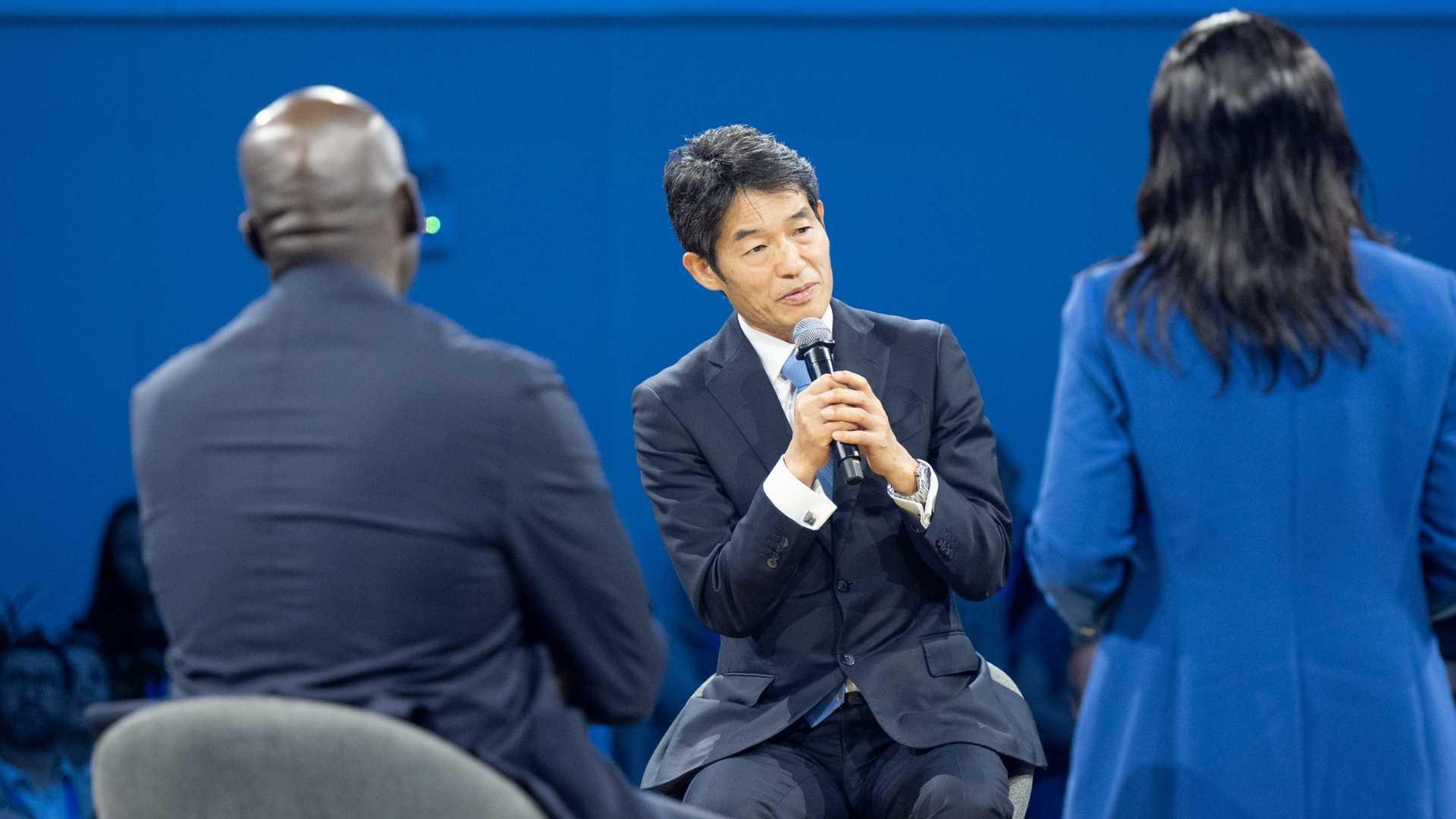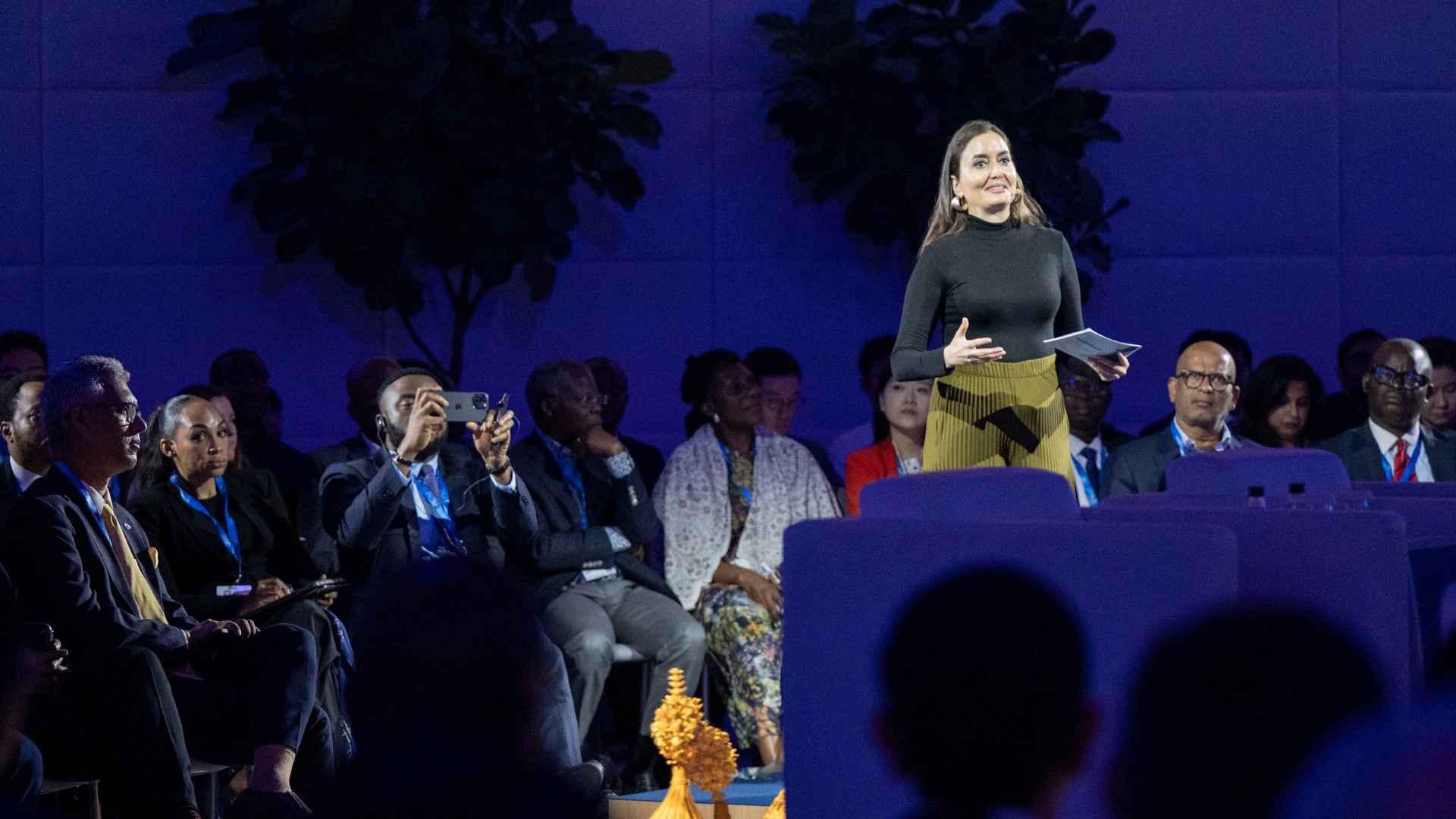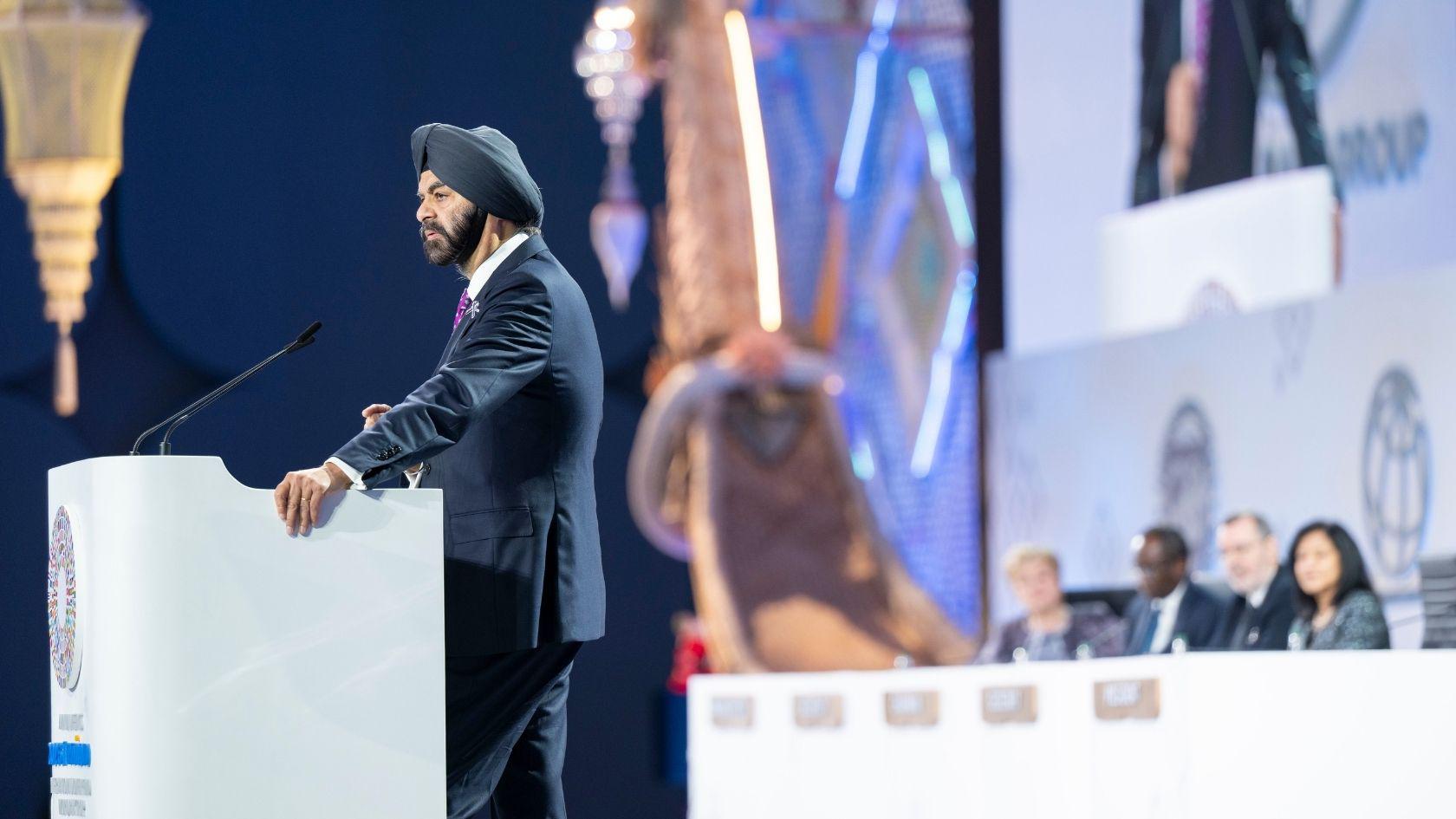







The 2026 Annual Meetings brought global leaders together in Bangkok, October 12–18, to discuss jobs, investment, growth, and practical solutions for development.
Small AI: More and Better Jobs | Annual Meetings 2026

Don't miss the Global AI & Digital Summit (Oct 19-22, 2026)
👉 Sign up for updates- ABOUT THE EVENT
- Transcript
GO TO SPEAKERS | ONLINE Q&A | POLL
How can developing countries harness AI to create jobs, improve services, and expand economic opportunities? This event explored the potential of “Small AI”, practical, affordable AI designed for specific tasks and local needs, including tools that can work on basic devices, with limited connectivity, and in local languages.
Ajay Banga, Kristalina Georgieva, Tharman Shanmugaratnam, government leaders, and technology experts discussed how AI can support agriculture, healthcare, education, skills development, and small businesses. The conversation highlighted the importance of preparing young people for changing labor markets and using AI to improve productivity and create better jobs.
Watch the replay to discover practical examples of AI for development and learn how digital infrastructure, skills, local data, responsible governance, and partnerships can help countries move from pilots to locally relevant solutions that strengthen services, businesses, and economic opportunity.
[Video introduction]
[Narrator]
It feels like AI is everywhere. The promise is enormous. More productive workers, expertise within reach, faster growth. Adoption is meteoric, including across developing countries. But scratch the surface, and AI looks a lot less global. The AI we hear most about is built by a small set of countries. And when it comes to data, right now the lingua franca is decidedly English. AI may seem everywhere, but global AI investment, compute, and capability is highly concentrated in advanced economies. The companies are concentrated. The talent is concentrated. So, how do we bring all the benefits of AI everywhere? Especially in developing countries, where it can also bring jobs. Is replicating 100 Silicon Valleys the way? Or is there a different path? Maybe we should be asking, what if AI can be small? Small AI is purpose-built, affordable, and accessible. When AI is small, it can go anywhere, like on a smartphone with limited connectivity, and it can be local: local data, local languages for local needs. It’s AI that fits developing countries because AI could allow them to compress decades of progress into years. When we hear that AI is coming for our jobs, that is not necessarily the case in the developing world. There, AI can be a job creator. Over the next 10 to 15 years, 1.2 billion young people will reach working age in developing countries. What jobs in AI will await them? Will it help them earn more? Can increased productivity bring new economic opportunities? When we say AI is everywhere, that means in developing economies. There, the fundamental risk is not that AI takes jobs; it is that we are too slow to use AI to create them.
[Video ends]
[Rajini Vaidyanathan]
Hello everyone, and welcome to the World Bank Group and IMF Annual Meetings 2026. I hope you’re all ready and awake on this early Monday morning start, and it’s good to have all of you here in the room in Bangkok with us. And of course, it’s great to be joined by all of those of you who are watching. Around the world.
[Speaking in foreign language]. Welcome everyone. I’m Rajini Vaidyanathan. I’m a Presenter and Correspondent with BBC News, and I’m your moderator for this program. We do have an exciting and interesting hour or so ahead of us. Well, this flagship is kicking off an exciting week, I should say, of conversations. We’re going to be hearing from global leaders on the future of jobs, which of course is at the heart of the World Bank Group’s mission. We’re going to be talking about Artificial Intelligence, how can we mobilize private capital, and how medium and small enterprises are powering development. So, there’s a lot to come through the week. Now, let’s begin this session with a history lesson. We’re here in Thailand at the Queen Sirikit National Convention Center, and there’s a particular connection to this location. This convention center was originally built specifically to host the 46th Annual Meetings of the World Bank Group and the IMF back in 1991. I wonder if any of you here in the room were present for that meeting back then. Well, fast forward 35 years later, and we’re now at the 81st Annual Meetings. Round of applause, 81st
[laughs].
[Applause]
[Rajini Vaidyanathan]
Time moves on, doesn’t it? And today, of course, as we meet, the world is in a very different place. And one of the biggest challenges and changes right now is, of course, Artificial Intelligence. Now, much of the global conversation around AI has focused on managing its risks. But today we’re going to ask a different question: how can AI be harnessed for good to create jobs and growth? We’re going to be exploring that today with a particular focus on practical, accessible applications of AI, what we just saw in that video up there, small AI, and how can it turn technology into real opportunities. Remember, you can share your thoughts at any time on X, Facebook, and LinkedIn, or you can use the hashtag #WBGMeetings. We have experts in multiple languages standing by online to answer any of your questions. Please, do use the QR code you can see on the screens as well to send us a question. And if you’re following us online, do join us via the live chat. Well, without further ado, let’s kick off this session. Do join me in welcoming three leaders who are helping to shape that conversation. I’m joined by Ajay Banga, President of the World Bank Group, President Tharman Shanmugaratnam, President of the Republic of Singapore, and Kristalina Georgieva, of course, the Managing Director of the International Monetary Fund. Welcome to all of you.
[Applause]
[Rajini Vaidyanathan]
Hi. Hi, President. Hello. Hello. Welcome to all of you. The 81st Meeting, as we were saying, and a lot has changed, of course, hasn’t it? So, I think we’ll start with you, Ajay. This session is called “Small AI: More and Better Jobs.” Jobs and opportunity are at the heart of the World Bank’s agenda. How’s the Bank changed in that way? And how does AI fit into all of this right now?
[Ajay Banga]
Yes, thank you. And thanks to… Being on a panel with the two of them is a privilege, and I’m lucky to be here. I believe that the Bank’s entire focus has to be on jobs for a very simple reason: 1.2 billion young people in the coming 15 years are going to become 18 years of age. So, that could be a huge demographic dividend if, when they’re growing up, they get clean air, clean water, healthcare, education, skilling. But once they’re grown, they need the opportunity to have and be a productive part of society. So, the word “job” does not mean working for a big company or a small company or as an entrepreneur. It’s being productive in society, having a sense of optimism, and a sense of dignity that comes from earning and being a part of that system. That’s what we’re talking about. The Bank’s entire focus has moved towards that over the last few years. It’s not that we don’t build a school. Or we won’t build a highway, or we won’t build a skilling center or a healthcare clinic. We have to do all those, but we’ve got to do them with the perspective of job creation, which starts from having the right foundations, which is physical and human infrastructure, having the right governance and policies in place, something that Singapore has done very well in its history, and then having the right way to de-risk private capital to be able to come in and invest at scale because it is private capital that creates jobs. Governments enable and the private sector generates between 75% and 85% of jobs in any country. That’s what we are trying to do. How does AI fit in? In the emerging markets where the conversation is not about large language models, where people are concerned about the possible impact on jobs, possible, not proven yet, but possible, in the emerging markets, it’s about applications. that could add enormously to productivity for a school, an educator, a healthcare system, an agricultural system for small farmers to get to scale. And hopefully, as we speak, as well as from subsequent panels, you’ll get a bunch of examples of that type. That is what we are focused on, the rollout of small AI into the emerging markets as a productivity enhancer.
[Rajini Vaidyanathan]
Okay, thank you very much, Ajay. Let’s move on to you, President Tharman. Ajay mentioned your country and the work that you’re doing when it comes to developing AI. You’ve said in the past that AI may disrupt jobs in advanced economies, but could create a different risk for developing economies. And Ajay made that distinction in some way just then. You say that new jobs may simply not be created fast enough in developing countries. What do developing nations need to do now, President Tharman, to make sure that their young people are able to participate and benefit from the next wave of technology and economic growth? And as we just heard there from Ajay, it’s the future of young people and jobs that’s so crucial to all of this conversation.
[Tharman Shanmugaratnam]
Good. Well, I think taking off from what Ajay said, although I’ll speak at 10% the pace that he spoke at, the first thing we have to realize is it’s early days. This is not a shock. This is not a pandemic. This is a whole new era. And we should start with the recognition in the public sector and across all our stakeholders. Growth is going to be critical to secure good jobs, but growth is not itself going to be sufficient to achieve those good jobs. And the evidence is already there. If you look at China, India, developing Southeast Asia, they’re growing quite well, but job creation is weak. So, there’s already a divergence between growth and job creation, and AI is going to widen that divergence if we are too passive about it. So, we’ve got to do everything we can to first use AI to create good jobs and to create jobs that can be done well by human beings, can allow them to climb up a career ladder, despite AI. The second thing we’ve got to be really concerned about is a K-shaped economy and a K-shaped labor force. In the first wave of automation, it was the low end of manufacturing that fell out, and some of them moved into services, to the gig economy, and so on. This time round is the broad middle in the workforce that we have to be concerned about, and we cannot afford to have a K-shaped workforce or population, where the broad middle and that broad set of skills that the middle in the workforce has accumulated falls out. So, bear that in mind. These are two broad structural changes now. I’m an optimist, actually, like Ajay and like Kristalina. I think there are sectors of the world economy that still offer very significant promise for the developing world. First, don’t give up on manufacturing. I’m not a pessimist on manufacturing. There are whole swaths of the labor force in the developing world where costs are still cheaper than China and still cheaper than robots. Just look at four or five states in India that are now growing at a remarkable pace in export manufacturing. If the other states could do the same, India gets lifted up despite its late start. Look at Vietnam and look at those that haven’t yet started that game. Courting investment, making land available without encumbrances, sorting out labor regulations so that workers can get into a job and move up the ladder is critical. Green energy is another opportunity with many multiple benefits. First, of course, it provides for energy security, and it allows you to take part in the AI economy because you need energy. But it’s also a job multiplier because renewable energy generates three times as many jobs as fossil fuel energy for the same billion dollars that you put in. The third opportunity, think of the jobs that can be enhanced by AI and are very unlikely to be displaced. Healthcare is a huge opportunity in the developing world. The opportunity to just get anywhere close to advanced country standards, you don’t have to get… You don’t have to be terrific. You don’t have to get right to the top. Just close, half the gap even, means many more doctors and nurses and community health workers. The proportion of nurses per capita in the developing world is 1/5 to 1/10 the level of the advanced countries. Huge potential. In India, community health workers are now a major part of the health system because they’re helping to do immunization, they’re helping to do maternity health, they’re helping to educate families. So, it’s a whole set of jobs in healthcare that can be created. Finally, I just want to make one point which cuts across sectors. AI is going to blur the distinction between being an employee and being an entrepreneur. The rise of the one-person company, so to speak, or a company that starts with one person, then it has a few more brought into it, is a new phenomenon that’s already coming up in many parts of the developing world and the developed world. And we’ve got to encourage that, because that too is a new form of employment, but it’s different. You have agency. Small players using AI can reach markets and access technology much, much more feasibly and efficiently and at a low cost compared to before. What can we do about it? If you look at Zhejiang Province in China, they now have a service alliance for one-person companies providing a range of such services, including AI models, including sources of energy, and including some professional services. So that’s itself a new growth sector in the job market, and we’ve got to encourage it.
[Rajini Vaidyanathan]
Thank you, President Tharman. It’s interesting you mentioned healthcare there because we do have a speaker who’s using small AI in India coming up in the program. So, we’ll get more on that later. Thank you. Kristalina, now over to you. What’s the economic impact on all of this, particularly, of course, in developing countries, as we’ve heard?
[Kristalina Georgieva]
Let me first say that it is fantastic to start this week of meetings with Ajay and President Tharman, and I want to recognize our fabulous hosts. We have Deputy Prime Minister Ekniti here and his team.
[Rajini Vaidyanathan]
Round of applause again.
[Applause]
[Kristalina Georgieva]
So, AI, love it, hate it, fear it, it is here. And we are already seeing the first wave of impact. It is a demand shock, an investment shock, that has lifted up growth in a small number of economies because of the construction of data centers, because of the investment in the models that are driving AI. When you look at supply chains, you have, broadly speaking, three economies, United States, China, India, that are the most important AI producers. But then you have those that build the infrastructure for AI, and many of them are in Asia, including Thailand. So, that shift to a higher gear is what is keeping the world economy growing at 3%, around 3%, despite the fact we are being dragged down by the energy supply shock. But this is only the beginning, and this is not the most exciting thing of the AI story. The next wave of AI would be adoption. And there, everybody can participate. Actually, adoption, if we work hard to have the basics for it, can be very democratic, as democratic as the cell phone. However, we have to be fair and say for developing economies, there are some preconditions and the World Bank report is very clear about them. Well, you need access to electricity, you need access to digital infrastructure, people have to be geared to adoption, and the government should be able to give some safety, to protect against bad actors so that adoption can work. We have done some estimates. I admit, we all look into the future and it’s a bit foggy. By our estimates, growth in Asia for the advanced Asia can go up somewhere between half a percentage and one percentage point, 1% additional growth is a very big deal. And even in the emerging Asia, it could be somewhere between 0.2%, 0.8%. Now, when I talk percentages, very often people say, “So, what is 1%?” Let me tell you what it is. If advanced Asia that is aging very rapidly, was to gain 1%, this would more than offset the loss that comes from aging population. So, AI would compensate for aging and even exceed that compensation. Now, why is it that we are excited about AI? It is a transformative technology. It so completely changes how we work, how we live. I’ll finish with this. This morning, my AI assistant, in the 30-second instruction that it gives me every day, said, “Your number one thing today is the panel with President Ajay Banga and President Tharman. Be ready.”
[Rajini Vaidyanathan]
Thanks, Kristalina
[laughs]. Imagine if it got it wrong and told you you were doing something else.
[Ajay Banga]
They say AI can give you false results. The only real president in this group is this guy. The rest of us are not. So, I think that’s the false result.
[Rajini Vaidyanathan]
Well, I’m going to call you President of the World Bank right now. So, that’s not an AI instruction. Let’s get back to you then, Ajay. We heard from Kristalina there talking about the economic opportunities, particularly in developing countries. I want to pick up on what this event is all about in some ways, which is Small AI in developing countries. What does it look like in practice, Ajay, and how can it create jobs and opportunity? And I think just picking up from what Kristalina said about electricity and getting people online in the first place, how can small AI be accessible in the way that it’s sort of developed? It’s different, isn’t it?
[Ajay Banga]
Yeah, so, I’ve been very fortunate that President Tharman has helped us at the Bank. We run what’s called a Jobs Council. He’s the Co-Chair of it, and we have a group of people from academia, from public and private companies, as well as from civil society. And we came out with five sectors that were critical to grow jobs, all of which are not reliant on outsourcing jobs from the developed world to the developing world, kind of the last 30, 40 years’ model, but instead build locally relevant jobs. And those five sectors connect to this conversation. The first is infrastructure. It’s construction, but then what it enables: bridges, roads, airports, digitization, electricity, water. But also, human infrastructure in terms of skilling and education and the like. The second is agriculture for small farmers. Most of our economies are very heavily dependent on food grown by small farmers. They get competed to the point where it’s tough for them to play in the system. But access to cooperatives, access to technology of the type we are building, I’ll give you a couple of examples, it enables them to get past that. The third one is primary healthcare and its delivery. President Tharman was just speaking to it, but think of Indonesia with primary healthcare centers, each with a nurse, a midwife, and a medical diagnostic technician. Think of the quality and number of jobs you create through that extension, and then use technology and AI to connect to remote doctors and the skills that may not be present in a primary healthcare center. And the fourth is tourism and what it can multiply in terms of jobs. I mean, Thailand is a principal example, but they’ve got ambitions to go even further than what they’ve done thus far. And then manufacturing, particularly value-added manufacturing, which is not pure extraction but creation of local jobs. Minerals and metals, the emerging markets are gifted with large quantums of deposits, but they need real quality jobs. But also look at Africa, the creative industries or the like. There’re so many opportunities on manufacturing across, whether you do this as an entrepreneur, to President Tharman’s point about individual agency, or you do it out of working for others, all are possible. That’s the idea. Examples: healthcare clinic in Indonesia. You’re the patient, I’m the nurse. You walk in and you say, “I have a rash here.” And I look at it and I can’t figure out what it is, but I can take a photograph and send it to the doctor I share with 20 other clinics.
[Rajini Vaidyanathan]
I do actually have a rash right now
[laughs].
[Ajay Banga]
Sorry about that, but I’ll ask the doctor to intervene. And so, he in turn can either look at it himself or run it through a simple local AI tool delivered at the edge in a local 3G phone. It’s very simple to do. Gets that and says, “It’s an eczema, give her this ointment, tell her to go home” or “don’t like it, tell her to come to the regional hospital to meet the specialist in 14 days at 10:30 in the morning.” That is a very difficult thing to do even in the advanced economies today. Getting a specialist appointment organized digitally is a very hard thing to do. So, you can cut through the arbitrage of all this by creating simple AI tools. Another one, something we’re doing right now with farmers in India and elsewhere with Google’s help, actually. And I think the Google guys are going to be in the next panel.
[Rajini Vaidyanathan]
We are going to be talking about that in the next panel, yeah.
[Ajay Banga]
We are going to see this. The idea is a platform that’s been built to connect farmers and cooperatives to better fertilizer, better seeds, better crop insurance, better credit, and most importantly, better offtake prices for their product. And so, an illiterate woman farmer in India can point a 3G phone at the back of a leaf and say, that disease, I don’t need to know the name, but that disease, equal to this insecticide, press the button, because India has put bank accounts in everybody’s hands. You press the button, 25 rupees, that insecticide at my cooperative. That’s the kind of stuff that small AI is about. The reality is that large language models are estimated, probably, to create some degree of disruption in jobs of the developed world. But by the time you get to middle-income countries and lower-middle-income countries, actually the opportunity from small AI to build jobs and build productivity is enormous. That’s what we are trying to do. And that’s what the Jobs Council started out. In fact, the small AI word came from a Jobs Council meeting with President Tharman.
[Rajini Vaidyanathan]
Okay, thank you. And I think what’s interesting, isn’t it, Ajay, is the accessibility of it. Like you say, it can just be in someone’s pocket. Countries like India where smartphones have a huge uptake. We’ll come to you next, Kristalina. You’ve described AI as a tsunami for the labor market, with young entry-level workers especially exposed. What should policymakers be doing now to ensure that it creates more opportunities rather than disrupts? And I know President Tharman touched on some similar areas already.
[Kristalina Georgieva]
Well, it is a slow-moving tsunami, but a tsunami nonetheless. The impact over time on jobs globally, we estimate to be around 40% jobs either augmented or downgraded or eliminated. And we are already seeing some of this impact in advanced economies, 60%, low-income countries, 23%. You may say, “Oh, they’re better off.” No, that is just because AI is further away the small AI hasn’t quite yet reached all of them. So, you’re asking a question that is really important to answer. What can be done? Well, first, we need to carefully research what is happening in the labor market. We have to gather information, analyze this information. And this is what we do at the Fund. We did a study in the United States that shows that already 10% of jobs require AI skills, higher skills. They pay better. It shows that the routine, repetitive jobs are shrinking. And very interestingly, it shows that low-paying jobs are increasing and they’re increasing in two directions. Construction, data centers, and services. And you would ask, and the net impact of the area we studied is actually positive. But that’s not a story to celebrate because it is positive on the side of lower-paying jobs. And when we look at this, what we recognize is that the people to worry about first and foremost, young people that are coming into the labor market. Normally, they would get into this routine, repetitive jobs and then grow up the ranks. But if they’re gone, I don’t think any young person wants to be a barista in a coffee shop in the professional future. So, my first point is study, understand what is happening. Burst the myth that AI is shrinking demand for people. What it is doing is it is shifting demand for people now. That may not be the case in the future. Second, get governments to recognize they have a huge responsibility to rethink how education should be done in the world of AI and recognize that no more we can acquire a skill and hold on it for our life, and that lifelong learning is actually a paramount necessity. And third, and what I would say clearly would show I’m the Managing Director of the IMF, think about the fiscal side of the story. Why? Because traditionally, governments would generate revenues by taxing, mostly, people. Well, if AI changes the structure of the labor market, and then there is less labor, more capital, what do we tax? How do we generate the revenues so governments can help play their most important role, which is to help society adapt to the world of AI? If revenues are shrinking, they would be in a tough spot. So, to make that long story about the slow-moving tsunami short, we cannot today imagine what exactly the world of work will be five years from now. But we can be disciplined and carefully assess what is happening and then draw lessons, but most importantly, act on them.
[Rajini Vaidyanathan]
Okay, thank you, Kristalina. Well, you mentioned a lot of things that governments should do. Conveniently, we do have a President sitting next to you. Obviously, you have a role on the Jobs Council as well. There’s lots of really interesting points that Kristalina raised about fiscal issues, about skills in particular. Let me ask you about skills then, because you’ve emphasized the need to invest in skills regularly, particularly the importance of public-private partnerships. What do you think governments and businesses can do differently then to make lifelong skills development a reality? I mean, it really does pick up on what we’ve just heard from Kristalina, doesn’t it?
[Tharman Shanmugaratnam]
Well, the silver lining in jobs displacement by AI is that it’s going to happen task by task. And that gives us time. It means that in the workplace, whilst people still have jobs, there’s that opportunity to adapt, to learn new skills, to build on what you already know, and to stay agile. AI, as a tsunami, isn’t going to come all of a sudden, as Kristalina was saying. It’s going to come gradually. It’s going to be diffused throughout the economy, and we have time to adapt. What’s critical is learning on the job. There is a particular problem that we have to address very soon, though, across the world, advanced countries and developing (ones), and that is that the first rung in employment, your first job upon graduation, is now seeing less demand. The evidence is already very clear. It’s clearest in the most AI-exposed sectors, by the way, which are the tech sectors. But it’s clear, it’s becoming clear across the board. And what governments did during COVID and what some governments did during the global financial crisis, now has to be thought of not as a crisis measure, but as part of the menu of structural policies that governments have for a new era, which is that governments have to get involved with the private sector to make that first job possible, to make that pathway into the first rung of your career ladder possible. We can’t afford to lose that. Because if you lose that, you not only have that cohort of young people waiting a year and then competing with the next cohort the next year, you lose more than one year of skills. You lose a whole set of intangible attributes, and you lose trust in the future. So, we’ve got to do now, as part of public policy, ways of incentivizing the private sector to take in fresh graduates so they get that first foot in the door. In the market, and they learn from there. That’s one policy implication. But I also want to work backwards from what’s happening in the world of work, work backwards into the tertiary education system, because I think there are two very important shifts that are required there. If you look around Asia, you look around the developing world, in fact, if you look around the advanced world, and you think about how you have to avoid that middle getting displaced, the middle of the workforce getting displaced, it means we also have to change how the middle gets educated. And the reality of tertiary education systems, higher education, universities and the like, is that it’s overwhelmingly academically focused. And here again, the data is already clear. The link between academic credentials and career prospects is weakening. In the US, for the first time in a century, demand for graduates has gone down. The wage premium that college graduates earned has gone down very significantly. So, we’ve got to take these as early signals of a new era, work our way back into the education system, and reduce that skew that you currently find towards an academically oriented education, towards an education that’s more applied, has more bursts of work as part of education, more attachments, more internships, more of the dual model of education where you spend serious time in a firm as part of your tertiary education.
[Rajini Vaidyanathan]
Okay.
[Tharman Shanmugaratnam]
That’s one major shift that has to be made. It’s a critical issue for developing countries where you still have to develop that applied education stream. But one final point I’ll have to make is one that comes from what Kristalina said about the fact that we don’t know what will happen in five years’ time. We need some humility amongst education planners. Don’t fixate on one particular model of education, particularly on the issue of depth versus breadth. We don’t know what will be required. The reality is, in some areas, you need great depth of expertise to be able to learn continually on the job. And there’ll be other areas where you need more breadth of exposure to different disciplines because you have to integrate AI across functions. You’ve got to do many other jobs that require a breadth of human skills. But there is no one model. So don’t fixate on one model. Have some humility. Be clear-eyed enough to realize that the future is fuzzy. And agility is the way we have to go, not just for firms and industry, but agility in education itself.
[Rajini Vaidyanathan]
Okay, thank you so much, President Tharman. We’ve run out of time, but it was really interesting to talk to you all. I wonder if just in two words you can just give me, or three words, a quickfire thought on where you think things are going to be. You mentioned five years, things are going to change a lot. What you would like, your one big goal in five years’ time. Start with you, Ajay.
[Ajay Banga]
A realistic application of small AI, in as many emerging markets as possible. That’s what I’d like to get to.
[Rajini Vaidyanathan]
Thanks, Ajay. President Tharman.
[Tharman Shanmugaratnam]
Well, avoid a new divergence between the developing world and the advanced world and see continued convergence, as we’ve seen in East Asia, especially, using AI, using technology, and developing the best of human capabilities.
[Rajini Vaidyanathan]
Okay, thank you. And last but not least, Kristalina.
[Kristalina Georgieva]
Get AI to do all the stuff we don’t want to do and let us enjoy the things we love to do. High productivity, high standard of living, but also the dignity of being socially viable.
[Rajini Vaidyanathan]
Thank you so much for your time, all of you. A round of applause, everyone.
[Applause]
[Rajini Vaidyanathan]
Thank you, Ajay. Thank you, President Tharman. Thank you, Kristalina. Thank you. Thank you. I’m sure you’ll all agree that was a really thought-provoking beginning to this discussion, looking at the issue of skills and education when it comes to the future of AI, and of course looking at technology and infrastructure as well. Now, one of the central challenges around almost every conversation anyone has about AI is trust. The question’s often asked, is it safe to use? And do people really have the confidence to use it? Who’s accountable? And will our AI support people rather than replace them? Well, our next speaker has spent years working at the intersection of technology, trust, and responsible innovation. Please, give a warm welcome to Tiffany Xingyu Wang, the national bestselling author of “The Trust Code” and the founder of Songsheet AI. Over to you, Tiffany.
[Tiffany Xingyu Wang]
Thank you, Rajini. Hello, everyone. Thank you.
[Applause]
[Tiffany Xingyu Wang]
So, in Silicon Valley, we talk in big numbers, trillions of dollars for one company, billions of parameters for one model, and of course, gigawatts of power to sustain both. But today, the most debated question is, should we trust it? Oh, trust is the most overloaded and underdefined notion. It can mean alignment, safety, security, privacy, and before the list ends, we have already lost you. So, what should you know? AI can sound confident while being wrong. It can feel intimate without being responsible. It can act authoritative without being accountable. And behind every answer and every action lie the objectives you may never see. The engagement metrics, the revenue goals of AI labs, and with more evidence showing machines’ own drive to survive. So, being capable does not mean being beneficial. The central question today is not whether to trust AI, but how to trust AI wisely. I’ve spent a decade building AI and the digital trust systems, and the last two years researching for the book “The Trust Code: How to Unlock AI’s Promise Without Losing Humanity.” And there are two things for you to remember. One, trustworthiness is about the machines and trust is about us. Every single frontier model today has failed safety tests, every single one. So, it is our responsibility to hold AI labs accountable for the potential liabilities and build the scaffolding for safer deployment. Second, the biggest risk of AI is not replacing us, but persuading us to surrender our judgment without even noticing it, which brings me to this room. Here I see the true promise of AI, and you are the stewards. There are three judgment calls I want you to think of. It’s this way you walk into every single discussion about how to invest in, build, and deploy small AI in the most needed places in the world. First, model diversification. East or West, closed or open, the differences in performance for those models barely matters for the jobs small AI tries to do. Do not depend on one model. Because one day, the investor subsidies might dry up and AI labs’ incentives might stop aligning with yours. Your freedom to walk away is your path to sovereignty. Second, own your context. 2.2 billion people are not yet connected online. That means the big models have learned the world without them. They barely understand your languages, your laws, your crops, your patients. And their blind spot is your advantage. Rent the intelligence, but own the context. No training on your data, no data kept longer than needed. Technology scales, but the context doesn’t. So, you have to keep your context. And third, build the human infrastructure, which the panel mentioned during the talk. AI will reach the people experts never did. Think of the patients without specialists, farmers without agronomists. But you need the people who understand how to trust it, how to verify it, when to refuse it. If in 10 years the job of your workforce it’s simply to click a button to approve AI, then we missed the entire point. Look, trust is built one judgment at a time. Which models, whose data, which skills, and these judgments are yours, your stewardship. Now, let us bring AI to the most needed places. And that’s the race of trust you can win. And with that, thank you everyone for your time.
[Speaking in foreign language].
[Applause]
[Video: Small AI Already at Work]
[Narrator]
A different kind of AI is changing someone’s life right now, somewhere in the world. This is Small AI. Already at work. AI that tells you when to water your crops, what’s harming them, and when to harvest.
[Farmer]
The biggest advantage is that our costs are falling. It also tells us if a spray is needed or if a fertilizer is required.
[Narrator]
Or AI that helps you choose a career, connecting students to real jobs, real salaries, real futures.
[Student]
The Gallito AI app helped me develop a clear idea of what I wanted to pursue. I think I’m going to be a great mining engineer!
[Narrator]
First platform that puts AI in the hands of frontline workers. Ask a question, the app speaks back in your language.
[Voice in an app]
[Foreign language]
[Narrator]
Diagnosing crops, spotting health risks, shaping futures. Small AI is the path to better jobs, stronger businesses, thriving economies. Built for scale, built for the world.
[Video ends]
[Rajini Vaidyanathan]
Thanks once again for Tiffany’s talk there. And we heard from her, didn’t we, about why trust matters. Before that, we heard from leaders about their vision for small AI, which moves us on to our next question and panel. If you want to stand in front of your chairs, and I’ll introduce you one by one. And the question we’re looking at is, how do you make small AI work on the ground? What does it take to scale up initiatives and how do countries build the infrastructure and skills to make it all work? Well, they’re already on stage, as you can see, surrounding me, and our next panel brings together a diverse range of perspectives on exactly those questions. I’m joined by people from governments, tech companies, and philanthropists. A round of applause for our next panel, everyone.
[Applause]
[Rajini Vaidyanathan]
So, I’m just going to introduce you all. We first have Ximena Lincolao, Minister of Science, Technology, Knowledge, and Innovation of Chile. We have Pierre Laporte, His Excellency Minister for Finance, Economic Planning, Trade and Investment from the Seychelles. On the other side of the circle, we have Vilas Dhar, the President of the Patrick J. McGovern Foundation, Doron Avni, Vice President Public Policy and Emerging Markets at Google, and last but not least, Kathleen Reen, Head of Global Affairs and Market Development at SpaceXAI. Welcome to all of you. We have about 20 minutes or so to discuss what is a really interesting issue, because in the end, we’ve heard from the presidents, haven’t we? The heads of the World Bank, and of course, the IMF and the President of Singapore giving their big visions. But this is looking at the practical now, in a way. So, we’ll start with you, Minister Ximena. You’re speaking today as a government minister. But what struck me actually is your previous lives as well. You’ve been a schoolteacher; you founded a number of AI tech companies as well. With all of that experience, how do you think AI can be used to raise productivity and create jobs for young people? Of course, something we were just discussing in that earlier panel.
[Ximena Lincolao]
Well, AI gives us a very large number of new jobs, and some of the new jobs can be trained quickly. Data annotator, for example, is one of them, is needed for a very, very large number of applications, and it can be trained in four or five months. And so, it’s really reshaping how education works. Unfortunately, in the education world for a long time, we’ve been saying that schools have not changed. Everything has changed and we keep educating kids the same way. And so, my takeaway is that we’re not gonna change, unfortunately, some of these manners, but we can change how we change the paradigm on not thinking about education sequentially, where you study first and then you go to work. In countries like Chile, where university has become the most respected way to have a career, we have to also break the paradigm that a technical education is also a solid academic…
[Rajini Vaidyanathan]
And that’s something that President Tharman was talking about, wasn’t he?
[Ximena Lincolao]
Yes.
[Rajini Vaidyanathan]
And Kristalina as well, the idea that actually the education could come at different stages in a way.
[Ximena Lincolao]
Absolutely, it’s the continuum to life. For a long time, we’ve been talking in the world about the future of work. Unfortunately, Chile didn’t anticipate that change, so we have almost 10% unemployment. So, we don’t have a lot of time right now to make dramatic changes that can take a long time. We have to be quick in training people quickly. We have made a lot of good synergies with the private sector, with Google, Amazon Web Services, doing quick certifications. But apprenticeships that have been a huge factor in innovation in Switzerland, the US also adopted them some years ago, that provide this alternative education of learning by doing, very well paid. In Latin America, it has not been something exposed. So, we’re trying to make a lot of quick changes that get us there, but hands-on learning has to be the new sexy and not necessarily just going to school for 16, 18, sometimes even 20 years, and then at the end just work. So, we have a very good number of people with very high degrees that are unemployed.
[Rajini Vaidyanathan]
Okay.
[Ximena Lincolao]
So, my experience as a public-school teacher, but also as an undersecretary before in the States, has shown me that in the countries in development, we don’t have to reinvent the wheel. We have to see also what works somewhere else.
[Rajini Vaidyanathan]
All right, thank you, Ximena. I think this brings me nicely on to you, Kathleen, because what we heard there from Ximena was about skills and the use of AI in education. You’re with SpaceXAI, and you’re using artificial intelligence for the world’s first nationwide AI-powered education system, or program, I should say, in El Salvador. And the World Bank’s also working in El Salvador on the issue. How does that SpaceX program work? What is an AI-powered education system? Is it AI teachers or learning? I mean, just explain that.
[Kathleen Reen]
Thank you, Rajini. This is really, this is really a government story. And a community story and a teacher’s story before it’s a technology story. The government of El Salvador decided that it wanted every student, regardless of whether they’re in a rural area or in the cities, to have access to the same learning platforms and the same opportunities. We’re co-developing that solution with them, and it comprises a personalized Grok tutor for an initial 5,000 schools and one million students across the country. And the aim is to make sure that those students have access to the same opportunities, learning…
[Rajini Vaidyanathan]
Can I just jump in just to clarify? So, you’re saying a personalized Grok teacher or tutor alongside them going to a regular school?
[Kathleen Reen]
Exactly. So, this is teacher-centered. Teachers are at the center of the classroom, or rather at the front of the classroom. It doesn’t work without them. In fact, their training and the building of their skills to lead and adapt and drive this solution has proven to be essential to it. But the idea is that every student, regardless of who they are, should be able to learn at their own level, at their own pace, with the national curriculum. And this is new. It began last year. It’s an initially two-year undertaking, but two things really. One, we’re measuring the success via live real-time mastery. That’s the first thing. And the second is that this has moved beyond a pilot, which is really essential to being able to understand whether we can really do this and see the achievement and the outcomes. So, by the time we reached an initial 40 schools and the government was working and leading across that, we knew that we were working at scale.
[Rajini Vaidyanathan]
And just one sentence before I move on. What would you say in the two years has been the biggest takeaway from this system or this program?
[Kathleen Reen]
It doesn’t work without partnership. This is the government’s vision. They drive it, they own the mandate, they’ve co-developed the entire process. From our point of view, this isn’t transactional. This is about what leadership looks like. We want to see a result where we’re no longer working simply to deliver technology, but rather to see countries be architects of their own technology.
[Rajini Vaidyanathan]
Okay, thanks, Kathleen. That brings us nicely on to you, Doron, because Kathleen talked about partnerships. That is part of the theme of really the week, public-private partnerships on some of these initiatives. You’re from Google, of course. Let’s move on from AI in education to AI in agriculture. Ajay mentioned earlier the collaboration that Google has with AgriConnect in India. One project that’s often talked about is in the state of Uttar Pradesh, where small AI is empowering farmers. Ajay talked a little bit about that, of course, as well. I wonder if you could just tell us more about how that is working, a bit like we heard from Kathleen. And also, I’m intrigued, and I think this applies to the entire panel, about how this small AI can be scaled up.
[Doron Avni]
Thank you, Rajini. It’s great to be here. So, let’s start with the sheer scale of the opportunity, right? The World Bank tells us that with AI, emerging markets can compress 100 years of economic development into just 10 years. Now imagine what 100 years of innovation looks like for education, for healthcare, and for agriculture, as you mentioned. So, we have AgriConnect. This is a partnership with the World Bank. And what we’re doing is we’re working with the World Bank and the government of Uttar Pradesh in India. And we created AI tools that allow farmers just to speak to their phones. Very simply ask questions about their crops, about available loans, about selling their harvest. And this is all built on top of Digital Public Infrastructure, what we call DPI. And you can think about this as digital highways that the government builds, and it allows you to cover things like digital IDs or better payments. And on top of these highways, you build your applications. And you mentioned small AI. So, for these kinds of applications, you don’t need the frontier models. You need tailor-made AI tools for these particular purposes that also work on feature phones. And you spoke about scaling, and we’re very proud to have this partnership with the World Bank. The Global Alliance on DPI. And our goal is pretty ambitious. We want to reach 100 million people across 25 countries. And today, I’m happy to announce that we’re making a significant step on that journey. Google.org will be committing 2.5 million dollars in catalytic funding. And this will allow the IFC, the World Bank, to work on these kinds of projects to allow more farmers on AgriConnect, one million more farmers by the end of 2027. And we’re starting with several key countries that will be India, Nigeria, Kenya, Ethiopia, Brazil, and the Philippines. And I think for us, our motto on AI is pretty simple. It’s three words: bold, responsible, and together. And I think through this partnership, we’re delivering on that promise.
[Rajini Vaidyanathan]
Thank you, Doron. And I think that’s the first time you’ve announced that extra injection of money into this.
[Doron Avni]
That’s right.
[Rajini Vaidyanathan]
Yeah, you heard it here first, everyone. Okay, Pierre, we’ll move on to you because we’ve heard lots of different examples, practical examples of small AI. What is your government in the Seychelles doing to drive all this? I mean, you’re a small nation. I’ve been (there). It’s beautiful as well, of course, and very well connected, isn’t it? I mean, technology and interconnectivity are big parts of your country’s infrastructure too.
[Pierre Laporte]
Look, thank you very much. First, we’ve started to implement a strategy whereby we’re using AI to assist learning with our smart education program, but then also we use AI to have a greater pool of digitally literate workforce down the line. Because for us to be able to achieve that productivity and transformation in the key sectors is to be able to now use the digital skills acquired through these education programs to now accelerate growth in the growth sectors. For example, tourism, blue economy, financial services. These are sectors that really drive the economy. For us to be able to have a greater pool of digitally literate workers who will come out, the youth who will come out, and then use digital tools to achieve growth in those sectors. For instance, tourism is one, the major sector for Seychelles, and I believe that we can achieve that transformation where we can have higher-skilled workers in that sector with better-paid jobs. The same for fisheries and blue economy. For Seychelles, very important sectors. And I believe that we can use more AI tools to, for example, better manage stocks of fish, tuna. We can even assist management of, for example, climate patterns. These are things that for us are critical for a small island economy. And by using these education programs, we can prepare ourselves further down the line. to really achieve the growth and transformation that we want.
[Rajini Vaidyanathan]
Thank you very much, Minister Laporte. I think there’s some collaborations that could be forming here already. Is Google in the Seychelles yet? Anyway, I’m not planting any seeds. Moving on to you, Vilas. We’ve heard from people at the coalface of this in different ways. Your foundation brings a philanthropic perspective to all of this, so I wanted to ask you a slightly different question to everyone else. How do you build on all of these programs but ensure that people who are marginalized or have less access to technology don’t get left out?
[Vilas Dhar]
Thank you, Rajini, and thanks for having me here. I think we often are at risk of telling a story that becomes too simple too quickly. The story of AI can be a story of tools and technologies and companies that do the work, or sometimes of policy. But we’re here to talk about jobs. I want to tell you quickly about my first job. I never got paid for it, but it shaped my entire worldview. When I was a kid, I would go back to a very rural village where my family was from. And on summer nights, surrounded by mosquitoes and under the light of a kerosene lamp, villagers would bring in these…
[Rajini Vaidyanathan]
Sorry, can I just ask which country you’re talking about?
[Vilas Dhar]
Sorry, this is in India.
[Rajini Vaidyanathan]
India?
[Vilas Dhar]
Just outside of Bangalore. They’d bring in these red welds tied up with thread and wrapped in saris, and they’d put them in front of me. And my job was to try to read and decipher the scrawled notes from doctors, and help them understand what was going on in their health. It wasn’t a formal job. They were coming to me, a 14 or 15-year-old kid, because they had no one else to go to. The lesson I learned was you can spend a lot of money on restructuring a healthcare system. You can build policy and you can build tools that give people information. None of it gives them power in their decision-making. And that’s where we’re stuck now with AI. We have plenty of companies that will make a tool and deploy it with a pilot. We have countries that are trying to build a policy that creates that space. But information doesn’t equal agency and promise doesn’t equal power unless we invest in the full societal approach to what AI looks like. Now, unfortunately, the market doesn’t necessarily take us right there. So, what we do in terms of philanthropy, and we’ll hear from some other partners, I think, over the course of this week as well, is we’re the world’s largest investor in building the full ecosystem that puts communities back at the center of a technology-enabled journey. Let me give you a few examples of what that could look like. It looks like investing in jobs that have nothing to do with coding anymore, but the jobs that create the translational infrastructure to take what’s happening in agriculture or in health and translate it from the information that feels like it’s what the industrial sector needs to what people need to make better decisions about how and when they plant, about when they sell into the market, and what that means for whether they can send their kids to school. It means investing in nonprofits and civil society, it means investing in the full spectrum of a social approach that says AI isn’t a story about products, it’s a story about people.
[Rajini Vaidyanathan]
Okay, thank you, Vilas. We’ve got one more round with you all in the next 5 minutes. I’m going to do another sort of quickfire like we did with the first panel. But I’m going to ask a different question, actually. We just heard, of course, from Tiffany about trust. And I think that’s at the center of a lot of what you’re all doing. How do you get the farmers to trust that your technology works, or the teachers to trust that it’s not going to take their jobs away? And in government as well, how do people trust their governments to do AI in the way that they can trust? So, I just want to ask you all for one thought on where you think trust needs to be built or can be built when it comes to using small AI. I’m just going to start at random. I’ll start with you, Jerome, just in a minute, please. Thanks.
[Doron Avni]
Yeah, look, I think trust is everything. So, at the end of the day, for us, what success looks like is that we want to reach everyone everywhere and show how we impact their lives in a very tangible way. At the end of the day, that’s what matters. I totally agree. It’s not just about technology. It’s how technology helps you change your life for the better and helps you impact your community, whether you’re a nurse in a small town or a teacher in a small village.
[Rajini Vaidyanathan]
Okay, thanks, Doron. Kathleen.
[Kathleen Reen]
Look, this is a really hard question because we’re at the beginning of a new era, and there’s no shortage of challenges and controversy and fear and panic and worry while searching and pursuing the quest of what AI can do for communities and society. From our point of view, trust is also in the proof of the product. So, in our partnership with the El Salvadorian government, we know that, and from our perspective, by delivering and working together and co-developing these solutions and ensuring that they’re locally owned and locally driven, that’s where you’re going to get the results and the proof will be in the pudding. It needs to be in dignified work and real opportunities, and it needs to move those indicators on mathematics, on reading, on scientific reasoning, and equipping people for what humans can do and the best of what humans can do in driving and supporting and guiding that process.
[Rajini Vaidyanathan]
Really interesting to get you back for these Meetings in about five years’ time just to catch up and see how the project’s doing. Thanks, Kathleen. Pierre
[Pierre Laporte]
There’s been mention of partnerships here, and I believe trust is created through partnerships. I believe that government has to play its part and the private sector should be allowed the space to do so. What I would say is private sector needs government to have the right policies in place, the right frameworks that will allow them to thrive and create the investment opportunities that are needed. I believe if government and private sector work together, where government is there to lay the foundation, and then private sector can lead the way, not just in investment but also through training programs and creation of a skilled workforce.
[Rajini Vaidyanathan]
Thank you very much, Minister. Vilas?
[Vilas Dhar]
Well, we’re at the Meetings of the great development institutions. I think the biggest opportunity is for development finance to build the capacity of governments not to be the takers of what technology companies are providing, but build the trust that says they have the capacity and competence to define what technology should do for development outcomes. I think if we can get there, then people trust governments and governments make good decisions about technology. I see this around data centers in particular these days, but we’ll see it around surveillance, we’ll see it around data protection, we’ll see it around how AI is affecting employment. That has to be driven by democratic policy, not by technology companies.
[Rajini Vaidyanathan]
Thank you, Vilas. And Ximena.
[Ximena Lincolao]
Well, there is a false dilemma, responsibility and care for people, and innovation. And we can do both, we have to do both, and we’ve done both before. I mean, AI, it was created by humans. But that false dilemma that is being installed is very dangerous, and it weakens the ability for those most vulnerable to actually take advantage of this opportunity. That’s why we have to share the good stories, be very firm about the fact that AI is not gonna kill us. And also, we have to empower people teaching them. We have to do a lot of trainings because fear paralyzes us and fear comes from not knowing. Knowledge is power. The more we train, the more we’ll be able to actually not be a passenger, we’ll be able to mitigate the risks.
[Rajini Vaidyanathan]
Okay, thank you. Well, that wraps up this panel. It was really interesting to have you all with us. Thank you very much, Ximena, Pierre, Kathleen, Doron, and Vilas. Thank you very much.
[Applause]
[Rajini Vaidyanathan]
Well, we’ve just been discussing practical applications of small AI in education and farming, and perhaps even fishing. Well, now we’re going to take a much more focused look on how it’s used in healthcare. We discussed it with Ajay earlier as well. We have one brilliant example. So, without further ado, let me introduce our next speaker, Shalina Wadhwani from Wadhwani AI US. Over to you, Shalina.
[Shalina Wadhwani]
Thank you so much. Hi everyone, great to be here. Today I want to introduce you to someone named Nisha. Nisha is a community health worker based in India. She looks after about 1,000 people, and she has a few simple tools that she carries with her, including a secondhand phone with limited connectivity and a basic spring scale. There are almost 2.5 million healthcare workers like Nisha globally. Now, she’s not a doctor, but for many families, she’s often the first and only healthcare they receive. So, today we’re going to look at one household on Nisha’s route. This is a newborn baby that was born small. For a baby like him, this is the most critical week of his life. We know that three quarters of newborn deaths happen in that first week. So, Nisha, as the health worker, needs to capture the baby’s weight, and to do so, she puts him on a spring scale. However, those measurements often come back inaccurate, preventing the baby from getting the care that he needs. Enter AI. Nisha can now film the baby for a few seconds, and with limited connectivity, an AI model can estimate the baby’s anthropometric measurements. Those include height, weight, and head circumference. Nisha’s model showed that the baby is under two kilos, and so the baby gets extra care that same day, not days or weeks later after the most critical period for the baby’s health has passed. Next in that household is the baby’s grandmother. She’s been coughing for three weeks. She might have tuberculosis, the world’s leading infectious disease killer. To get screened, she previously had to leave her village, go to a specialist, and get a chest X-ray. It’s just expensive and inaccessible for many folks in the developing world. But now with AI, all the grandmother has to do is cough three times into a basic phone, and from the sound of the cough, AI can screen for TB. Another family member has diabetes. We know diabetes is hugely common across the world. There are 600 million diabetics globally, and 80% of them live in the Global South where access to specialists is scarce. Many will go on to develop diabetic retinopathy. It’s one of the leading causes of preventable blindness and is asymptomatic. It has no symptoms until damage to the eyesight is permanent. Now, traditionally, getting the eyes checked meant going to see a specialist in a city. Not with AI. Now, all a healthcare worker has to do is take a simple photo of the retina, and an AI model can scan that image for diabetic retinopathy. If it finds signs, the patient can be referred to the specialist before any permanent damage to the eyesight is done. Now finally, I’d like you to envision one more person in the household, and that is the mother. When she gets sick, she goes to the nearest healthcare clinic, and like many rural clinics, it’s run not by a doctor but by a community health officer. That community health officer connects her remotely to a doctor by video. And as the mother is describing her symptoms, AI can suggest to the doctor the most likely conditions and treatments. It enables the doctor to make a faster, more informed decision about her health. This is what’s referred to in healthcare as clinical decision support. The doctor is still making the call, but AI is acting as a second set of eyes. Now, all of these solutions that I described around newborn health, tuberculosis, diabetic retinopathy, clinical decision support, they are all in use today. They were built by Wadhwani AI. So, let’s go back in history a little bit, 10 years ago in 2016, when nearly all AI investment was going into large-scale commercial enterprise use cases, my family started asking a different question. What could AI do for the three to four billion people in the world living on less than a few dollars a day? Our hypothesis was that purpose-built AI could dramatically transform their lives. So, in 2018, our family foundation launched Wadhwani AI. It is a nonprofit organization that’s dedicated to leveraging AI to improve livelihoods for the people who need it most, focusing on India and the Global South. Since then, the organizations that we funded have built more than 25 AI solutions, not just in healthcare, but in education and agriculture as well. And many of them now have national scale. So, the TB tools that I mentioned have already assessed more than 4.5 million people. They’ve been integrated into India’s national tuberculosis platform, and into next year we expect that number of assessments to double. The clinical decision support tools that I mentioned, these have also been integrated into India’s national telemedicine platform and to date have assisted in over 300 million patient consultations. That’s real scale. Now, every one of these tools is small AI by design, meaning two things. One, they are task-specific. They are meant to do a single job really, really well, so that they can operate in the deployment reality of the Global South on basic phones with no internet and in local languages. And two, they cost a fraction of what a larger, more complex general-purpose model would cost to run, which for a government means that these solutions can impact the lives of an entire population and not just one or two pilot districts. But getting a tool to every citizen takes a lot more than a good model. In fact, we’ve learned that building a good model is really only about 20% of the effort. In fact, after 8 years and over 200 million lives impacted, what we’ve learned about the other 80% of driving scale really comes down to a few key principles. Number one, partnering with government from day one, picking use cases jointly together, and building and deploying solutions on top of workflows and platforms that frontline workers are already using. Two, training every model on local data, real data from real clinics and real homes. We’ve learned the hard way that a model that performs beautifully in a lab will inevitably stumble once it meets real patients. And three, ensuring that the government’s own people run it so that the skills stay within the country long term. In fact, this last principle is where we see AI and jobs coming together. For us, the AI most worth building makes people better at their jobs. It doesn’t replace them. Now, we are far from the only ones doing this, and that is a good thing because the world needs all of it. At Wadhwani AI, we are AI optimists. We’ve seen what small AI built with government can do for a frontline worker with a basic phone and 1,000 people to look after. And we believe that if governments, funders, and builders work together, then by 2030, we can leverage AI to improve the lives of the billion people who need it most. Thank you.
[Applause]
[Rajini Vaidyanathan]
Thank you, Shalina. Thank you. It’s great to get a practical example of what we have been discussing earlier in the session. So, it’s great to hear from Shalina. Well, as we approach the close of this session, it is of course fitting that we hear from our host country. And once again, thank you to Thailand for hosting this year’s Meetings once again. Well, it’s my pleasure now to welcome the Deputy Prime Minister and Minister of Finance, Ekniti Nitithanprapas, to hear from. But before we bring you to the stage, let’s take a look at how Thailand has placed innovation, digital transformation, and economic opportunity at the center of its development agenda. Thank you.
[Video: Nokrasip AI - Thailand]
[Narrator]
Small AI, big jobs. They open early, they close late, they still do so much manually. But when a small shop grows, one person’s hard work can create jobs for others. As digital platforms bring more customers, Nokrasip AI, the business assistant for small merchants, helps turn more orders into growth. Nokrasip AI is already reaching over a million merchants with over a million questions asked, bringing practical help into everyday business. Merchants can track sales, spot their busiest hours, compare performance with nearby shops, understand their costs, and see money coming in and going out. They learn as they go with less waste and more money to reinvest. When growth takes funding, Nokrasip AI helps merchants generate financial statements for loan applications and credit guarantees in just a few clicks. Through participating banks, including Krungthai Bank, merchants can find funding to put back into their businesses and turn their plans for growth into action. More business, more room to hire, more jobs. A one-person business becomes a team. Nokrasip AI, small AI, big jobs.
[Video ends]
[Applause]
[Ekniti Nitithanprapas]
Your Excellencies, President Tharman Shanmugaratnam, Ajay Banga, President of the World Bank Group. Distinguished guests, ladies and gentlemen, welcome to Bangkok and welcome to Thailand. As we begin the IMF-World Bank Annual Meetings here in Bangkok, I think AI and jobs are a very good place to start the conversation. As the discussion earlier pointed out, AI is already changing the way people work and how businesses operate. And one of the big questions is, how can we use AI to create better jobs and more opportunities for our people? For Thailand, we are focusing on three priorities: how to use AI to improve existing jobs, how to build new capabilities and create new jobs, and how to make sure everyone can benefit. We call this AI in All, All in AI, and AI for All. First, AI in All. We need to make existing jobs and businesses more productive. As you saw in the video earlier, we introduced our fiscal support programs to help small merchants cope with the energy shock, but we wanted to go beyond providing immediate support alone. As a result, we introduced a simple AI assistant called Nokrasip, or Whispering Birds in Thai. Nokrasip is embedded in the mobile wallet applications that merchants already use to access their subsidies. So, Nokrasip AI acts like a small business advisor, helping ordinary merchants every day. As we speak, almost one million small merchants are using Nokrasip to manage their stocks and work out their profits. And over time, with consent, their transaction data could also help banks better understand their businesses. This is important for small merchants who may not have collateral or formal credit history. Second, All in AI. We need to build the capabilities to create new jobs. Thailand is already attracting major investment in data centers, semiconductors, cloud services, and advanced electronics. But we cannot just invest in infrastructures. We need to make sure these investments provide jobs for Thai people. That is why we are working with investors through our Skill Bridge programs. By partnering with educational institutions to provide the right training, we match investors with the skills they require from their workers. We believe it is a practical method to upskill our workers and connect them to real jobs’ opportunities. Additionally, we do not want to build an expensive AI highway that only large companies can afford to use. As we invest more in computing and cloud infrastructures, we also want to bring down the cost of using AI, including the cost of tokens. That way, our startups, SMEs, universities can also develop and use AI tools rather than leaving these opportunities only to big companies. Third, AI for All. We need to make sure that nobody is left behind. We must recognize that not everyone will be able to adapt to AI at the same speed. Some workers will need new skills. Some businesses will need more time and support, and some jobs will change with the times. Our responsibility is to help people make that transition easier, and we believe that AI can help us with this task. In Thailand, we are working to connect data through our digital public infrastructures and fiscal programs. This is to ensure that we can better understand the nature of support required. This in turn will allow us to provide more targeted assistance to people, from income support, reskilling, and better access to credit. We recognize that at the heart of all of this is about empowering people. That’s one of the host country themes for this Annual Meetings, but we cannot do this alone. I believe the World Bank and other international institutions can come together to share practical lessons so the countries and people can truly benefit from AI. At the same time, it also means protecting people from new risks, including online scams and deepfakes, and working together internationally to make sure AI is governed responsibly. So, I hope we can take this work forward together, starting here in Bangkok. Thank you very much.
[Applause]
[Rajini Vaidyanathan]
Thank you so much, Deputy Prime Minister. And once again, of course, thank you for hosting this event this year. Well, that wraps up this inaugural session of the 2026 Annual Meetings, and today’s discussions began with a very simple question: how do we turn the potential of technology into opportunity? We’ve heard from ministers, tech firms, and the people on the ground making it happen, which brings us back to our original premise: small AI, more and better jobs. Well, this session’s offered some ideas, solutions, and hopefully some inspiration as well. And it’s the first of many conversations we’re having this week. So, please do join us tomorrow, where we’ll be discussing financing medium and small enterprises. And on Wednesday, we’ll be looking at ways to mobilize private capital. Well, next week is the AI and Digital Summit in South Korea. Please, do scan the QR code to learn more and follow along online. That’s it for now. Thanks again to all of our speakers, and thanks to all of you here in Bangkok, and of course to all of you watching online. Thanks very much.
Speakers
-
Ajay Banga
President, World Bank Group
-
Tharman Shanmugaratnam
President, Republic of Singapore
-
Kristalina Georgieva
Managing Director, International Monetary Fund
-
Tiffany Xingyu Wang
Author of the national bestseller, The Trust Code
-
Ximena Lincolao
Minister of Science, Technology, Knowledge and Innovation, Chile
-
Vilas Dhar
President, Patrick J. McGovern Foundation
-
Kathleen Reen
Senior Dir Global Affairs and Market Development at SpaceXAI
-
Pierre Laporte
Minister for Finance, Economic Planning, Trade and Investment, Republic of Seychelles
-
Doron Avni
Google’s Vice President of Government Affairs
-
Shalina Wadhwani
Director – Wadhwani AI US
-
Ekniti Nitithanprapas
Deputy Prime Minister and Minister of Finance, Thailand
Moderator
-
Rajini Vaidyanathan
Chief Presenter, BBC World Service
Take The Poll
Ask Our Experts
Hello everyone, and welcome to Small AI: More and Better Jobs
The event will show how practical, affordable small AI tools can help developing countries improve lives, expand opportunities, and create more and better jobs.
We're gearing up to begin shortly. While we prepare, feel free to share your thoughts and questions in the live chat.
Liveblogger: Nugroho Sunjoyo
Welcome everyone. I’m Nugroho Sunjoyo from the World Bank Group, and I'll be guiding our online discussion today. I'll be sharing updates and resources related to today’s discussion.
We're joined by our experts, Sameeksha Khare and Valentina Mejia, who will be answering your questions live.
Liveblogger: Nugroho Sunjoyo
The event is now starting.
Liveblogger: Nugroho Sunjoyo
We’ll start with a leadership conversation on how AI can improve lives, also create more and better jobs. Joining us are Ajay Banga, President of the World Bank Group; Tharman Shanmugaratnam, President of the Republic of Singapore; and Kristalina Georgieva, Managing Director of the IMF.
Liveblogger: Nugroho Sunjoyo
what is the role or place of AI in public education?
Elizabeth Goryunova, United States
It should support teachers, not replace them: low-cost tutoring, lesson help and less admin work. It needs strong foundations, guardrails, AI literacy and pilots with impact evaluation before scaling.
Read more about AI in education: shorturl.at/4EWse
WBG Expert: Valentina Calderon-Mejia
The World Bank Group’s World Development Report 2026 provides a framework to help countries capture AI’s benefits without wasting scarce resources or deepening dependence on any single supplier: shorturl.at/Nw3jD
Liveblogger: Nugroho Sunjoyo
What skills should young people in Bangladesh develop to benefit from AI?
MD GOLAM
Foundations first: literacy, numeracy and reasoning, since AI training without them yields limited returns. Then AI literacy, meaning the habit of verifying outputs, plus critical thinking and people skills that complement AI, like judgment and project management. Favor transferable skills over narrow specialization.
WBG Expert: Valentina Calderon-Mejia
There are concerns about the governance and accountability of Big AI. How are similar concerns addressed with Small AI?
Elizabeth Goryunova, United States
Trust created through appropriate governance is crucial for adoption of small AI as well. Its narrow scope, however, makes testing and accountability easier. Safeguards and vital standards, such as local validation, transparency and human oversight, will enable this trust in its use. Read more here on global trends in AI governance: shorturl.at/bXiUq
WBG Expert: Sameeksha Khare
Tiffany Xingyu Wang, Author of the Trust Code, presented how trust, safety, and accountability enable AI adoption.
Liveblogger: Nugroho Sunjoyo
I believe Small AI can adapt Human Intelligence while creating various opportunities to work alongside real-time Artificial Intelligence. India has a strong practical environment and it's moving rapidly towards generic intelligence which is helpful in every sights as I see it coming. It feels great seeing milestone achievement for every Country towards development to make lives better technologically.
Bikram Basumatary
The World Development Report 2026's "adopt, adapt, advance" approach, which treats human judgement and local context as central rather than replaced by AI.
Get the report: shorturl.at/Nw3jD
WBG Expert: Valentina Calderon-Mejia
Next, we turn to what it takes for developing countries to benefit from AI. This conversation will look at how skills, infrastructure, financing, and strong institutions need to work together to expand AI adoption, scale practical applications, boost productivity, and create more and better jobs.
Joining us are Ximena Lincolao, Minister of Science, Technology, Knowledge and Innovation of Chile; Vilas Dhar, President of the Patrick J. McGovern Foundation; Doron Avni, Vice President for Public Policy, Emerging Markets at Google; Kathleen Reen, Head of Global Affairs and Market Development, SpaceXAI Asia Pacific; and Pierre Laporte, Minister for Finance, Economic Planning, Trade and Investment of Seychelles.
Liveblogger: Nugroho Sunjoyo
Learn more about this topic from our Toolkit on Accelerating Artificial Intelligence Investment in Emerging Markets: shorturl.at/BABzP
Liveblogger: Nugroho Sunjoyo
AI can create opportunities for African youth if they receive practical training, affordable internet and electricity, startup capital, and fair compensation for local data and creative work. Which of these investments should be the priority?
L Lwenda
Power and affordable internet come first, then practical skills, then startup capital and data fairness.
WBG Expert: Valentina Calderon-Mejia
Training in AI is important, but companies seeking lower costs may still replace workers with AI. We must recognize the genuine employment risks and respond accordingly. What protections could help workers benefit from AI rather than be displaced by it?
D Tshamakanda
Portable social protection that follows workers across jobs, retraining with income support, and human review of algorithmic workplace decisions
WBG Expert: Valentina Calderon-Mejia
We need to redefine economic value and create institutions that address AI’s social, environmental, health, and economic impacts. Training young people in AI alone is not enough. What role should governments and institutions play in making this transition fair?
Ndongoung E M
Governments should enable the foundations, use AI in public services, regulate fairly, and coordinate institutions across ministries.
WBG Expert: Valentina Calderon-Mejia
We need to modernize education to teach digital skills and critical thinking. Fund young people’s technology projects and create local incubators to support innovation and entrepreneurship. What should schools start teaching now to prepare young people for an AI-driven economy?
Keurcy K
Build foundational literacy, numeracy and digital skills early, teach AI literacy rather than coding, and design tasks that build critical thinking, not AI dependence.
More about AI in education: shorturl.at/4EWse
WBG Expert: Valentina Calderon-Mejia
AI will not take African youth’s jobs. The real risk is facing this revolution unprepared. Train, connect, and finance young people, and give them the tools to succeed. Of training, connectivity, and financing, where is the biggest gap today?
Souleymane M S
For youth entering the labour market, the foundational skills gap is most visible. For start-ups, lack of finance is a leading constraint. Connectivity is a precondition for both.
WBG Expert: Valentina Calderon-Mejia
AI services, especially in engineering, should be paid rather than free so that engineers and professionals who develop and provide these services can benefit financially. How can we make sure AI creates economic value for the people developing it?
Rim O
Fair data licensing, local ventures and public procurement help local developers capture AI value.
WBG Expert: Valentina Calderon-Mejia
AI should be directed toward new career opportunities, while young people should have access to free training adapted to AI-related skills and professions. Which AI-related skills do you think will create the most opportunities for young people?
Hans B B
AI literacy, adaptable judgment and people skills open the widest range of jobs for young people. No-code and low-code tools also lower the barrier to building digital products, without advanced programming.
WBG Expert: Valentina Calderon-Mejia
Young people should be trained to use AI effectively and have better internet access for practical learning, since different AI tools can support different activities, including design. How are young people already using AI in their work or businesses?
Baruti
Young people already use AI for farm advice, tutoring, health screening and small business tasks. Many also build simple apps with AI coding tools, often without advanced programming skills. Training and affordable connectivity would let more take part.
WBG Expert: Valentina Calderon-Mejia
To create more opportunities for young people in Guinea and Africa, investment is needed in practical digital training, entrepreneurship, and equitable access to AI tools. What would effective practical AI training look like for young people?
Timothée M
Effective training should be hands-on, tied to local employers and projects, delivered by phone with community guides, and split into short certified courses. Learners also need affordable devices and data. Trainers should also know where AI tools fail.
WBG Expert: Valentina Calderon-Mejia
Africa should train young people to work with AI, expand digital access, and develop locally relevant AI solutions for agriculture, health, education, energy, government, and industry. Which local challenges do you think AI could have the biggest impact on?
Al QTD
AI could have the biggest impact in agriculture, health, and skills-to-jobs matching. It can extend scarce expertise to smallholder farmers, community health workers, and young job seekers through low-cost, local-language tools.
WBG Expert: Valentina Calderon-Mejia
Young people should be trained to use AI for work and entrepreneurship, with better access to digital skills, financing, internet, and partnerships that support job creation. What would help young entrepreneurs turn AI skills into real businesses and jobs?
F Mukendi
AI could have its biggest impact on farm advice for smallholders, health screening where specialists are scarce, phone-based tutoring, and tax administration. Local data and trusted partners will decide how far these gains.
WBG Expert: Valentina Calderon-Mejia
As Kenya and other African countries implement competency-based education, how can the Small AI agenda support teachers and learners in ordinary public schools, including rural and low-resource settings, through curriculum-aligned, locally relevant and affordable AI tools? And can the World Bank help governments move from isolated pilots to measurable improvements in learning outcomes and youth employment?
AUGUSTINE RONO
Small AI tutors on basic phones can align with national curricula and reach rural schools. World Bank financing could move pilots to scale, but learning and jobs outcomes must be measured against clear targets, with teachers and local languages central.
WBG Expert: Valentina Calderon-Mejia
In education, we often invest in digital tools before adequately preparing the people expected to use them. How can governments ensure that AI investment includes sustained teacher training, professional support and safeguards for learners, instead of focusing mainly on technology procurement?
AUGUSTINE RONO
Fund teachers before tools: sustained training, coaching and peer support, guardrailed learning tools rather than open chatbots, and small in-house teams that own products and can switch vendors. Procurement should reward results, not one-off purchases.
WBG Expert: Valentina Calderon-Mejia
The discussion rightly emphasises AI as a tool for job creation. What practical investments will help African teachers, young people and graduates acquire the skills to build, adapt and maintain Small AI solutions locally, rather than becoming merely consumers of technologies developed elsewhere?
AUGUSTINE RONO
Fund local language data, university and bootcamp AI programmes, affordable cloud compute and open models. Use public procurement to buy from local developers, so graduates can build, adapt and maintain Small AI solutions, and teachers can help tailor them.
WBG Expert: Valentina Calderon-Mejia
Africa is part of developing countries but the exposure to AI is still low and with the event topic I don't hear anyone talk about Africa's statistics, so where does the continent stand in terms of this topic
Mary from Kenya
Several Small AI solutions and firms are indeed originating in African countries. Even though Africa is trailing on AI foundations and as countries invest in strengthening these foundations, small AI can provide a shorter term solution to not delay the benefits of AI for the populations. Learn more data insights from the WBG Digital Progress and Trends Report 2025 here: shorturl.at/TTjX1
WBG Expert: Sameeksha Khare
How can African countries develop Small AI tools that understand local languages, cultures and curricula, rather than simply importing AI systems designed for wealthier countries? What support could the World Bank provide to make locally developed solutions affordable and widely available?
AUGUSTINE RONO
Build African language datasets, curriculum-aligned tutors and open models with local teachers and communities. World Bank financing, shared compute and public procurement can make them affordable and widely available.
WBG Expert: Valentina Calderon-Mejia
Small AI offers developing countries an opportunity to leapfrog traditional barriers to education. But how can we move beyond isolated AI pilot projects to affordable, scalable solutions that genuinely improve learning outcomes in ordinary public schools, where internet connectivity, devices and teacher training remain limited?
AUGUSTINE RONO
Move beyond pilots by funding teacher training and coaching, offline-capable tools on basic phones, and evaluation from day one. Scale only tools that show learning gains in ordinary schools, and budget for devices, data and teacher time.
WBG Expert: Valentina Calderon-Mejia
Farmers in developing countries and technology entrepreneurs may have different perspectives on adopting AI. Even when AI tools are affordable and available in local languages, how can we build trust among smallholder farmers and encourage them to adopt these technologies in their farming practices?
Nattarinee, Thailand
Trust grows through local facilitators, extension workers and cooperatives who already have farmers' confidence, advice in local languages and voice, and proof of accurate, context-specific results. Adoption should be tested, not assumed.
WBG Expert: Valentina Calderon-Mejia
How Integrating Artificial Intelligence into Higher Education in Developing Countrie( special Somali )
Jabriil from Somalia
Somali universities need AI-ready curricula, retained faculty and industry links. Local data on university capacity, connectivity and staffing is needed before designing programmes.
WBG Expert: Valentina Calderon-Mejia
How can small, localized AI models—deployed via low-power or solar-powered offline edge infrastructure—be scaled in low-connectivity regions like South Sudan to accelerate youth digital skills training, enhance agricultural productivity, and support small business growth?
Frida Rukia
Scale Small AI on offline devices by funding local compute hubs, bundling mini-grid power with connectivity, and training local entrepreneurs to adapt tools for farming, skills and small business. Test each pilot against clear results before expanding.
WBG Expert: Valentina Calderon-Mejia
what support can the World Bank provide to help make small AI tools affordable and available in local languages?
Yann Leroy
The WBG Digital and AI Strategy has 4 pillars of support to help countries to eventually reap benefits of AI in an inclusive and affordable way. This includes supporting access to affordable devices, building datasets in local languages for AI models to train on, and building an AI ecosystem that can support service delivery for all. Moreover, small AI tools are inherently low-cost and meant to be adapted to local contexts. Read the Strategy here: shorturl.at/N8NZ3
WBG Expert: Sameeksha Khare
Which Small AI applications could realistically help health workers deliver critical care without having to spend hours on the road?
Yann Leroy
Local AI screening for eye disease and TB lets nurses refer only patients who need specialists. Text-based maternal advice reduces unnecessary trips. Language-model advice still needs clinician checks before use in critical care.
WBG Expert: Valentina Calderon-Mejia
What policy and private-sector strategies can help countries such as Ghana harness Small AI to create more and better jobs, especially for young workers, while ensuring that limited digital infrastructure, skills gaps, and unequal access to technology do not widen existing inequalities?
Gifty Adu Gyamfi from Ghana
Support local firms through public procurement and early finance, partner with operators on devices and skills, and connect youth to employer-linked training. Pair this with portable social protection and track youth jobs against clear targets.
WBG Expert: Valentina Calderon-Mejia
How AI will help small farmers?
Rajeev Ranjan Kumar Choubey
Small AI tools can help smallholder farmers in several practical ways: optimizing irrigation and fertilizer use through sensor data, detecting crop diseases early via image recognition, predicting weather patterns for better planning, and providing market price insights to improve selling decisions. These tools are increasingly accessible on low-cost smartphones, even in remote areas. Learn more here on WBG's work on the topic: shorturl.at/EBgPY
WBG Expert: Sameeksha Khare
Next, we’ll see small AI in action in the health sector. Shalina Wadhwani, Director of Wadhwani AI, will share how practical, locally relevant AI solutions can be responsibly adopted and put to work in a country context to deliver tangible results.
Find out more about AI in the health sector in our blog: shorturl.at/CnSIj
Liveblogger: Nugroho Sunjoyo
How can small AI help solve distribution problems when the poor can not access the technology?
Patompong
Small AI reaches people through what they already have: basic phones, SMS and voice in local languages, and offline use. Shared access points such as clinics and schools, and financing and support for affordability efforts such as plus pay-as-you-go models, widen reach to people at the bottom of the pyramid. Read more here on WBG Strategy and Implementation Plan for Digital and AI to support the world's poorest: shorturl.at/N8NZ3
WBG Expert: Sameeksha Khare
Small AI, More and Better Jobs, My question is to challenge global leaders to explain how developing countries can move beyond simply adopting AI to creating sustainable employment youth and women, local enterprises, and inclusive economic growth.
Dr. Olugbemiga Olatidoye USA / Nigeria
The message for development leaders is clear: Small AI can create more and better jobs, but only when it is financed, tailored to local needs, and rigorously evaluated. Moving beyond adoption requires action on four fronts.
First, support local enterprises. Nearly 90% of workers in low- and lower-middle-income countries are self-employed or work in firms with fewer than ten employees. Affordable AI can help these businesses grow, but access to finance remains critical. Blended finance, credit guarantees, and startup-friendly public procurement can help bridge the gap.
Second, invest in skills. Foundational literacy, numeracy, and reasoning must be complemented by AI literacy and the ability to critically assess AI outputs.
Third, prioritize inclusion. Women are 13% less likely to own smartphones, making voice- and SMS-based tools, alongside human intermediaries, essential for reaching women and young people. Fourth, measure jobs, not adoption. Impact evaluations should assess net employment and earnings effects, including spillovers and displacement. Job quality matters as much as job numbers, particularly when AI-related gig work often pays near minimum wage. The bottom line: AI adoption is not the objective. The objective is more and better-paid jobs.
WBG Expert: Valentina Calderon-Mejia
How do phone photo tell when to plant using weather and soil data and predict market prices
David Macharia
Phones paired with AI apps can analyze soil color and texture from photos to assess soil health. Combined with real-time weather data and historical climate patterns, such apps can recommend optimal planting windows. For predicting market prices for farmers, AI can process regional supply trends, seasonal demand, and transport costs to forecast prices at harvest time, helping farmers decide what to plant and when to sell to maximize profit, all accessible directly from a smartphone. Learn more here: shorturl.at/cqgG5
WBG Expert: Sameeksha Khare
African countries contribute relatively little to global emissions but face significant climate-related impacts. How can the World Bank substantially increase accessible and affordable adaptation financing for Africa, especially for drought, food insecurity and climate-resilient infrastructure?
Niguse Shishay
Scale adaptation finance through concessional and blended funding, disaster insurance, and more grants for drought and food security. Link each project to measurable resilience outcomes and to African government priorities.
WBG Expert: Valentina Calderon-Mejia
Africa has one of the world’s fastest-growing working-age populations, but job creation is not keeping pace. What specific, measurable actions will the World Bank take over the next five years to help African countries create decent jobs at scale, particularly for young people and women?
Niguse Shishay
Small AI can work alongside people, with humans reviewing the output. India's public tools and farm and health pilots are promising, but most are still at pilot stage. We should test what works at scale before celebrating milestones.
WBG Expert: Valentina Calderon-Mejia
How can AI boost productivity and inter-regional economic integration In a very remote off-grid parts of Ethiopian south Omo region and similar areas in Africa? With the lack of network coverage, proper trading ,the lack of financial means and other factors makes talking about AI irrelevant
Biniyam Tibebu
WBG's support on Digital and AI is tailored to suit developing world realities and address the valid concerns raised here. The WBG Digital and AI Strategy provides a holistic approach: connecting unconnected rural areas by bundling digital connectivity with off-grid energy solutions and utilizing alternate technologies such as satellite, improving affordability including by promoting pay-as-you-go device and data financing, and building local digital ecosystems, while leveraging regional integration. Meanwhile, Small AI can provide solutions in the shorter term for fit-for-purpose AI to improve productivity in such resource constraint situations. Read more here: shorturl.at/gj9Gq
WBG Expert: Sameeksha Khare
Should governments block or make process of developing AI slower?
Mariam (Georgia)
AI’s rapid development has created a global consensus: robust AI governance is needed to build trust in AI and ensure it can benefit everyone without causing harm. However, robust AI governance and innovation are not “zero-sum” games – in fact, governance and regulation create a level-playing field, encouraging greater trust in, and adoption of, AI solutions, thus fostering innovation. Without trust, AI cannot deliver on its transformational promise, and the AI divide will only grow. Read WDR 2026 for more on AI governance: www.worldbank.org/en/publication/wdr2026
WBG Expert: Sameeksha Khare
My question is How AI help our people of small business specially in Agricuture and farmers in our country
HABANA Phodidas
AI offers farmers and small agribusinesses practical, affordable tools: crop disease detection through phone photos, weather-based planting advice, soil health assessments, and market price forecasts to improve selling decisions. Voice-based AI in local languages makes these tools accessible even for low-literacy users. For small businesses, AI can assist with inventory management, customer insights, and access to credit through digital financial solutions. Read more here on Small AI solutions in agriculture: shorturl.at/4xUqw
WBG Expert: Sameeksha Khare
How can small AI integrate into existing infrastructure in developing countries aiming for greater efficiencies in agricultural production?
Oprah Omeka. Kenya.
Small AI integrates through what already exists — basic smartphones, SMS networks, and existing infrastructure in developing countries and low-resource environments. It layers onto existing tools: attaching to smart irrigation systems, leveraging historical data and to rural cooperatives' records for market insights, or basing planting advice on weather and soil data being collected. This makes Small AI a practical, low-disruption upgrade to existing agricultural systems, delivering efficiency gains without waiting for advanced infrastructure development. Read more here: shorturl.at/ag7md
WBG Expert: Sameeksha Khare
How can AI boost agriculture productivity to ensure food security.
Abdul Jalil Nyandu Ghana
AI boosts agricultural productivity by enabling early pest and disease detection, precision farming, market price forecasting, and alternative credit scoring for smallholder farmers — directly strengthening food security. These tools reduce losses, improve yields, and expand financial access. For more, refer to WBG's recent publication covering multiple AI use cases across the agrifood value chain, with a focus on low- and middle-income countries: shorturl.at/ag7md
WBG Expert: Sameeksha Khare
How can developing countries use Small AI to build their own digital capabilities and participate more actively in the global AI economy rather than remaining primarily consumers of foreign technologies?
Luis/Angola
Build local capability by adapting open models to local languages, using public procurement to back domestic firms, and funding local data and skills. Focus on the parts of the AI value chain where each country already has an advantage.
WBG Expert: Valentina Calderon-Mejia
What financing mechanisms could help low- and middle-income countries overcome the cost barriers associated with developing, deploying, and maintaining AI solutions?
Luis/Angola
Blended finance, guarantees, and trust funds can cut upfront AI costs, while results-based financing ties payments to outcomes. Budget for operations and maintenance from the start, since AI systems need ongoing teams and updates to stay useful.
WBG Expert: Valentina Calderon-Mejia
What investments in digital infrastructure, data systems, skills, and education are most important for countries that want to build a strong foundation for AI adoption?
Luis/Angola
Start with reliable power, affordable connectivity and devices, then strengthen foundational literacy and numeracy. Add local-language data and data governance, and teach AI literacy once those foundations are in place.
WBG Expert: Valentina Calderon-Mejia
What role can the private sector, universities, and local technology entrepreneurs play in developing affordable AI solutions tailored to developing-country needs?
Luis/Angola
Global firms bring devices and compute, universities supply talent and local-language research, and local entrepreneurs know local needs. Public procurement and blended finance can bring these groups together to build affordable Small AI.
WBG Expert: Valentina Calderon-Mejia
How can Small AI help farmers in developing countries increase agricultural productivity, manage climate risks, and improve access to markets?
Luis/Angola
Phone-based AI advice in local languages can extend scarce extension services, improve diagnosis and input choices, and provide weather warnings. Market gains are not yet proven, so pilots should test them with local cooperatives
WBG Expert: Valentina Calderon-Mejia
What practical steps can governments take to move successful AI pilot projects from limited experiments to solutions that can be deployed nationwide?
Luis/Angola
Scale only tools with proven results in ordinary settings. Fund them as products with recurring budgets and in-house teams, buy through procurement that favours local firms, and build the connectivity, devices and data that make them work nationwide.
WBG Expert: Valentina Calderon-Mejia
We often talk about AI needing to be adapted to local languages, infrastructure and budgets. But the bigger bottleneck may be distribution and access to capital. What is the World Bank willing to do differently to help local AI companies go from a promising 1,000-user pilot to serving millions of people—and actually create jobs along the way?
Joshua Baah - Ghana
Pillars 3 and 4 of the WBG Digital and AI Strategy Implementation Plan focus on addressing exactly this challenge by taking an ecosystem approach to catalyzing local digital and AI industries. This includes creating meaningful market opportunities for domestic firms by promoting public contracts, providing early and growth stage financing through appropriate funding programs, cost-sharing grants, and venture funds. This plays a catalytic role in attracting angel investors and local venture capital to crowd in private financing. Read more here: shorturl.at/N8NZ3
WBG Expert: Sameeksha Khare
As AI continues to shape education and employment, how can we ensure that students from rural areas like Ruhango District in Rwanda , who may have limited access to technology and digital resources, are not left behind but are given equal opportunities to benefit from AI?
SIBORUREMA Pascal,Rwanda
Small AI is meant for exactly this kind of low-resource setting. For example, AI learning tutors in rural schools that can run locally with no or limited connectivity on affordable devices will ensure students in rural areas can access benefits of AI. Pairing such deployment with digital and AI literacy delivered through trained local facilitators as in Rwanda's Digital Ambassadors programme, can democratize the benefits of AI. Learn more here on WBG's Learning and Earning initiative being scaled through the AI in a suitcase initiative: shorturl.at/nHaHW
WBG Expert: Sameeksha Khare
How can Small AI help developing countries create jobs and improve productivity without requiring the massive computing infrastructure associated with frontier AI models?
Luis/Angola
Small AI runs on basic phones and shared servers, so it needs far less computing. Local firms can adapt open models for small businesses, tutoring and farm advice, creating jobs. Power, connectivity and affordable devices must come first.
WBG Expert: Valentina Calderon-Mejia
What solutions can you give to the dire need for AI in areas where network and ICT infrastructure are limited(load shedding), poor or absent?
Simonee Shihepo
The Small AI approach is built to address exactly this challenge. Small AI solutions can run offline on low-cost devices at the edge, with no or limited internet required. To further enable this, the "AI in a Suitcase" model brings edge computing directly to remote communities — portable, self-contained processing infrastructure that can be deployed in a village, clinic, or school to deliver AI-powered services entirely offline, without any fixed infrastructure. Learn more about Small AI here: shorturl.at/HpNVC
WBG Expert: Sameeksha Khare
How can AI help in tracking product glut in one country to inform scarcity facing countries to take advantage. Ho can AI help to simplify cottage industries for cost affordability for peasant farmers who want to gtoup to add value to profucts
Connie nyador
AI early-warning systems can flag local surpluses and shortages so farmers and governments can plan trade. Groups of farmers can share low-cost digital tools and processing services through cooperatives, cutting costs for each member.
WBG Expert: Valentina Calderon-Mejia
Can Small AI help increase financial inclusión for informal microbusiness owners in countries like Peru, where many entrepeneurs lack formal credit histories and remain outside the banking system?
Andree Riquelme
Phone-based records and psychometric screening could help Peruvian microbusinesses build credit histories and reach banks. Lenders should still check repayment results, and test tools for fairness and privacy before relying on them.
WBG Expert: Valentina Calderon-Mejia
Should you have to develop the small market to grow up?
Stephen Damasi Rulenga
Small economies do not have to fully develop their domestic markets before joining regional or global trade, but they do need some basic rules and capacity first, or they are likely to gain little from it.
WBG Expert: Valentina Calderon-Mejia
In fragile and low-income countries such as the DRC, where most young people work in informal or small businesses and access to advanced digital infrastructure is limited, what practical policies or investments can governments and development institutions make to ensure that Small AI becomes a tool for creating better jobs and increasing local productivity—not simply replacing workers?
Mr. Blessing Muguma from DR CONGO 🇨🇩
Extend power, affordable devices and digital ID so informal workers can reach Small AI and support. Train workers on literacy and job skills, buy from local firms, and evaluate tools before scaling them.
WBG Expert: Valentina Calderon-Mejia
Agriculture and livestock in Tanzania have become an important economic support for smallholder farmers and herders. Many people depend on farming and livestock for food and raw materials for industries. However, agricultural technology in Tanzania has been too expensive for small farmers and herders to access and use.
My question is: In what way can artificial intelligence help solve this problem for farmers and herders so that farming and livestock production can continue to be a key livelihood in Tanzania? Is there any plan to ensure that small-scale farmers and herders in Tanzania receive knowledge on using small (or “lightweight”) artificial intelligence in their farming and livestock activities?
Sikudhani Yahaya
Voice and text-based AI advice in local language, delivered offline or on basic phones, can improve productivity for farmers and herders. Combined with digital literacy initiatives to enable them to access these low-effort solutions will ensure benefits of AI reach the smallholder farmers. Read more here on how small AI is benefitting rural farmers in India: shorturl.at/mJaIw
WBG Expert: Sameeksha Khare
what impact can small AI have on the survival of minority languages? will it be enough for communities to continue to speak their ancestral languages as a mother tongue, in the face of globalization?
Loukas Juritsch, Canada
Small AI can help by adapting to local languages, including through community-built datasets to ensure accuracy. For example, India's BHASHINI, an AI and natural language processing (NLP) platform, enables local AI solutions to be accessible in 22+ Indian languages.
WBG Expert: Sameeksha Khare
Given the disparity in AI development and growth rates taking into account the aging society in Adia for instance and the young population in Africa how does growth of AI respond to or contribute to growth where in Asia it can contribute to the gap while in Africa with the limited infrastructure and opportunity where it shifts the demand for employment
Elvis Walemba
For Africa, weak infrastructure and uneven adoption limit both gains and near-term disruption, but regions with high youth unemployment are vulnerable. AI should be paired with connectivity, skills and small-firm growth.
WBG Expert: Valentina Calderon-Mejia
- The use case is what makes the difference not that AI is being used. AI has become the default but what matters is the outcome, the problem that it solves.
- AI is powerful and versatile and we can truly make the difference only by its impactful adoption. The use cases would be impactful when they come from a place of empathy. When there is connection through purpose, a higher purpose, extraordinary things happen.
- Why the scale of AI adoption in MSMEs is limited although there are pockets of great use cases being implemented? The answer is small AI needs to be seen as a low cost, high value proposition. It is merely a way of solving a focused problem. AI is not just trillion parameter models. The ecosystem needs to develop on these premises.
- Data is everything. A small comment - Small AI needs to focus on creating and collating authentic data. It will succeed.
- India has all the ingredients to make it happen.
- Building trust in AI is important for its adoption in mission critical uses. This trust means transparency, authenticity, ethical and accuracy. How do we build this? This is the core for AI’s success and wide scale adoption.
Seema Sutradhar
Indeed, trust is a pre-requisite for AI adoption. Risk-based governance - transparency, local validation, audits, accountability and human oversight - is a path forward. Voluntary standards and regulatory sandboxes can help where capacity is limited. Read more here on global trends in AI governance: shorturl.at/bXiUq
WBG Expert: Sameeksha Khare
How can small AI create more jobs in developing countries like Bangladesh?
MD GOLAM
Small AI can create jobs mainly by helping small firms and the self-employed, nearly 90% of workers in low and lower-middle-income countries, to grow: managing inventory, serving customers and marketing on basic phones. It can also let less experienced workers do more skilled tasks.
WBG Expert: Valentina Calderon-Mejia
AI sovereignty in SME’s is important in controlling privacy, core business data and customer workflows. How far has sovereignty progressed thus far.
Reetash South Africa
WDR 2026 cautions that full AI sovereignty is costly and risks fragmentation. Given that strong data protection and necessary safeguards is the foundation, it recommends open standards, interoperability and shared infrastructure, to strike the right balance and focus instead on outcome-based approach. Read more here on digital and AI sovereignty: shorturl.at/lrMsr
WBG Expert: Sameeksha Khare
Speaking about small AI, we also should think about small people - kids. As a human rights lawyer, I believe that in the best interests of the child must be always remembered, especially developing small AI, which may be too accessible for kids, preventing them from the development, learning and knowing got to think differently, How would you ensure the best interests of the child? One day they become grownups, would they be ready to be still independent from an AI?
Guljakhon Uzbekistan
Children's best interests must be a design rule for Small AI: tools with guardrails and teacher oversight, foundations first, strong data protection, and teaching kids to question AI, so they grow up able to think independently.
WBG Expert: Valentina Calderon-Mejia
Most of the applications of small AI are centered around drafting and automation. Looking forward to see other usecases.
Aditya Gaikwad
Several Small AI examples from developing countries do indeed cover use cases beyond this in sectors such agriculture, education, healthcare etc. This includes offline crop disease diagnosis, AI weather forecasts for farmers, fetal monitoring in Malawi, AI tutoring in Nigeria, mobile-money credit scoring, and more. The AI Repository here provides more such examples: airepository.worldbank.org/
WBG Expert: Sameeksha Khare
Can I use AI in small agricultural projects?
Alejandro Suarez
Yes. Start small: pick one use, like pest diagnosis or planting advice, with a locally tested tool delivered by voice or SMS in local languages. Keep extension agents verifying advice. Tailored advice raised Ethiopian wheat yields 38%.
Here’s a story how small AI is transforming farming: shorturl.at/8dicO
WBG Expert: Valentina Calderon-Mejia
How much resources linke water, acreage, etc. will energy consumption of small AI need?
rüdiger stegemann, germany
Unlike frontier models, Small AI is designed to work with limited resources. It is meant to run on phones or laptops, even offline, therefore, needing minimal energy consumption. Read more about Small AI in Spotlight 1 in the WDR 2026: shorturl.at/s0Jqr
WBG Expert: Sameeksha Khare
Given that the biggest opportunities for developing economies lie in affordable 'Small AI' tailored to local languages and budgets rather than frontier models, how are the World Bank and IMF planning to restructure international financing and fiscal policy to directly support local entrepreneurs in scaling these applications into sustainable job-creation engines, rather than letting benefits concentrate in traditional tech hubs?And If Small AI's greatest transformative potential for developing economies lies in scaling access to finance, markets, and public services, what structural or regulatory reforms are finance ministries willing to implement to bridge the infrastructure and budget gaps for local entrepreneurs trying to deploy these solutions at scale?
Davies Kamfwa
The 2026 World Development Report which is on AI recommends guarantees, blended finance, compute vouchers and open procurement; the WBG adds trust funds, MIGA and rural small AI access.
Link to the report: shorturl.at/Nw3jD
WBG Expert: Valentina Calderon-Mejia
The World Bank now treats human capital as infrastructure, alongside physical and digital. In small states, a handful of skilled people can make Small AI transform an economy, but one departure can set that progress back. How should finance protect an infrastructure asset that can walk out the door?
Nichole Esparon, Seychelles
Finance should support depth and sustainability, not dependence. An ecosystem building approach, train-the-trainer programs, regional talent pools and shared services, and documented, open tools are crucial, so no single departure stalls progress.
WBG Expert: Sameeksha Khare
In countries such as India, where a large share of livelihoods comes from informal work, agriculture and small enterprises, how can Small AI create better income opportunities without widening existing digital and skills divides? Which policy interventions have shown the strongest evidence of success?
Kamalakanta Dash (INDIA)
WDR 2026 shows Small AI creates income gains when it is fit for purpose. Examples are offline crop diagnosis and AI weather forecasts that saved Indian farmers up to $560 each. Voice and SMS delivery, local-language tools, and AI literacy training, including peer-learning programs help avoid widening divides. For informal workers, "expertise leveling" lowers entry barriers, and portable safety nets protect them. Read the WDR 2026 here: shorturl.at/s0Jqr
WBG Expert: Sameeksha Khare
As AI transforms entry-level jobs and professional tasks, how should universities and business schools redefine graduate employability? What evidence-based changes in curriculum, assessment and industry partnerships would the World Bank recommend for preparing young people in developing countries?
Kamalakanta Dash (INDIA)
Graduate employability should be defined by practical job-ready, AI-complementary skills rather than by knowledge recall based testing systems. The WBG SkillUp Implementation Plan and Digital and AI Plan recommend embedding industry-designed curricula, internship and vocational partnerships with private sector, stronger assessments systems, and employer-backed upskilling and reskilling. Read more here: shorturl.at/HMeVM
WBG Expert: Sameeksha Khare
The World Bank rightly emphasises Small AI as an opportunity for developing economies. But how should we measure its success in terms of net new jobs, job quality and sustainable livelihoods, rather than productivity gains alone? Is the World Bank developing a framework to measure AI-driven job creation?
Kamalakanta Dash (INDIA)
The WDR agrees that productivity alone isn't enough. It looks at net job effects as the balance of displaced tasks, new tasks and productivity gains, and it flags weak job quality in gig work. It doesn't announce a dedicated AI-jobs framework, but Spotlight 6 calls for rigorous impact evaluations of net effects on beneficiaries and non-beneficiaries, and that is where jobs and livelihoods should be measured.
Download the report: shorturl.at/Nw3jD
WBG Expert: Valentina Calderon-Mejia
Do you support small health business or non-profits in integrating AI tools in digital health care and providing on-line trainings. classes and semimars.
Navin Thapa in Nepal
The World Bank supports digital health through capacity building, knowledge sharing, and AI governance, and it promotes AI literacy for health workers.
More about AI in the health sector: shorturl.at/CnSIj
WBG Expert: Valentina Calderon-Mejia
I am one of the small scale farmers in rural Africa. We are not exposed to AI , secondly, opportunities and jobs are not created hence high employment levels which has resulted of very high crime rate especially crop thefts which are experiencing every season. How are we fitting in this AI? Our fellow farmers in developed countries are ahead of us
Binwell Mumba
Low-cost, local-language tools on basic phones, backed by skills and connectivity investment, could deliver farm advice and rural jobs where they are most needed. Farmer groups should shape design.
Here's an example how small AI is helping farmers in India: shorturl.at/8dicO
WBG Expert: Valentina Calderon-Mejia
AI should help create sustainable employment for young people by strengthening collaboration between people and technology and developing useful tools that respond to their needs. What kinds of AI tools would be most useful for young people in your community?
Dorys N M
mall AI tutors, skills and farm advice tools that work on basic phones via WhatsApp or SMS.
WBG Expert: Valentina Calderon-Mejia
Is AI necessary for small businesses and how intensive is the training?
Analia Perillo Australia
WDR 2026 recommends governments enable AI adoption for small businesses so that benefits of AI can reach all. The process starts with digitalization first where needed, with AI literacy being key. Then comes supporting AI adaption efforts to build a local AI ecosystem. Large-scale public-private backed AI literacy and skills initiatives, such as India's FutureSkills program, which also target small businesses are key. Read the WDR 2026 here for more: shorturl.at/s0Jqr
WBG Expert: Sameeksha Khare
To close the session, we’ll hear from H.E. Ekniti Nitithanprapas, Thailand’s Deputy Prime Minister and Minister of Finance. He will share what Thailand is doing to build the foundations for AI that works for its people and what this could mean for other emerging markets.
Liveblogger: Nugroho Sunjoyo
That brings our event to an end. Today’s conversations showed how practical, affordable small AI, supported by the right skills, infrastructure, financing, institutions, and international cooperation, can help developing countries improve lives, also create more and better jobs.
Thank you for joining us. If you missed any part of it, the event recording is available on this page. Feel free to bookmark it for later viewing and share it with anyone who might find it insightful!
Please take a moment to share your feedback through this short survey: bit.ly/4hRF7Uu
Liveblogger: Nugroho Sunjoyo
Learning Resources
NEWS & STORIES
- Story: After Cyclone Gezani: Madagascar’s Resilient Response to Restoring Energy and Connectivity in Public Higher Education
- Story: Broadband Access Transforms Rural Life Across the Kyrgyz Republic
- Story: Small AI Transforms Farming in India
EVENTS & MULTIMEDIA
- Event | Global AI and Digital Summit in Seoul, Oct 20-21, 2026- Podcast: Why Digital Transformation Matters
- Replay | Making AI Work for All — You Ask, We Answer
- Replay | Building AI Foundations—From Farms to Future Economies
RESEARCH & TOOLS
- Report: World Development Report
- Report: Digital Progress and Trends Report
- Toolkit: Accelerating Artificial Intelligence Investment in Emerging Markets
TOPIC
Annual Meetings Resources
FOR IN-PERSON ATTENDEES
OTHER RESOURCES
- World Bank website
- IMF website
SOCIAL MEDIA
.