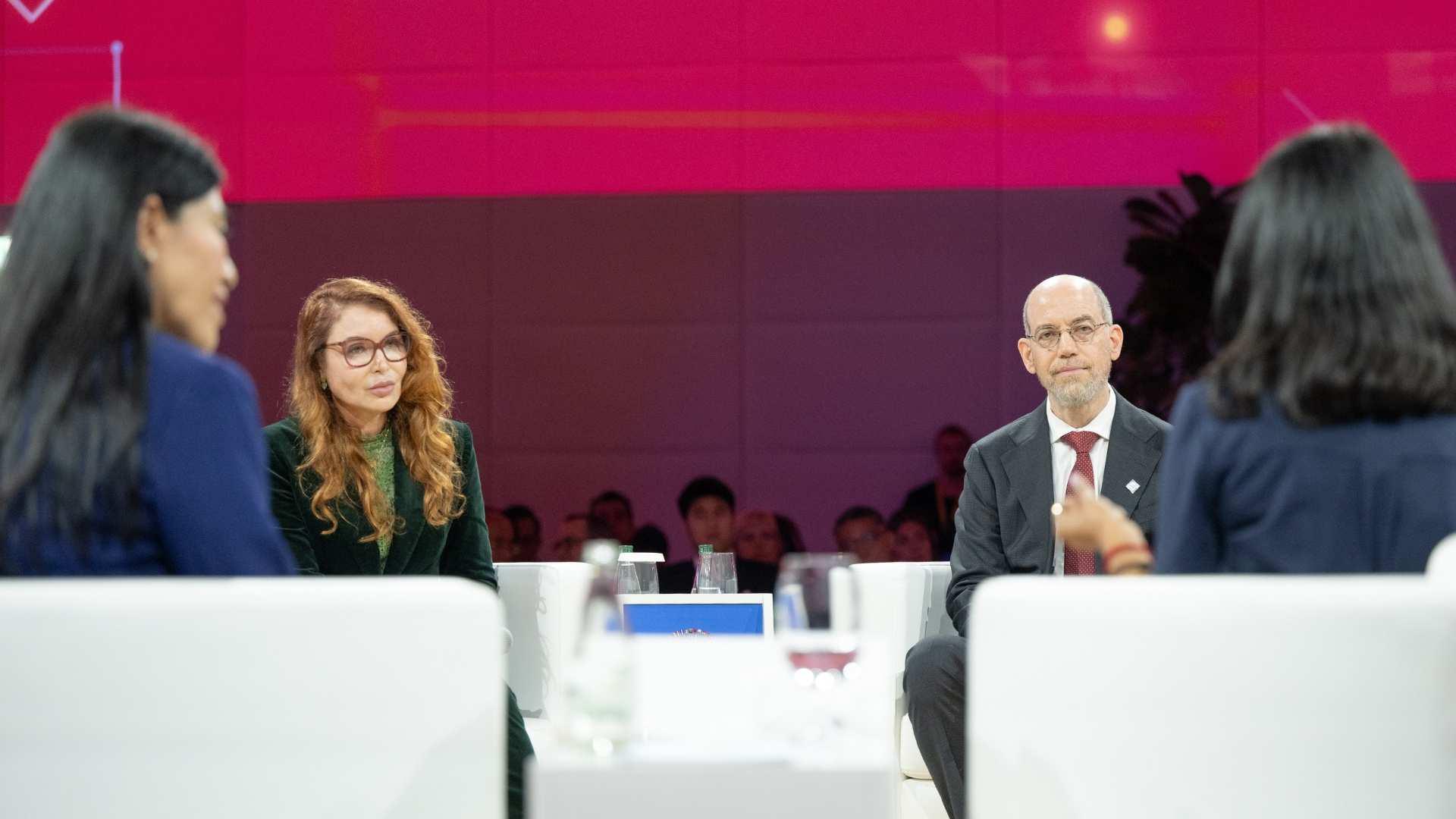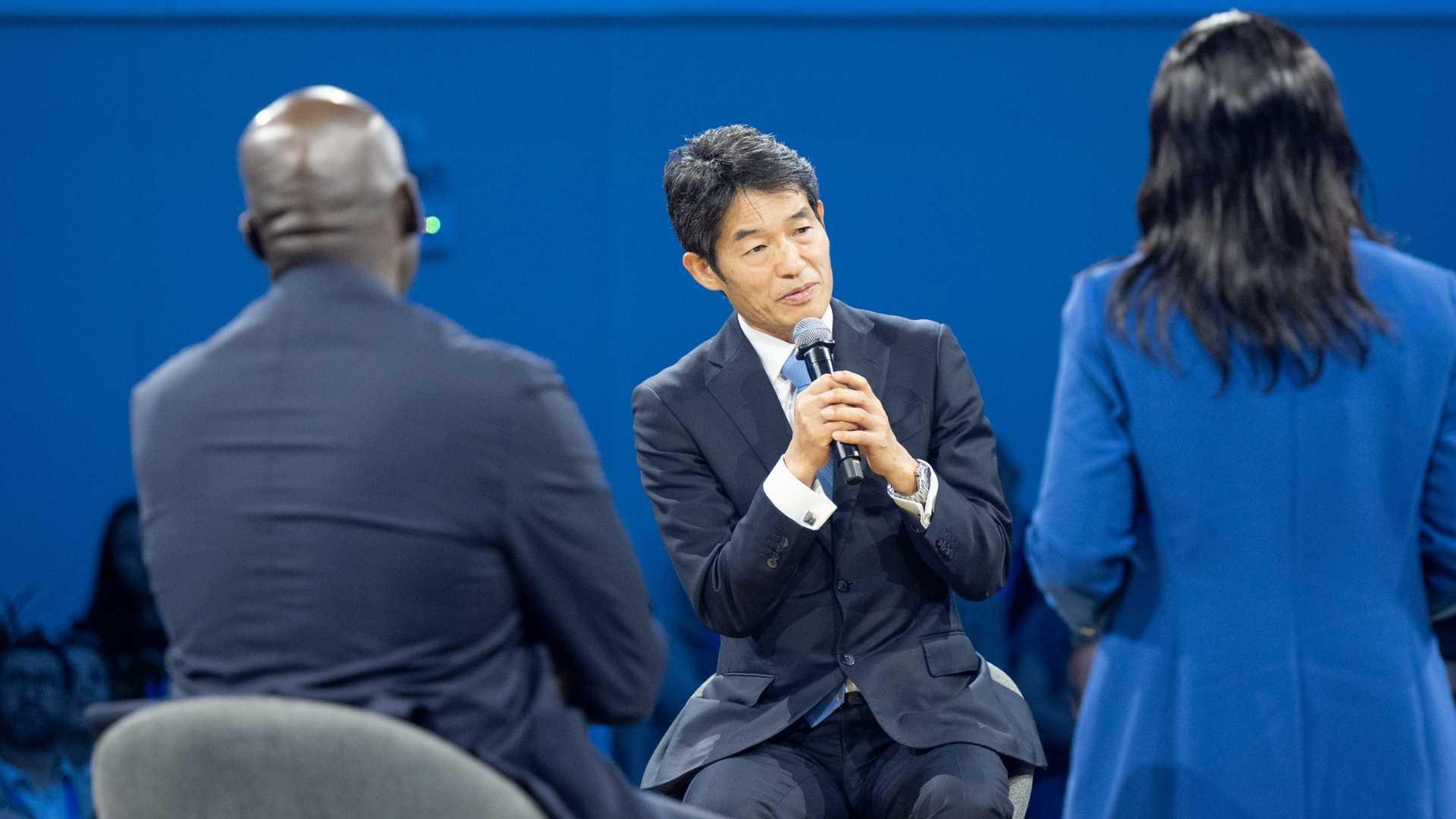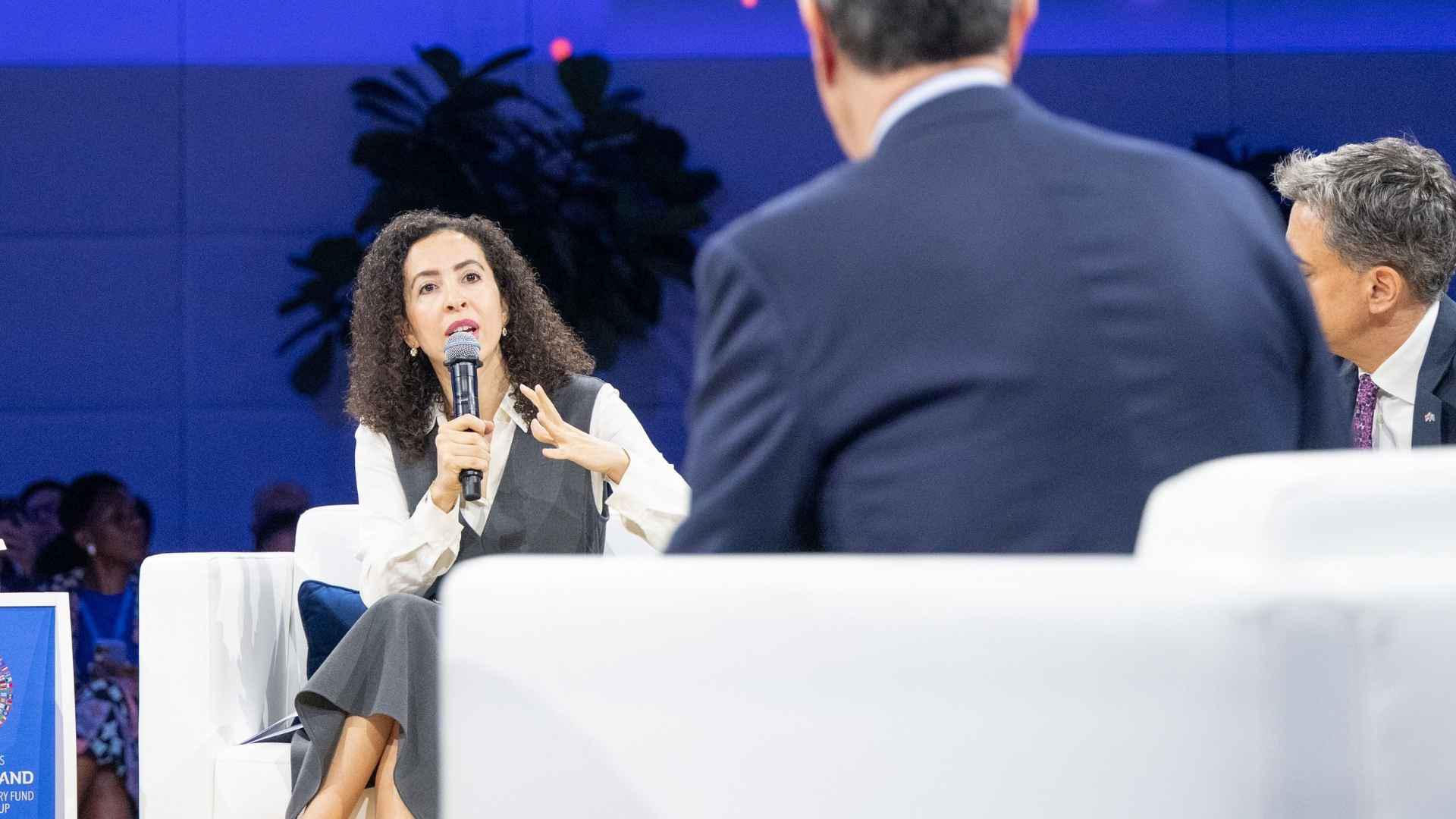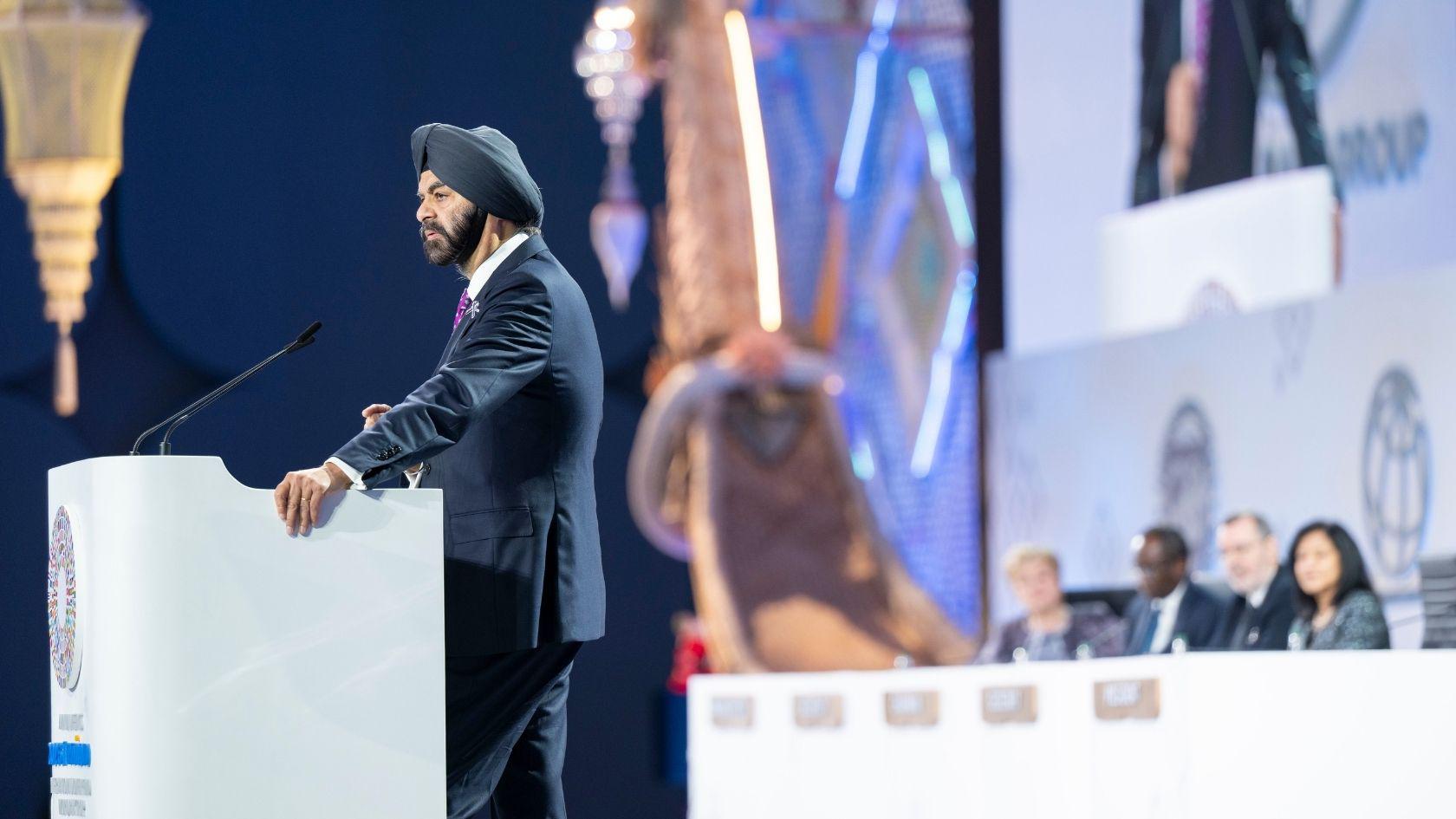

The 2026 Annual Meetings brought global leaders together in Bangkok, October 12–18, to discuss jobs, investment, growth, and practical solutions for development.
MSME Finance: Leveraging Data for Jobs | Annual Meetings 2026

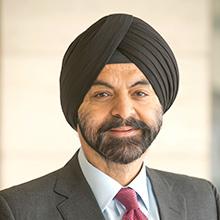
Read Ajay Banga's remarks at MSMEs: Leveraging Data for Jobs
👉 Read the remarks- ABOUT THE EVENT
- Transcript
GO TO SPEAKERS | ONLINE Q&A | POLL
Micro, small, and medium enterprises (MSMEs) are key to jobs and opportunities in developing countries, yet many struggle to access the financing they need to grow. This event introduced the World Bank Group’s new MSME strategy that aims to help them become visible, connected, enabled, and funded at scale.
World Bank Group President Ajay Banga highlighted how data and digitalization can unlock opportunities for businesses traditionally excluded from formal finance. Panelists discussed how transaction records, digital payments, e-invoicing, and cash-flow data can help lenders better assess businesses that lack traditional collateral or a borrowing history. And an entrepreneur shared her experience overcoming the challenges faced by a women-led technology company.
The discussion showcased what it takes to scale solutions, from digital infrastructure and simpler regulation to data and risk sharing, and partnerships that mobilize private capital. Expanding access to finance can help MSMEs grow, trade, compete, and hire.
[Rajini Vaidyanathan]
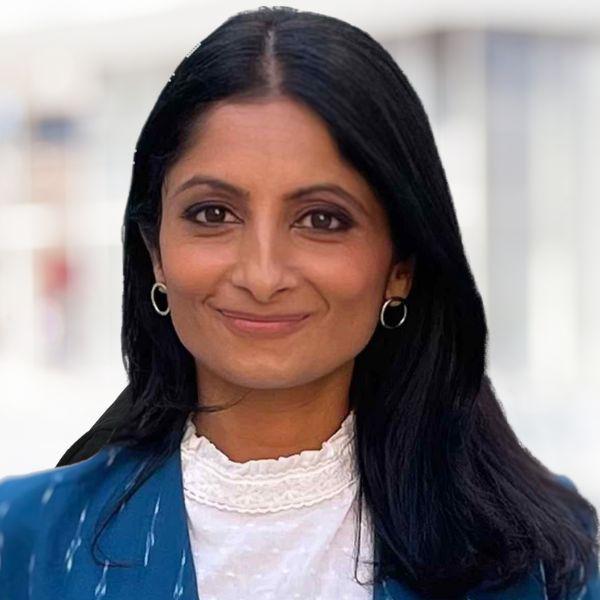
Good morning, everyone, and it’s great to be back for Day 2 of the Annual Meetings. So, a warm welcome to all of you for the second day of the World Bank Group and IMF Annual Meetings. This, of course, the 2026 edition. And of course, welcome to this, the second of the World Bank flagship events. This one is “MSME: Leveraging Data for Jobs.” We’re very pleased to have all of you, all of you here in the room in Bangkok, and of course a warm welcome to all of those of you joining us online. I’m Rajini Vaidyanathan, as was said just then, a Presenter with BBC News. Well, yesterday we kicked off the Meetings by talking about AI and jobs, and tomorrow we’ll have an event looking at private capital mobilization. Today, micro, small, and medium-sized enterprises, a really important discussion because, of course, these enterprises make up some 90% of all businesses worldwide and they contribute to around 70% of jobs. So, it’s no surprise that they’re the backbone of economic growth in developing nations. Yet many of these enterprises can’t access the financing they need to grow and create jobs. So, over the next hour, we’re going to be focusing on how digital innovation and data-driven solutions are creating new opportunities for MSMEs. Well, with more than one billion young people in developing countries reaching working age in the next decade, addressing this challenge has never been more urgent. Whether it’s about building foundational infrastructure, improving regulations, or mobilizing private capital, all roads lead to job creation, a key priority, of course, for the World Bank. MSMEs are at the heart of the journey. Well, in just a moment, we’re going to be hearing from the World Bank Group President Ajay Banga about the Bank’s efforts to expand access to finance for MSMEs. We’re also going to be hearing from an entrepreneur from Türkiye and hear from her about her experiences on the ground. And then, we’ll have a panel of experts who are going to be discussing what it takes to help businesses grow, and thrive. Well, remember, you can share your thoughts on the topic at any time using the hashtag #WBGMeetings. As usual, we’re live on X, Facebook, and LinkedIn, and we do have experts standing by online in multiple languages to answer your questions in the live chat. And of course, if you’re in the room here, you can use the QR code you can see on the screens here to post your questions too. Without further ado, do please join me to welcome the President of the World Bank Group, Ajay Banga. Welcome, Ajay.
[Applause]
[Ajay Banga]
Thank you very much, and good morning. Here in Bangkok, we’re in a city that’s shaped by traders and by entrepreneurs. We’re reminded that the people who build businesses, who create jobs, and who serve their communities are actually the ones who power the global economy. Most of those people run micro, small, or medium enterprises, MSME. They are the engine of the economy, as Rajini just said. They represent 90% of firms. They employ 75% of workers in the developing countries. And by the way, their role will only grow in the coming years. So, over the next 10 to 15 years, 1.2 billion young people will reach working age in the developing world. And the same countries are expected to create only 420-odd million jobs. So, what happens to that generation will shape far more than the countries where they live. If they can find work, if they can build businesses, if they can see a pathway to a better life, then they become the foundation for growing economies, for stronger trade, and frankly, far more stable and healthy societies. But job creation is not automatic. It comes from businesses that can start, that can grow, that can hire, that can trade, and that can compete. And that is why we have built a job strategy around the foundations that businesses need, starting with infrastructure, both physical and human, with better governance, and then the private capital to be mobilized at scale. Last year, we committed 40 billion dollars to infrastructure, another 24 billion to better governance, together accounting for more than half of our financing. So, we are directing our financing into the pillars that could create jobs and attract private capital. Now, this approach comes to life in five sectors with the greatest potential for job creation. Energy and infrastructure is the first one. Agribusiness, particularly to help small farmers remain competitive and productive, is the second one. Primary healthcare, better access to that across the world, is the third one. Fourth is tourism. It’s the single best multiplier of jobs per dollar invested. And then, of course, value-added manufacturing, everything from minerals and metals that the developed world needs and the emerging world is blessed with, but all the way to creative industries. And remember, the word here that matters is value-added manufacturing, not just extraction, but creating higher local value-added jobs to enable some of the benefit that comes from these minerals and metals to also be shared with the people in the economy from where those minerals are coming. MSMEs are the backbone of all five of these. They cannot create jobs, however, without funding. They cannot create jobs without the right capacity building. MSMEs in developing countries face a financing gap of over four trillion dollars a year. The reasons are structural. Under current regulations, a bank needs to hold roughly four times more capital when lending to an unrated small business than to a local AAA-rated corporation. Banks require hard assets such as real estate for collateral. MSMEs rarely have those. And small loan sizes do not offset a bank’s overhead costs. It’s an expensive model to originate and service. Fintechs do offer an alternative. You’re going to hear from some of them. But without a deposit base, their funding costs and therefore their risks are still high. And across the board, investors perceive MSMEs as riskier than they actually are because there is so little data on their actual credit performance. What do you end up with? High cost of credit at best or no credit at all at worst. MSMEs may not have hard assets, but there’s something even better, and it’s called cash flow. The single most reliable indicator of repayment ability is your cash flow in a small business. The problem was we couldn’t see it, let alone forecast it. But now you can, because data and digitalization are changing the game, transforming how firms operate, how they access the market, how they navigate regulation, and how they unlock finance. And that is the core of what the World Bank Group is trying to do here with the MSME strategy that we are launching today, using data and digital solutions to help MSMEs overcome the constraints at scale, making them the following four: visible, connected, enabled, and finally, funded. So first, visible. Fewer than one in three MSMEs in developing countries are digitized. Around 60% of payments are still in cash. There’s no track record. There’s nothing a lender can assess. However, digital fast payments, e-invoicing, and tax and utility payment data change all that. Every transaction then creates a data trail, what we call a data exhaust. Every payment builds a track record of repayment capacity. Data is actually the new collateral, and we are helping countries build it. Governments have an essential role: create the data, let it flow, but most importantly, enable lenders to use it. On fast payment systems, we have helped 20 countries build interoperable infrastructure in the last three years alone. On e-invoicing, and digital access to tax and utility data, eight countries. On open finance frameworks that can enable secure, privacy-protected access to that data, five more countries. What we have to do is redouble this effort and aim for higher numbers than 20, eight, and five. Second is connected. Being visible is necessary, but it’s not a sufficient condition. MSMEs also need customers, they need suppliers, they need logistics, they need affordable services to grow. Most cannot afford their own accountant or their own compliance team. We think we can help to fix that by investing in digital shared service providers that can deliver professional services to thousands of small businesses at a fraction of what each would pay individually. We will embed our services into digital platforms so entrepreneurs can have step-by-step guidance, almost like an export plan, but made at their fingertips. And we will help link them to markets as we are doing through AgriConnect, which digitally connects smallholder farmers and cooperatives to buyers, to financiers, and to shared infrastructure like storage. So that’s the second one, connected. The third is enabled. Running a business should not require navigating a maze. Burdensome licensing, high compliance costs, and very weak insolvency frameworks push entrepreneurs to the margins of what they should be doing. We think we can help countries cut red tape. Simpler licensing, simpler registration, fair rules for public contracts, and insolvency systems that allow an entrepreneur to fail, to learn, and come right back again to try again to win. Over the past three years, we have helped 35 countries cut red tape, 10 improve their insolvency frameworks, and seven have reformed procurement and competition regulations to support MSMEs. Again, interesting numbers: 35, 10, and seven. We need to do more of these. Fourth, funded. The world is changing very fast. Fintechs are already approving loans in 24 hours. They use AI-driven credit scoring, no balance sheet, no collateral. Their lending has reached roughly 400 billion dollars in the emerging markets. Aggregators, ride-hailing platforms, Grab, as an example is a partner, e-commerce marketplaces, major exporters, they sit on MSME transactions and receivable data. In fact, they’re becoming financiers themselves, and they can be a great way of accessing the vast majority of these micro and small enterprises. And then, of course, securitization can turn large pools of MSME loans into an asset class that attracts institutional investors, pension funds, asset managers, and the like, who have never touched this market before. Banks are trying to become fintechs. Fintechs are trying to become banks. The winners of the next decade will be those who marry the best of both: the liquidity, trust, and license of a bank with the speed, data intelligence, and digital reach of a fintech. What we are trying to do at the World Bank Group is support all of them. If banks are willing to use digital data but are nervous about the risk, we can help share it. We can give them the breathing room to try a new model. For fintechs and aggregators that hit a ceiling, we can step in with equity. We can step in with loans backed by their MSME receivables to help them scale. We’ve already invested in over 100 fintechs and aggregators, and we think we can do much more. We will also deepen our work with governments to streamline fintech licensing and create legal frameworks for asset-based lending and securitization. So, at the earliest stage, the microentrepreneur with an idea, the constraint is often not credit but equity. And that is why we are creating centers where entrepreneurs can get equity, mentorship, and the early support they need, because you cannot borrow your way to the first business you open. And most ambitiously, we are building the evidence base to persuade global standard setters to recognize that cash flow lending backed by digital data and adjust capital requirements accordingly. This is not going to be easy. It’s a hard shift, but that impact, if we get this right, will be generational. Our role is to help make these big shifts possible. So, let me tell you what it looks like when we execute. Last year, the World Bank Group mobilized $112 billion in private capital, more than triple what we mobilized 4 years ago. We invested that, by the way, alongside $120 billion of our own balance sheet. So, we’re not replacing our balance sheet with private capital. We’re enhancing the total available into the developing markets by bringing private capital to do what there is not enough public capital for. Growth was broad-based in the private capital mobilization. We quadrupled in upper-middle-income countries, like Argentina, India, and Gabon. We nearly tripled in lower-middle-income ones like Angola and Bangladesh, and we actually did two and a half times across Africa. IFC, our private sector arm, grew its commitments in IDA and FCV countries to $12 billion, and they mobilized $11 billion in private capital on top of that. But the issue is the scale of the jobs challenge demands we go much further, especially in FCV countries. There, the kind of private capital mobilization that went into the $112 billion hasn’t moved the needle enough for those countries. Why is that? MSMEs there do not just contribute to the economy, they are the economy. We have to reach the roadside mechanic in Nairobi, the seamstress in Lagos, the exporter in Dhaka, people that the traditional model was never designed to serve. We will not reach these entrepreneurs alone. The infrastructure is too thin. The informality is too pervasive. The geography is too difficult. So, we have to do it based on an ecosystem, build fast payment systems to make MSMEs visible where cash still dominates, strengthen local banks and microfinance institutions and other intermediaries like aggregators who know these communities, have trust with them and can reach them, and then deploy pooled first-loss facilities to help de-risk private capital that would never enter those markets on their own. If we get that right, we do more than close the financing gap. We reach millions of businesses, millions of entrepreneurs that the traditional model could never touch. In that process, we create the jobs that the next generation is counting upon. Thank you very much for your support in this journey.
[Applause]
[Rajini Vaidyanathan]
Thank you very much for those remarks there, Ajay. And I think the key takeaways, which we’re going to be discussing in a moment with a panel, are being visible, connected, enabled, and funded. And one of the lines that really stood out for me, again, which we’re going to pick up in a moment, is data is the new collateral. Now, let’s now hear from someone who is a small entrepreneur, Co-Founder of Ingosa, a conversational AI digital marketing company. She’s grown her business from just a two-person startup to a 10-person team. So, it’s not as small now, and it now counts global brands among the clients, including the very bank which first invested in her. So, please give a warm welcome to our next speaker, Gökçe Duman.
[Applause]
[Gökçe Duman]
Thank you. I was planning to sing “I Will Survive,” but my voice decided to sing Metallica instead. It was like that since the flights. So, please bear with me till the end of my speech. Thank you. Let’s be honest, starting a micro-SME in an emerging market is basically a masterclass in survival. It’s like holding your breath underwater, waiting for someone to hold you an oxygen tank called “credit.” And now try that as a woman in tech. We were two co-founders, two women co-founders, but the numbers, let’s have a look at the numbers. Sadly, only 2% of the global capital goes to the all-female teams. And again, sadly, only 15% of the decision makers are women. And sadly, up to 70% of SMEs in the developing regions are completely shut out of financing. We know that oxygen tank exists, but it’s in a room we are not invited into. We built an advanced conversational banner technology for the advertising and the research markets. We gained the interest of the clients, partners, and even the government itself. We needed to pay the bills, and we even got the attention from the government grant called KOSGEB. But to get that government grant, we needed one simple thing: a letter of guarantee. How hard can it be? So we went to the banks, and they all asked the same question. They said, “What do you have?” We said, “AI, cloud, a talking banner, an emerging technology for the advertising market.” And they said, “OK, you own a building?” That’s the irony. We were talking about AI, a technology startup, and paying customers, but they were all talking about bricks and mortar. And every bank said no. Then Garanti BBVA stepped in with one yes, finally. Initially, we were a client for the bank, a tiny startup just trying to survive. And then we were selected to their technology partner program, and then we became a partner. And suddenly we became a supplier to the bank itself. We created conversational banners for the finance system. And then here’s the fun part. This is me. I was the billboard face for the bank itself across the 14 billboards in Istanbul. Look what happens with one yes. A client, partner, supplier, and a billboard face. So, what does a bank actually buy from us? An emerging technology called conversational banners. Personalized dialogues for five different segments. This is what we created for the bank itself. If you want to learn more, please scan the QR code to watch the case study. This is the recent case study we did with them. Speaking of the studies, this isn’t a charity story. This is a growth story. Since then, (in) one year, we grew from two to ten people. We have generated over billions in digital impressions and so on. We created thousands of customer attention. We started to work with Unilever, Ford, Garanti BBVA, and this is just a glimpse of it. We are the exact solution digitalization promises, but leaping over the gaps was not easy. It took stubbornness and luck, but entrepreneurs shouldn’t have to be superheroes to get one line of single credits. Superheroes don’t scale; systems do. As the President said, the World Bank wants to make businesses visible, enabled, connected, and funded. We started out invisible until one bank said yes. My ask to the financial system is simple. Please, see what we do have initially, the initial traction, paying customers, digital footprints, etc. When you fund women-led tech businesses like ours, we just don’t survive. We make businesses, we make billboards, we scale the markets, we create the jobs of tomorrow. Last but not least, we just closed a new round with FutureBright Ventures, a famous venture and a research institute in Türkiye. We co-created InsightMate, a new digital research tool for the digital and the research teams, and it’s already at work with finance systems in Turkey and Azerbaijan. We know that cash keeps you alive, but your real investors are your customers. So, if you want to empower women-led businesses like ours, and if you’re interested in InsightMate, please scan the QR code to learn more, or maybe come find me after the session. Thank you.
[Speaking in foreign language].
[Applause]
[Rajini Vaidyanathan]
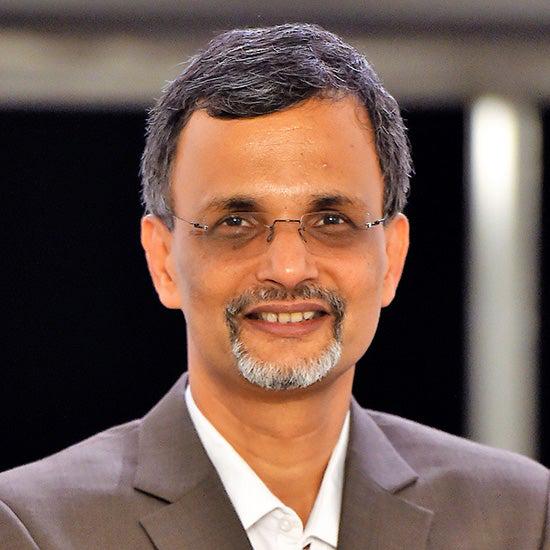
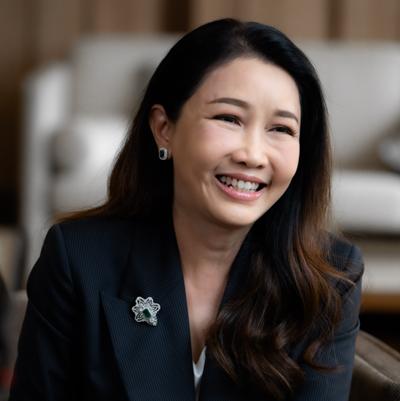
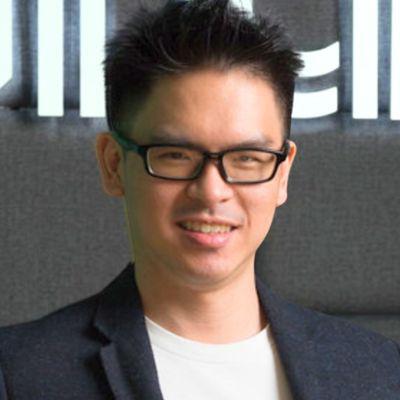
Thank you so much Gökçe, for that. And, I wonder if we could all just congratulate Gökçe once more for that round of funding she secured. We look forward to seeing your business grow. Now, we’re going to discuss the key elements which are at the core of the World Bank Group’s MSME strategy, which Ajay announced earlier. We have an esteemed panel to discuss all of that, so let’s welcome them to the stage. John Denton, Secretary General of the International Chamber of Commerce. Anantha Nageswaran, Chief Economic Advisor for the Government of India. Kattiya Indaravijaya, the CEO of KASIKORNBANK, one of Thailand’s largest commercial banks. David Arana, the CEO of Konfío, a Mexican fintech company. Chris Wehbe, the CEO of Lendable, that’s a British fintech firm. And last but not least, Kell Jay Lim, Head of Financial Services for Grab. Welcome to all of you. And I’m going to start with you, Anantha. We heard there from Ajay about digital-first payments, and you’re obviously representing the Government of India. I lived in India for some time, and one of the things that struck me so much living there was you can go to the most remote part of the country and using a payment app called Paytm, which many of you may be familiar with, you can buy anything on the roadside. So, the example I always use is I would go to a remote part of Kerala, I would use my mobile phone and buy a banana. I mean, that is just one example of the digitalization of India’s payment infrastructure. India has built that at a very large scale. Which part of that infrastructure do you think has made the biggest difference for MSME finance?
[Anantha Nageswaran]
There are three dimensions to the digital payment infrastructure that have made a very big difference. If I have to pick the first one, it is the introduction of the Goods and Services Tax because that made businesses formalize. It gave them an incentive to formalize because otherwise they will not receive orders from the bigger buyers. So, Goods and Services Tax introduction gave a huge incentive for informal micro, small, and medium enterprises to become formal. The second thing is what you mentioned, the UPI, which even for a very small vendor, on the pavement or inside a shop establishment. It gives them the payment trail, cash flow patterns, which, as President Ajay mentioned in his remarks, enables fintechs and banks to lend to them. So, UPI, as he put it very beautifully in his initial remarks, made data the new collateral. And this data is now generated every day, every minute with transactions. And this enables cash flow-based lending. So that’s the new collateral. The third development, which is not very well spoken about outside India, is this new thing called “account aggregator.” So, there are financial information generated every day by businesses. There are people, there are institutions which generate the data, other institutions want to use them, account aggregator is the platform that intermediates the two with the permissioned usage, with the clients authorizing release of data. Now financial data of the client flows between financial institutions seamlessly so that he or she can get credit on any other financial product from whichever institution is willing to provide it without doing reams of paperwork. So, these are the three dimensions of the data-driven digital economy architecture that is now helping MSMEs in India get credit at much more generous terms and in ample quantities than they used to get before.
[Rajini Vaidyanathan]
Thank you. That’s really interesting. Of course, the flow of data is a big part of it as well. I’m going to turn to you now, David. You did a podcast with the World Bank and there was one staggering statistic. Well, I thought it was staggering anyway. You said that 84% of the businesses who you lend to are coming to you for their first ever bank loan. That’s quite a large percentage, isn’t it? Now, Konfío was built around the financing needs of smaller businesses. What do you think’s made the biggest change in allowing you to serve firms that would be difficult traditionally through the other lending models?
[David Arana]
Yeah, so I think traditional financial institutions have always had very strict requirements around physical collateral, banking relationships, prior credit history, and so forth. And that doesn’t necessarily mean that the businesses that don’t have these requirements, which, by the way, in emerging markets, many of these businesses aren’t going to meet all of those requirements, but they do produce a lot of data through digital information, their sales, e-voicing now, which has been a big theme in Latin America or in Mexico where we’re based. And that data, as President Ajay put it very well, is the new collateral and has allowed us to view, to basically take a customer that was invisible in the past to the traditional methodology and make them visible nowadays. And with that methodology, we, in a little over a decade, have been growing a lot and we’re the third largest player in SME lending in terms of number of borrowers now in the country compared to Mexican banks. But I think the most interesting thing isn’t around how much credit is being produced, but what happens with the businesses after they obtain that credit. And you’re right, 84% of our customers historically, it’s their first business loan. But we did a study alongside IDB Invest where what their research produced after two years, basically we learned that the average growth rate for the businesses on our platform is around 19.4% in around a year and a half, two years. And when it’s a woman-led business, it jumps to 42%.
[Rajini Vaidyanathan]
Wow!
[David Arana]
So, I think, I mean, for us, that’s great news. It’s exciting. And I think the biggest theme for us is, if we can not only view SME lending as something important or a priority for financial inclusion, but also for economic development.
[Rajini Vaidyanathan]
Okay, thank you, David. Kattiya, I’m going to turn to you. Something Ajay said there, banks are trying to be fintechs, fintechs are trying to be banks. I mean, KBank has made digital channels an important part of how you’re serving MSMEs. Tell me more about how data, which of course is the new collateral, has allowed you to finance businesses. which were previously harder to assess?
[Kattiya Indaravijaya]
Firstly, we are not trying to out-fintech the fintech. Yeah, so actually data through that digital channel has significantly helped us a lot, and it goes through the entire lending process starting from lead screening, loan approval, monitoring, and collection. The QR payment ecosystem in Thailand is one of the good examples. So, with that, it’s not only convenience for the payment, but it also creates the data and digital footprint for millions of MSMEs. With that, it will build the credit, I mean, the financial history and help the customer have, how should I say it, build the ability to successfully access financing. However, there’s a challenge, as was mentioned in the previous session, it’s like partly of the operation is physical cash. The accounting standard records mix between personal transaction and the business transaction. So that’s why we need the more broader data ecosystem through Bank of Thailand open data initiatives and also work with the fintech. Work with the fintechs. For example, like our joint venture with one of the fintech s called LINE Financial (Asia). The company, the joint venture called KLINE, is successfully operating and has become profitable last year. So, I think to us is the success of lending to MSMEs is not stopped when we lend the loans grant to the customer, but it is achieved when the customer succeeds, when they use the capital to grow, to become more competitive, to create significant values and repay back to its owner and also repay the loan to us. So, that’s how I view the success of the complete cycle of success.
[Rajini Vaidyanathan]
Thank you, Kattiya. And you talk about a cycle. There’s also a bit of a thread, really, because it’s about how you work with governments as well, and of course with fintech. So, let’s move on to you, Chris, speaking of another fintech. You work a lot in emerging markets, don’t you, Lendable? What do you think is needed to scale some of the solutions we’ve been talking about into a new attractive asset class for institutional investors?
[Chris Wehbe]
Well, I think the starting point is that there’s no real obvious bucket that MSME, fintech, emerging market loans sit for institutional investors. In some sense, it’s at least a triple niche. So, I think the thing that you need to do in order to make it and move it forward is to address those points in turn and trying to make them more mainstream and more understandable for an institutional audience. So, if we take those in turn, so on the MSME side, I perhaps lean on the comments that have come from my fellow panelists and also Ajay at the beginning. Traditionally, lending in emerging markets is hard asset-backed, and so that’s well understood. But lending, which is highly impactful, and this is perhaps the benefit of the fintech side, which is based more on cash flows, is something that’s less understood. So, the quality of data becomes very important. The degree to which the metrics that you quote are comparable across different players in the segments, and the degree to which you can validate them. So, this is where digitization is very important, because when you have digital cash flows, we can reconcile what would be in the reported numbers against real cash movements. So, I think that’s very important, and making that data be something that’s trusted to the same degree as a physical asset. And then, on the fintech side, when you’re talking about a fintech segment, it’s something which within emerging markets is little more than a decade old. So, you don’t have the same level of understanding that you do with, and same level of regulation that you do with banks. So, you’re talking about institutions that are perhaps much faster growing, that bias growth over maybe profitability in a very early stage and have different shareholders, sort of VC/PE versus maybe listings, etcetera. So, I think in that sense, it comes to the point of structuring and trying to divorce the risk of the receivables and those assets themselves from those originators. So, things like securitization, or on the path to that in terms of things like bankruptcy remoteness from structures, control over cash flow and collection accounts, backup servicing, all those things I think become very important and again take you into a more mainstream asset class.
[Rajini Vaidyanathan]
Okay.
[Chris Wehbe]
And the last thing I would say is that the other point that’s important for institutions is scale. So, what we can’t do is do this in standalone little “nichey” kind of structures, but it needs to come into a place where it’s an asset class that you can allocate lots to. And I think that starts with things like blended finance structures and first loss, and we’ve done things like that with the World Bank Group. But I think it needs to evolve into much more mainstream vehicles that can be backed initially by governments and development finance institutions, but then attract private capital.
[Rajini Vaidyanathan]
Okay, thanks, Chris. We’ll come to you in a second, John, but let’s speak to Kell Jay Lim now because we want to get the perspective from an aggregator. Now, many of you in the room, if not all of you, will have used Grab during your time here in Bangkok so far. I certainly have been using it regularly, but it’s not just a rideshare platform, is it? It also offers food delivery, parcel delivery, all kinds of things. What are the types of entrepreneurs and small businesses connected to Grab? What does Grab do to make them grow? And I guess the overarching question is, what are the key success factors for your model when it comes to supporting these MSMEs?
[Kell Jay Lim]
So, quick history about Grab. Grab became more of a food delivery business after the Uber acquisition of the Southeast Asia business back in 2018. And it was timely as well because soon after that we went into COVID. People were staying at home, they were not going out, but they were ordering food to their homes. And so, we became an essential service provider to the public. But at the same time, we also provide an income opportunity for our driver partners and our merchants. Many of them are small businesses as well.
[Rajini Vaidyanathan]
I’m just going to jump in and say I’ve been hugely impressed with the number of women that are driving Grab since I’ve got here as well. It’s fantastic, isn’t it?
[Kell Jay Lim]
Thank you. Yeah, so to David’s point earlier about more women, in fact, women and people with disabilities who borrow on Grab have a higher repayment rate. They’re actually lower risk to us. So really, really good stats there. Now, back to your question about who we serve, it’s really the drivers and the merchant partners. These are the entrepreneurs on the platform. How we help them specifically for the merchants, is that we grow, we expand the radius of reach for them beyond the one kilometer that typically sits around their stores to maybe three kilometers depending on the city and they get more demand. We also help them with cashless payments, which is fast becoming a primary mode of payment in this part of the world, and we provide financing. Now, in terms of success factors real quick, we run basically a three-sided marketplace. So, we have our merchants, we have our consumers, but we also have our delivery partners in between. And so, we do about 15 million transactions a day. Each transaction has multiple optimizations. So, in order for the marketplace to be really successful, we need to do a lot of optimizations, millions and millions per day. We collect about 500 terabytes of raw data a single day, and that’s what we focus on.
[Rajini Vaidyanathan]
Okay, thanks, Kell. John, last but not least on this first round, I want you to draw the threads of all the different things that we have heard so far, because of course, the International Chamber of Commerce works both on the rules which enable digital trade and on practical tools to help these MSMEs take part in business in the first place. Where do you think digitalization is making the biggest practical difference for MSMEs when they’re trying to grow and trade across borders?
[John W. H. Denton]
Well, thanks very much, and it’s great to be with you. And can I say that just up front, when Ajay framed the problem we’re trying to solve here, I think it’s really important never to lose sight of that. We’re in 170 countries, 70% in the Global South, and there’s something like 50 million businesses that are part of us. Our job is actually to create and improve economic activity, and the reason we’re doing that is because we want to create jobs. I think Ajay framed this very well. There’s a huge demand coming in all the economies represented here to create economic opportunity for next generation and continuing generation. And you look at the configuration of most of these economies, and frankly, they’re going to be in some cases, I mentioned an economy the other day, 98% SME, okay? And people often get focused on the value chain leaders, but that’s actually where the economic opportunity is. Now, digital is already here and it’s helping. What we’re trying to do though is actually untap the opportunity that’s there. And I think we’ve already heard a little bit about it around the table. There are actually inhibitions that are there in the way of SMEs, okay? One of the risks we’re seeing is the emergence of what we call “digital islands,” where you’re not getting the necessary connectivity. And it’s one of the pieces in this strategy around connectivity that I heard, because what you’ve got are different rules happening across the border and makes it harder to untap the value of digital. What we’re trying to do is get… We know we’re not going to get integration. I mean, that’s just unrealistic in the current geopolitical and geoeconomic environment we’re in. But we can get recognition, mutual recognition. We can get some form of harmonization, and we’ve been working to do that because what we want to do is make it easier for SMEs to trade digitally across borders without having to go through a whole set of new restrictions, new regulations, etcetera, to actually get on top of. I fully understand that there’s a very important argument about digital sovereignty, and that’s a very potent political argument in economies. But digital sovereignty should not mean closing your borders. Digital sovereignty should be about making choices. And one of the choices, when you think about the problem to be solved, how do you create more economic activity? How do you enable your SMEs to trade across borders using the digital? You need to work with us, with others, with the World Bank to harmonize. And we’ve created the platforms to enable that to happen. I mean, we actually created the platform with the UN which enables digital payment systems to be recognized. So, if you want to convert and use an e-bill of lighting, at the moment it’s not legally recognized in a court of law, but it can be because we created a model that enabled the legislation to take place. And political leaders all agree, let’s do it, but we need to actually activate that. So, if you leave this room as a political leader or a policy leader, activate the legislation that’s necessary to have digital tools recognized legally so people can rely on them as well.
[Rajini Vaidyanathan]
Thanks, John. Well, there’s plenty of political leaders in this room, so John’s speaking to you all. And speaking of political leaders, that moves us nicely on to Anantha again. We’ve talked about the progress that India has made when it comes to building infrastructure for data-enabled finance. What do you think is the most important remaining constraint when it comes to scaling? We heard this side of the panel about scaling up, didn’t we, earlier?
[Anantha Nageswaran]
Absolutely. That’s an important area to focus on next. There are three constraints. In fact, the first one is payment on time to micro, small, and medium enterprises. That is still important work in progress for many countries. Large buyers always find creative ways to delay payments, to accept the goods, etcetera. That is one area where work needs to happen continuously. That will take care of a lot of the financing constraints they face if they receive payments on time for the goods and services they rendered. The second area is deregulation reforms because compliance burdens fall disproportionately more on micro, small, and medium enterprises. They don’t have the bandwidth to take care of business and undertake compliance as well. So, deregulation reform at the subnational government level is actually equivalent of MSME policy. And the third area, the third constraint is capacity building, which again, President Ajay mentioned in his remarks as well. MSMEs are very good in a few areas. They know the customer, they know the market, they know the product, but most of them do not have the kind of training they need for working capital management, cash flow management, for hiring, human resource practices, etcetera. Basically, capacity building for MSME entrepreneurs will also unlock their management potential. These are the three constraints: payment on time, deregulation reforms, and capacity building.
[Rajini Vaidyanathan]
Thank you, Anantha. Kell, I want to get your thoughts on that, really, some of the constraints there outlined. As an aggregator, of course, Grab connects MSMEs and their transaction data. Remember, data is a collateral, as we heard earlier, allowing them to have access to more and better finance when they come to people around the panel here. What do you think is needed to expand it, though, into a much broader set of financial solutions to allow growth?
[Kell Jay Lim]
I would say maybe three things. And these all three things are things that we’re already working on, but we can do more of. I think the first thing is data sharing, right? There are initiatives across the region, perhaps globally as well, in trying to make data more open, whether it’s through open banking, open finance, credit bureau, and so on. And it’s a good thing. And I think companies need to accept that data is becoming a commodity. We compete not so much of how much data that you have, but on what you can do with the data. So that’s one. Second thing would be sharing risk. Development banks or institutions have been doing sharing of risk, partial guarantees, first loss tranches. These things are really helpful in enabling fintechs like Grab, like Lendable, to be able to reach out to more SMEs. In fact, this is where I wanted to also acknowledge and thank the IFC, which is a subsidiary of the World Bank, who has done exactly that with our digital bank in Malaysia, which has enabled us to hopefully reach out to 10,000 more businesses in Malaysia alone. And then the third thing is on making payments more open. So, QR payment is becoming a primary mode of payment around the region. But I think more can be done. It’s a great initiative, but more can be done. For example, traveling into Thailand, for example, travelers and foreigners still find it a bit difficult to make payments on PromptPay in Thailand, but that can be improved. Also, perhaps access to QR payments beyond just the bank, but also to other fintechs as well. So, for example, in Malaysia, DuitNow, InstaPay in the Philippines, these are all open now to all financial institutions and not just the banks.
[Rajini Vaidyanathan]
Okay, thanks, Kell. I wonder if I could just get a 30-second follow-up to what you heard from Kell there, because he talked about needing to do more for data sharing across borders. That’s something that I’m sure you’ll have a thought on.
[John W. H. Denton]
Well, absolutely. But can I just pick up on something?
[Rajini Vaidyanathan]
Yeah, absolutely.
[John W. H. Denton]
In terms of access to financing. And everyone’s talking about the importance of data, but for some reason, some of the most important data is ignored when we look at access to finance for SMEs. We at the ICC, we enable like a lot of the trade finance, so it’s our rules that enable it to happen. So, we look at this very, very closely. The data we assemble show, and this goes, it (really) backs up your point, David, and your point as well, the level of default it’s like 0.24%. We are on the ICC Trade Register, but you actually look at how that risk is weighted by the system and the frameworks, that’s actually making it uneconomic to service a lot of these SMEs, which is where I think the interventions from the World Bank are incredibly helpful. But there actually has to be something fundamental here. Again, to policymakers in this room, we actually have to rethink and actually make contemporary the rules that actually surround and actually enable access to finance for SMEs because that gap will not be limited or diminished until we actually deal with that. So again, everyone says about the data, it’s very important, but can we rely on some of the data as well that we’ve assembled and actually make some better policy choices?
[Rajini Vaidyanathan]
David, can we rely on that data?
[David Arana]
Absolutely. And I think, the biggest opportunity with that data is that it’s unlocking a lot of the economic growth. And the challenge in the past used to be around, hey, how do I do better underwriting? How do I understand how these businesses are performing? That is somewhat solved by fintechs along with the distribution part. But to tie it into the theme around scaling, the next big challenge is, how do we scale this? And, I think we are at a turning point. There are… One of the biggest things, biggest challenges now is around the financial infrastructure. And when we think about it, we think of three things, right? One is the funding element. The second has to do with data. How do you make data accessible? And the third is around regulation. On the first, you do need a lot of the players, as the rest of the panelists were mentioning, to come and add solutions. You need to combine the trust element, the stable funding element with these more innovative data-driven business models or fintech platforms. That’s one important piece. Data, how do you make it travel across borders? And that effectively helps your cost to serve or cost to decide reduce significantly. And then the third is regulation, right? How do you get these two worlds to coexist where you don’t necessarily have to have a discussion around innovation versus financial stability. Those two, I think the biggest opportunity is how do you get these two worlds to live together? And that’ll unlock a lot more growth, a lot more productivity, and at the end of the day, more jobs.
[Rajini Vaidyanathan]
Okay, thanks, David. Fintech perspective there, Kattiya. Bank perspective on all of that.
[Kattiya Indaravijaya]
To us, we are the largest lender to MSME in the country, I could say that. But there are still the risks that we don’t understand. So, we are unable to serve the micro or small SME well enough. So, I think the role of, the number of fintechs entering into this MSME space is good for the customer. And it’s good for… I mean, it’s the advances of financial inclusion, and at the end, it’s a benefit for the country.
[Rajini Vaidyanathan]
Do you think it changes the role of banks like yours, though?
[Kattiya Indaravijaya]
Yes, yes.
[Rajini Vaidyanathan]
And how does it?
[Kattiya Indaravijaya]
So, I think what we believe is that different players have different strengths. Fintech, they have… They bring the speed, innovation, and different sets of data to be able to assess the risks and the potential of the customer, some data that we do not have. So, I believe the result would be even better if we collaborate. And we can be like a joint venture, the example that I mentioned earlier, or through lending to the fintech. And then let them, who know, who have more data, (or who) have a different set of data to lend to that micro-SME instead. So, I think in this thing is… The winners in this game is the customer. And the one, the player who wins the customers’ hearts is the one who aligns the strategy, the execution to that, to the customers’ needs to become trusted, innovative, and truly partners that support the MSME throughout their growth journey. So, that’s what I believe. We can work together. Yeah.
[Rajini Vaidyanathan]
Thanks, Kattiya. Chris, how can you all work together then?
[Chris Wehbe]
So, I think a point that’s come up here time and again is in terms of data. And I think if you look at Lendable, for example, our data team is as big as our credit underwriting team. And so, from both a borrower and a lender perspective, y ou need to treat fintech in a slightly different way from just fundamental underwriting. And so, that means, as I’ve said, data quality, it means data homogenization across sectors, and it means verification of that data. I then also think, as we talk about trying to give access and make this more mainstream, I think it means being global. So, to the extent that we also try and operate on a country-by-country basis, you’re still going to run up against these same problems that John alluded to in terms of the way that the world is set up to look at sovereign ratings and to cap the credit rating of the underlying at that level. Unless you create diversification in the global portfolio and so mix assets ultimately through securitizations and things like this, you’re still going to come up against a cost of capital that’s very expensive. So, I think, ultimately, it’s about that collaboration at a global level, both in terms of the terminology, the way you set up and you report, and then how you structure the assets for sale afterwards.
[Rajini Vaidyanathan]
That perfectly sets me up to ask John another question on all of that, because what we heard there from Chris is a bit of a problem. And the question, I suppose, is where can there be greater alignment to make the biggest difference when it comes to scaling MSME finance? Because, of course, the work that you do across markets shows that different rules, different standards, and documentation requirements can create friction for some smaller businesses.
[John W. H. Denton]
Well, frankly, the biggest advantage we’re going to get is if we actually get a rebalancing of the way in which these macroprudential regulatory frameworks operate. The way that the risk is weighted here makes a lot of the opportunities for scaling uneconomic. You think about the amount of checking, rechecking that needs to go on. I can be checked in one economy, that’s not mutually respected in another economy, so it has to go through it again. Banks have to go through the same process. The way in which that’s leading to friction is actually disabling our capacity to scale. So fundamentally, we do have to look at rebalancing macrocredential frameworks to enable the kind of risk that should be averted here, which is the risk of not getting the economic opportunities, not getting the economic inclusion we need, which is putting pressure politically on economies as well. So, I actually think, and that’s what we’re pushing, that that’s where the reconsideration needs to happen. That’s where the greatest upside lies in terms of getting access to finance to globally scale it to support SMEs.
[Rajini Vaidyanathan]
Okay, thank you, John. Well, we have time now for one more lightning round, as we’ve been calling it in these Meetings. So, you only get about a minute each to answer the question, but it’s a closing thought from you all, really. If you could all make one change over the next year when it comes to data, which we’ve talked about, scaling, regulation, or the way that finance is accessed, what would that be? And I’m just going to start with you, Kell.
[Kell Jay Lim]
Yeah, I’d like to… I’ll just reiterate what I mentioned just now about the access to data. I think making data accessible to all, as many of the entities as possible and making it really efficient in sharing that data and just let the companies compete on innovation and on how to use that data to serve their customers.
[Rajini Vaidyanathan]
Anantha.
[Anantha Nageswaran]
Data disclosure and sharing between financial organizations, institutions, and the data generators, the companies, to be able to… for the risk of MSMEs to be assessed much more accurately. Second, again, as President Ajay mentioned in the opening remarks, it’s about securitization and guarantees so that more financing can flow. Those are the data requirements that need to happen. Disclosure, more disclosure.
[Rajini Vaidyanathan]
Thank you. I think I’m going to start on MSME where everyone gives me a dollar when the word data is said. I might be quite rich by the end of this panel. Kattiya?
[Kattiya Indaravijaya]
It’s the data sharing and also the risk sharing can be through open data or data bureau that Bank of Thailand is now implementing. And also the… I think in Thailand specifically, we need a structural change. So, maybe some focus on some direction, which industry, which supply chain that we want to focus in order to reinvent Thailand. And also, part of it is the percentage of holding. So, when we’re talking about the partnership, the percentage of holding in the regulation, Bank of Thailand or some related laws. I think that can be changed and it will be like more partnerships happen in Thailand.
[Rajini Vaidyanathan]
Thanks, Kattiya. Chris.
[Chris Wehbe]
Regulatory risk ratings. As the other panelists have said, it is uneconomical right now for mainstream regulated financial institutions to invest without guarantees or lots of equity in MSMEs. In our database, we have almost 250 million individual loans globally that we can show track records now for over ten years where loss rates are incredibly consistent and much lower than the risk weighting would imply. So, it needs to be brought up to the times, as John said.
[Rajini Vaidyanathan]
John?
[John W. H. Denton]
Well, mine’s very practical. If you think about it, governments represented in this room have all committed to the digital recognition of electronic transferable records, bills of lading, etcetera, all these things. Because without that, the utilization is actually diminished. We know that to increase… that it will increase dramatically economic activity. So, everyone’s politically committed, but no one’s translated that political… Sorry, people have, but not enough have translated that political commitment into an outcome. We have worked to design what’s called the “Model Law on Electronic Transferable Records.” What we ask practically, and one thing that’ll make a huge difference, is apply that in your jurisdiction, make it work, and then we won’t have digital islands. We will actually have a sea of opportunity, and we can work with you to do that from the ICC.
[Rajini Vaidyanathan]
Thank you very much, John. And David?
[David Arana]
I would say I would put some of these themes together. So, a framework where you combine the underwriting benefits that a fintech brings, distribution as well, with stable funding that has a lot of trust involved to it, assuming we have the data element involved, risk-weighted assets issue as well, because that would allow us to mobilize a lot more private capital and have, some of these solutions scale.
[Rajini Vaidyanathan]
Thank you very much. Thank you to David. Thank you to Chris, thank you to Kell, Kattiya, Anantha, and John. Thank you.
[Applause]
[Rajini Vaidyanathan]
Well, I think you’ll all agree that was an engaging and thought-provoking discussion which built on some of the themes that we heard from Ajay earlier. And again, that keyword “data” and the way that digitalization can drive that is one of the key themes, and also partnerships as well. The way that banks and private equity can work together with aggregators, and government can work with organizations like ICC. Well, that wraps up this event. As we said just then, we’ve heard from government, the finance sector, and entrepreneurs at the coalface. Thanks to all of our speakers. Thanks to all of you watching here in the room. and online. Just a quick note before we end this, this was the second of three flagship events, so don’t forget tomorrow we’ll have our third flagship that will be focusing on private capital mobilization. Please, do join us for that. You can also continue to share your comments online with the hashtag #WBGMeetings. Thanks to all of you for joining us.
[Applause]
Speakers
-
Ajay Banga
President, World Bank Group
-
Gökçe Duman
Co-founder, Ingosa
-
John W.H. Denton
Secretary General of the International Chamber of Commerce (ICC)
-
David Arana
Chief Executive Officer of Konfio
-
Chris Wehbe
Chief Executive Officer of Lendable
-
V. Anantha Nageswaran
Chief Economic Advisor, Government of India
-
Kattiya Indaravijaya
Chief Executive Officer of KASIKORNBANK (KBank)
-
Kell Jay Lim
Head of Financial Services, Grab
Moderator
-
Rajini Vaidyanathan
Chief Presenter, BBC World Service
Take The Poll
Ask Our Experts
Hello everyone, and welcome to MSMEs: Leveraging Data for Jobs. We're excited to kick off shortly. While we get ready, feel free to share your thoughts and questions in the live chat.
Liveblogger: Erick Rabemananoro
Over the next 10 to 15 years, around 1.2 billion young people in developing countries will reach working age, far exceeding currently projected job creation. This event will explore how digital innovation and data-driven solutions can unlock the full potential of Micro, Small, and Medium Enterprises (MSMEs) to create the jobs and economic opportunities needed to support this rapidly growing workforce.
The World Bank Group has long supported MSMEs through financing, training, and policy interventions, helping to channel much-needed capital to underserved markets.
MSMEs are a key engine of job creation and economic growth for developing economies, yet many struggle to access the financing they need to expand and thrive. For MSMEs in fragile and conflict-affected countries, the challenges are compounded by conflict, economic uncertainty, poor financial infrastructure, and heightened risks for lenders.
Liveblogger: Erick Rabemananoro
We are fortunate to have an exceptional lineup of speakers joining us today. Their expertise will help shape a lively and insightful conversation on this important topic. Our speakers include:
- Ajay Banga, President of the World Bank Group
- John W.H. Denton, Secretary General of the International Chamber of Commerce
- David Arana, CEO of Konfio
- Chris Wehbe, CEO of Lendable
- Dr. V. Anantha Nageswaran, Chief Economic Advisor to the Government of India
- Kattiya Indaravijaya, CEO of KASIKORNBANK
- Kell Jay Lim, Head of Financial Services for Grab
- Gökçe Duman, Co-founder of Ingosa
You can learn more about our distinguished speakers by checking out their bios on this page.
The event will be moderated by Rajini Vaidyanathan, Chief Presenter, BBC World Service.
Liveblogger: Erick Rabemananoro
Your questions drive this conversation. Post them in the live chat or share them on social media, and our experts will respond in real time.
Liveblogger: Erick Rabemananoro
While we wait for the event to begin, take a moment to delve deeper into the topic by visiting our webpage dedicated to MSME Finance:
Liveblogger: Erick Rabemananoro
For those who would like to explore the subject, MSME Banking in the Digital Era is an excellent resource. The handbook provides a strong foundation for developing innovative MSME lending approaches and leveraging digital tools to expand access to finance for small businesses.
Liveblogger: Erick Rabemananoro
Curious about one of the ways the World Bank Group helps nurture the next generation of entrepreneurs? Explore the IFC Startup Catalyst, a platform that supports early-stage startups by investing in accelerators and seed funds. With investments typically ranging from $4 million to $6 million, the initiative helps expand access to financing and foster innovation across emerging markets.
Liveblogger: Erick Rabemananoro
Welcome everyone! I’m Erick Rabemananoro with the World Bank Group, and I'll be guiding our online conversation today. Throughout the event, I'll be sharing insights, updates, and valuable resources related to our topic.
I am joined today by four distinguished World Bank Group experts: Julian Casal, Lead Financial Sector Economist; Marlon Rolston Rawlins, Senior Financial Sector Specialist; Ashutosh Tandon, Operations Officer; and Cynthia Clarita R. Kusharto, Financial Sector Specialist. They will be answering your questions live and sharing their insights throughout the discussion.
Thank you for being part of this thought-provoking journey!
Liveblogger: Erick Rabemananoro
The event is about to start, so please stay with us. We are glad you are here.
Liveblogger: Erick Rabemananoro
Rajini Vaidyanathan kicks off the event by welcoming the audience and providing an overview of the program, setting the tone for an engaging and insightful discussion.
Liveblogger: Erick Rabemananoro
📊 MSMEs account for more than 90% of all businesses worldwide, around 75% of workers, and 50% of global GDP.
Liveblogger: Erick Rabemananoro
📊 Over the next decade, 1.2 billion young people in emerging economies will reach working age, yet only about 420 million jobs are expected to be created. The scale and urgency of this challenge cannot be overstated.
Liveblogger: Erick Rabemananoro
The event begins with opening remarks from World Bank Group President Ajay Banga. President Banga will set the tone for today's event by discussing one of the most pressing development challenges of our time and the role of MSMEs in driving jobs, growth, and opportunity.
Liveblogger: Erick Rabemananoro
If MSMEs are the primary engine of job creation, but millions of them remain invisible to formal financial systems because their economic activity happens outside traditional banking data, what would it take for the World Bank and financial institutions to recognize real-time commerce data—sales, inventory, customer behaviour and cash flow—as a legitimate basis for access to capital?
Joshua Baah(Ground Zero) - Ghana
This is a great question. Many MSMEs have no credit file but leave a daily digital trail which includes mobile money flows, USSD savings deductions, airtime or utility payments. Fintechs can turn this digital trail -with the consumers permission- it into a risk score, and a regulated lender can then provide credit based on this. In this model fintechs use alternative data to originate and score borrowers, the lender funds, and the saver's deduction history serves as proof of repayment capacity and as a pre-funded contribution toward a loan. The WBG has been supporting many countries around the world with frameworks that use alternative data for credit scoring and reporting, risk-based or tiered KYC for small-value accounts and strong consumer consent and data protection.
On market linkages, IFC invests in e-commerce platforms, supply chain finance facilities, and trade finance programs that connect MSMEs to buyers in regional and global markets. The IFC Global Trade Finance Program is the primary instrument for this, supporting financial institutions that provide trade finance for MSME exports.
WBG Expert: Marlon
Many initiatives aim to fund MSMEs. Unfortunately, even with measures like the First Loss Guarantee for banks, funding often still flows to the same bank customers. Technology helps scale scoring, but MSME lending is still lagging behind capital inflows. Are there initiatives for DFI Organisations like the World Bank willing to take a more direct approach through fintech partnerships to create new growth opportunities?
Jonah Chege Kenya
WBG/IFC is actively deploying a more direct, market-driven approach through digital and fintech partnerships. IFC works directly with non-bank and digital lenders, and also partners with digital platforms and fintechs for embedded finance, where lending is built into platforms that already hold merchant and transaction data. For example, IFC has entered direct risk-sharing partnerships with agile, tech-led underwriting platforms—such as its deal with Malaysia's GXBank—to rapidly approve micro-loans for entrepreneurs lacking credit history, utilizing alternative data analytics. (More details)
In addition, reaching new customers also depends on the enabling environment: credit reporting that accepts alternative data, movable-asset collateral and open data. The WBG works across these initiatives.
WBG Expert: Ashutosh Tandon
In developing countries where many microenterprises operate informally, how can digital finance expand access to credit without making formal registration a prerequisite?
Issa Kone
Digital payment systems generate transaction records that can substitute for documentation that informal microenterprises cannot produce. Mobile money histories, airtime usage, platform sales data, and invoice records are examples of information that can be used to assess creditworthiness without requiring a business bank account, tax registration, or credit history. Three building blocks help digital finance to reach informal microenterprises. First, regulators can issue guidance on how alternative data may be sourced and processed, with data privacy protection and consent requirements. Second, governments can invest in digital identity systems so that a verifiable identity can serve as a substitute for a registration certificate. Third, credit reporting systems can reduce minimum loan size thresholds so that micro-level repayment behavior builds a credit history over time. The WBG supports governments in building each of these conditions through its financial sector development operations, its Global Credit Reporting Program, and IFC's support for fintech lenders deploying alternative credit assessment models in markets where informal microenterprises predominate.
WBG Expert: Julian
We have talked about the potential of MSMEs in Africa, including Zambia, for many years, particularly their role in creating jobs and wealth. Yet the expected transformation has not materialised at scale. What is holding us back from turning this well-recognised potential into tangible results, and what fundamentally needs to change?
Makabaniso Ndhlovu
Thank you for raising this. The constraint is less the number of MSMEs than their ability to grow. Most Zambian MSMEs are informal, low-productivity and under-financed. They sit outside formal credit systems and often face high energy and input costs, thin skills and weak links to larger buyers. Three possible interventions: First, shift from broad support for "MSMEs" to targeting firms and value chains with real growth and job potential, especially agribusiness. Second, close the data and finance gap, using alternative data and credit reporting so lenders can price risk beyond collateral. Third, focus on infrastructure, firm and managerial capability, skills and market access as part of MSME policy, not separate to it.
WBG Expert: Marlon
How can we leverage AI to make access to SME finance more effective and equitable?
Vu (African Rainmaker) - South Africa
AI built and governed well can dramatically expand the credit frontier for underserved MSMEs. The WBG supports governments and financial institutions in building the governance frameworks needed to deploy these tools responsibly and equitably.
AI can make MSME finance significantly more effective and equitable — but only with deliberate design. IFC's 'Cracking the Credit Code' report (2026) examines exactly this: how AI and alternative data sources are transforming credit scoring for financial inclusion, using transaction histories, mobile metadata, utility payments, and psychometrics. See more details
WBG Expert: Ashutosh Tandon
What would be the biggest challenges in next 5 years for the financial firm in this AI era? And what are necessary to know?
Ju Courtney
Thank you for this question. For financial firms, the biggest challenges over the next few years is less about whether to adopt AI and more about adopting it safely and fast enough. AI/ML models can also embed historical biases, and their 'black box' nature requires robust regulatory frameworks, data protection, and transparency safeguards.
The WBG supports governments and financial institutions in building the governance frameworks needed to deploy these tools responsibly and equitably.
For more information, please refer to: World Bank, Artificial Intelligence for Financial Sector Supervision: An Emerging Market and Developing Economies Perspective.
WBG Expert: Ashutosh Tandon
Does the World Bank fund SMEs in developing nations ?
Shammah Yawing
The World Bank Group does not directly fund individual MSMEs. Financing flows through two channels: the World Bank lends to governments to build financial infrastructure and enabling environments, while IFC invests in financial institutions, fintechs, and platforms that on-lend to small businesses.
WBG Expert: Julian
Could AI be the accelerator that helps businesses develop digital tools and conduct more commerce online, and expand their markets beyond their immediate reach?
Jackson K Kadyampakeni
AI is already accelerating MSME digitization: AI-powered tools help small businesses build digital presences, manage inventory, process payments, and reach customers beyond their immediate geography at very low cost.
For example, IFC and Microsoft have signed a strategic alliance in 2024 to expand AI and digital transformation across Latin America and the Caribbean, with MSMEs as a key beneficiary group. (read more)
WBG Expert: Ashutosh Tandon
To what extent does the worldbank fund MSMES in developing nations and what are the requirements? Furthermore, does the worldbank offer market linkages globally especially for Europe,Asia and the US depending on the services or products been provided by an SME?
Zambia
The World Bank Group does not directly fund individual MSMEs. Financing flows through two channels: the World Bank lends to governments to build financial infrastructure and enabling environments, while IFC invests in financial institutions, fintechs, and platforms that on-lend to small businesses. On market linkages, IFC invests in e-commerce platforms, supply chain finance facilities, and trade finance programs that connect MSMEs to buyers in regional and global markets. The IFC Global Trade Finance Program is the primary instrument for this purpose, supporting financial institutions that provide trade finance to MSME exports. Find out more on the IFC’s Global Trade Finance Program.
WBG Expert: Julian
In his remarks, President Banga highlighted the transformative power of data and digitalization for unlocking the full potential of entrepreneurs and businesses to become drivers of job creation, innovation, and economic growth.
Liveblogger: Erick Rabemananoro
Moderator Rajini Vaidyanathan now welcomes Gökçe Duman, Co-founder of Ingosa, to the stage. As an entrepreneur who has navigated the opportunities and challenges of building a business, Gökçe offers valuable real-world insights into the role of innovation, growth, and entrepreneurship. You can learn more about her journey and company in her biography on this page.
Liveblogger: Erick Rabemananoro
As financial institutions increasingly rely on AI and alternative data to assess creditworthiness, what safeguards are needed to prevent algorithmic bias, protect privacy, and ensure fair lending?
Issa Kone
A recent report by IFC -- Cracking the Credit Code flags these same risks. Some key points inclide: (a) Regulators setting clear expectations for model governance so accountability stays with the lender, not the algorithm; (b) Borrowers giving informed consent, and their data should be protected and portable; (c) Decisions should be explainable, with a simple way to appeal or correct errors and human review of borderline cases; and (d) Models should be trained on representative data and tested regularly for bias. See more details
WBG Expert: Ashutosh Tandon
"Starting a micro SME in an emerging market is basically a masterclass in survival" says Gökçe Duman, Co-founder of Ingosa
Liveblogger: Erick Rabemananoro
Does the World Bank have a strategy on how to monitor funds advanced to individual countries or states on how they utilize funds aimed at supporting MSMEs? If yes, then what impetus do they use to determine success of this MSMEs?
Samson Maata
Yes, the WBG has robust monitoring frameworks. (a) For World Bank government lending, results indicators (MSMEs financed, credit volume, jobs created) are agreed at project design and tracked throughout implementation; (b) IFC uses its Development Outcome Tracking System (DOTS) to monitor both financial and development performance of its investments.
The World Bank's B-READY 2024 report also provides a benchmark framework for governments to assess and improve private sector conditions.
For more information on this, please refer to: World Bank B-READY (Business Ready) - www.worldbank.org/en/businessready
WBG Expert: Ashutosh Tandon
How does the World Bank provide assistance to Youths and Entrepreneurs in Conflict Affected Countries and Disaster Affected Countries?
LUIS MEH
Thank you for this question. The World Bank Group has a dedicated approach for fragile, conflict-affected and violent (FCV) situations. The WBG 2026-2030 FCV Strategy puts jobs at the center, with domestic MSMEs a particular priority. A one World Bank Group approach is adopted. To crowd in private investment, the IDA Private Sector Window provides blended finance for private investment in the poorest and most fragile countries. IFC works in these markets with adapted risk frameworks, and MIGA provides political risk insurance to attract investors into conflict-affected markets.
For young people and entrepreneurs, World Bank-funded programs combine finance with skills and market linkages, because recovery and reintegration need more than money. For e.g. In Iraq, the Promoting the Inclusion of Conflict-Affected Youth project (P161654) paired soft-skills training with US$1,000 grants and mentoring for young micro-entrepreneurs. Similarly in Ethiopia, the WBG supported the Government's efforts to reintegrate youths into productive activity, post conflict.
WBG Expert: Marlon
As AI and data-driven technologies transform MSMEs by improving productivity, access to finance, and business opportunities, how do we deploy these solutions to simultaneously build the long-term capabilities, autonomy, and independence of entrepreneurs and the workforce, rather than creating dependency?
Frederick Akuamoah
An important area is digital and financial literacy alongside tool deployment; supporting local fintech ecosystems rather than importing black-box solutions; and designing technology transfer so entrepreneurs own, adapt, and evolve the tools themselves.
IFC's 'MSME Banking in the Digital Era' handbook (2025) also provides guidance to financial institutions on building advanced digital MSME lending that is anchored in local context.
WBG Expert: Ashutosh Tandon
The conversation now turns to our panel discussion. Joining us are six experts who will share their insights how to unlock greater opportunities for businesses, including practical solutions that can help them access the resources they need to innovate, expand, and thrive.
Liveblogger: Erick Rabemananoro
We will hear from:
- Dr. V. Anantha Nageswaran, Chief Economic Advisor to the Government of India
- Kattiya Indaravijaya, CEO of KASIKORNBANK
- John W.H. Denton, Secretary General of the International Chamber of Commerce
- David Arana, CEO of Konfio
- Chris Wehbe, CEO of Lendable
- Kell Jay Lim, Head of Financial Services for Grab
Liveblogger: Erick Rabemananoro
Do we see relaxation on capital requirement and other complex regulations by regulator on equity financing and venture funding will help SMEs to scale up and become a part of global value chain.
Rupesh Sharma
Thank you for this question. The World Bank's view is that the goal is proportionate regulation, not simply less of it. There are two parts to the answer.
Equity and venture funding. Rules should be fit for purpose. Funds sold only to qualified investors can face lighter requirements than retail funds, and some jurisdictions give small venture funds lower compliance costs. Clear oversight also builds confidence among institutional investors. West Africa's WAEMU region adopted a new private equity and venture capital regulation in 2021, allowing pension funds and insurers to invest in SME funds.
Bank capital rules. Capital requirements protect financial stability, and the evidence shows a modest short-run squeeze on SME credit from stricter rules. The answer is simpler, well-calibrated rules suited to local conditions, not blanket relaxation.
Global value chains. Capital alone is not enough. Firms also need to meet buyers' quality standards and to supply reliably, often as suppliers to exporters.
WBG Expert: Marlon
MSMEs are often among the hardest-hit businesses when disasters strike, yet many lack insurance, emergency financing and the resources to adapt. What specific financial mechanisms could help close this protection gap, particularly for small businesses in flood-prone areas of Thailand?
Boe from Thailand
The World Bank supports many countries in expanding climate and disaster-risk insurance through parametric solutions and public-private partnerships, and improving SME access to tailored finance. Reducing physical risk (flood defenses, resilient premises) alongside financial products - will help lower premiums and makes insurance more viable. For more information, please refer to: World Bank Disaster Risk Finance and Insurance - IFC Building Resilience Index.
WBG Expert: Clarita Kusharto - Indonesia
How do MSME funds created and assist economic funds create job opportunities for the needy? Can the organization fund MSME for creating of job opportunities?
Pendex Kupini
The WBG does not directly fund individual MSMEs, but its instruments are specifically designed to generate employment at scale by improving the conditions under which small businesses access finance, grow, and hire. The World Bank finances government efforts to build credit infrastructure, improve regulatory environments, and enable financial systems that channel resources to MSMEs. IFC invests in financial institutions, fintechs, and platforms that on-lend to MSMEs, with the explicit objective of job creation.
WBG Expert: Julian
Given that access to finance remains the biggest barrier for MSMEs in developing countries like Rwanda, what innovative financing models is the World Bank promoting to help informal and youth-led MSMEs access affordable credit without traditional collateral?
Ndayishimiye from Rwanda
"Thank you for this question. Collateral is a barrier worldwide because most small firms own movable assets such as stock, receivables and equipment, and lenders often rely on immovable collateral like land and buildings. The World Bank Group works on addressing this collateral gap in several ways including: (1) Improve credit infrastructure such as (a) secured transactions reforms and moveable collateral registries, so lenders can accept movable assets as security (b) more robust credit information systems including alternative-data scoring that can help to reduce collateral and (2) Risk-sharing tools, including partial credit guarantees, which helps to de-risk MSME.
In Rwanda, the Access to Finance for Recovery and Resilience Project (AFIRR, P175273) puts this into practice. The Business Development Fund guarantees up to 75% of loan risk for women, youth and other priority groups, and up to 50% for other borrowers, so banks can lend without full collateral. Credit lines to microfinance institutions and SACCOs extend this reach to smaller borrowers. SACCOs get a lower refinancing rate once 40% of their portfolio goes to women and youth."
WBG Expert: Marlon
What measures are you putting in place to support women SMEs?
mambereraslyvia
The World Bank Group supports by deploying its full range of instruments, including sovereign lending through IBRD and IDA, private-sector lending and investment through IFC, and guarantees through MIGA. The World Bank supports legal and regulatory reforms that remove discriminatory barriers to women's entrepreneurship, and finances programs that address non-financial constraints through skills development, financial literacy, and market linkage support. IFC works with financial institutions to develop gender-smart financial products and expand digital financial services to women outside the formal banking system. Financing that benefits women-owned SMEs often benefits from MIGA guarantees. The WBG also hosts the Women Entrepreneurs Finance Initiative (We-Fi), a multi-donor partnership that has allocated close to $250 million to address financial and non-financial constraints faced by women-owned SMEs, with programs targeting 115,000 enterprises across more than 50 countries, over half of which are in IDA-eligible and fragile states.
WBG Expert: Julian
How can the World Bank help small businesses in Tanzania use digital records and mobile money transactions to access affordable loans, expand their businesses, and create more jobs?
Athumani Fundi
Small business owners can use mobile money for business payments, keeping basic sales records, and asking local banks or microfinance institutions which loan products use that data.
The WBG/IFC has on-going programs aims to improve SME access to finance and growth in Tanzania. For example, in addition to providing financing to the financial sector, IFC has supported Tanzania's mobile money market since at least 2014, including interoperability between providers, so more businesses can transact digitally. This includes improving credit reporting and exploring alternative data in credit assessments, so lenders can look at cash flow and payment history, not only collateral.
WBG Expert: Ashutosh Tandon
Thailand faces a dual challenge: helping MSMEs recover from increasingly costly climate disasters while ensuring they remain competitive in the transition to a low-carbon economy. How can the country integrate disaster resilience, digital transformation and access to finance into a single MSME development strategy?
Boe from Thailand
Thank you for the question. Thailand can adopt an integrated MSME policy framework that combines climate-risk assessment and financial protection with digitalization and access to green finance. Drawing form the World Bank Disaster Risk Finance and Insurance, the framework can promote proactive financial preparedness and appropriate risk-financing instruments, while approaches such as IFC’s Building Resilience Index demonstrate how climate-risk information can inform resilient investment decisions. The objective is to help MSMEs manage shocks, invest in resilience and low-carbon technologies, and remain competitive
WBG Expert: Clarita Kusharto - Indonesia
In Indonesia, many MSMEs in rural areas struggle to secure bank loans because they lack formal credit histories. How can alternative data such as digital wallet transactions or prepaid mobile top ups be effectively leveraged by financial institutions to safely assess their creditworthiness and expand financing access?
riyan antony
This is a great question. Many MSMEs in rural areas have no credit file but leave a daily digital trail which includes mobile money flows, savings deductions, airtime or utility payments. Fintechs can turn this digital trail -with the consumers permission- it into a risk score, and a regulated lender can then provide credit based on this. In this model fintechs use alternative data to originate and score borrowers, the lender funds, and the saver's deduction history serves as proof of repayment capacity and as a pre-funded contribution toward a loan. The WBG has been supporting many countries around the world with frameworks that use alternative data for credit scoring and reporting, risk-based or tiered KYC for small-value accounts and strong consumer consent and data protection.
WBG Expert: Marlon
Many people start business without business plan or market plan. after one or two years they close the business, how can you advice business on establishing sustainable business and how can we access World Bank funding?
Patrick Kilaka
The WBG does not lend directly to individual small businesses. Funds flow through governments and partner financial institutions such as banks, microfinance institutions and fintechs. Can consider approacingh local financial institutions that work with IFC, or to ask the World Bank country office about government programs for small businesses in your country.
For more information on this, please refer to: IFC MSME Finance.
WBG Expert: Ashutosh Tandon
How can small scale sisal farmer improve farming using digital technology?
Richard dumimba Kenya
The WBG's AgriConnect initiative aims to help smallholder farmers move from subsistence to surplus through infrastructure, policies, private capital and digital solutions, including weather data, trading applications and advisory tools. Digital tools for consideration can include: Mobile advisory on planting, weeding and harvesting, and on weather and pests; Market price information by phone; Mobile payments and simple digital records of costs and output.
For more information on this, please refer to: World Bank AgriConnect
WBG Expert: Ashutosh Tandon
Is there any policies guidelines inplace for the government and development partners to financially assist indeginous people in developing countries start MSMEs in developing countries?
Hendrick Tawakra Tambala
Thank you for this question. There is no dedicated policy framework on financial support to indigenous peoples, but operational evidence suggests that well-designed interventions can be structured to effectively reach indigenous entrepreneurs. For example, the Mexico: Expanding Rural Finance Project (P153338), financed by the World Bank, included a credit line intermediated through participating financial institutions that reached 140,000 rural MSMEs, of whom more than 50 percent were located in towns with a significant indigenous population, and 76 percent in the country's poorest southern states. An older loan, the Mexico: Savings and Credit Sector Strengthening Project (P070108), similarly expanded financial services to 440,000 people in rural and marginal areas, 18 percent of whom were indigenous peoples. These results demonstrate that financial inclusion of indigenous communities is achievable when interventions are appropriately designed.
WBG Expert: Julian
How can the World Bank Support SMEs in Africa and the Global South to play a key role in the Post 2030 Development Agenda?
ROSEMARY OLIVE MBONE ENIE/Rwanda
The World Bank Group supports by deploying its full instrument range, including sovereign lending through IBRD and IDA, private sector lending and investment through IFC, and guarantees through MIGA. The WBG's role must increasingly be catalytic, using blended finance and risk-sharing instruments to crowd in private capital at scale, particularly in frontier and fragile markets where commercial incentives alone are insufficient. A critical aspect of the support is not only to increase the number of MSMEs, but also to build the conditions under which they can grow, formalize, and generate the quality employment needed to increase economic growth and shared prosperity.
WBG Expert: Julian
Much of the digital promise for MSMEs relies on data — to make them visible to lenders, markets, and regulators. But 80-90% of MSMEs in Africa and South Asia are informal and intentionally invisible to avoid tax, harassment, or costly formalization. How do we design digital and data-based solutions that reward visibility without punishing informality, so that formalization feels like an opportunity for growth, not a penalty for survival?
Simon Owusu Boateng
Great questions.
Part 1 - Informal firms are responding to cost and friction, not simply hiding. Digital and data tools should make formalization an opportunity, with credit, markets and public services as the reward. The WBG approach is to lower the cost and raise the benefit of formality not force it. The goal should not just be more tax revenue. Where firms are required to pay taxes, they should, and clear, predictable rules make that easier. B-READY shows that across 50 economies in the 2024 report, registering a domestic firm takes anywhere from 3 to 80 days. So greater priority should be placed on simplification: one-stop shops, online registration and lighter regimes for micro firms.
Part 2 - Yes, the risk is real. Credit models trained on digital footprints can favor data-rich borrowers and overlook strong traders with little phone or mobile money history. Women are most exposed, because they are less likely to own a phone or hold a mobile money account. To avoid a digital collateral divide: (i) Combine data sources, including cash-flow records, trade associations and psychometric tools, so no single footprint decides. (ii) Test models for gender and other bias, and keep decisions explainable. (iii) Pair digital onboarding with in-person support ("tech-plus-touch"). (iv) Allow consent and a right to correct data.
Further reading: World Bank, Credit Scoring Approaches Guidelines (2020) and Leveraging Sex-Disaggregated and Alternative Data in Credit Scoring for Women-Owned SMEs
WBG Expert: Marlon
I am from Liberia, where rural communities lack access to farm-to-market roads and stable internet connectivity. As a public servant who trains MSMEs, how can I help rural businesses achieve their goals?
Alexander Jaycy Jumbo
Support for MSMEs often starts with financial management training, including separating business from household money, tracking sales and costs, and understanding cash flow. This does not require connectivity or formal tools. A notebook or a basic phone can help build the records that are the precondition for access to credit. Community-based financial entities, including savings groups, rotating credit associations, and cooperatives, can often operate in areas that commercial banks do not reach. Strengthening those structures and helping them maintain records can help MSMEs eventually borrow from formal financial institutions. Where mobile money is available, encouraging its use generates a transaction record that can serve as a credit history over time. Market access is also critical. In rural areas, where this is more challenging, identifying buyers, aggregators, traders, and public procurement channels in accessible markets and orienting MSME production toward them can help them grow.
WBG Expert: Julian
How can data-driven financing solutions reach microenterprises in rural and underserved areas, where digital connectivity and reliable financial data are often limited?
Issa Kone
Limited connectivity and data availability are significant barriers in rural and underserved areas, but can be surmounted by data-driven finance. High rates of mobile phone ownership enable mobile money transactions, airtime purchase patterns, and merchant payment records, forming a data trail that can support credit assessment without requiring broadband connectivity or formal financial statements. Where connectivity is intermittent, offline-capable applications that sync when a connection is available preserve the data generation function. Agent banking networks extend the reach of financial institutions into areas without physical branches, serving as both data collection points and credit disbursement channels. Agricultural data, including satellite imagery, weather records, and commodity price information, can provide an additional layer of credit assessment for rural enterprises where income is tied to land productivity rather than transaction records.
The WBG addresses this challenge at the infrastructure level: investing in mobile network connectivity, supporting digital identity systems and interoperable payment infrastructure, and working with governments to create regulatory environments that enable fintech lenders to deploy alternative credit assessment models in underserved markets. The 2025 Global Findex report confirms that mobile money adoption is accelerating in low- and middle-income economies, indicating that the data infrastructure required for rural finance is expanding faster than is commonly assumed. The binding constraint is less about data availability and more about whether lenders have the regulatory permission, technical capacity, and commercial incentive to use the data that already exists.
WBG Expert: Julian
Africa leapfrogged the digital age with the advent of mobile phones, mobile money and the Internet in the last three decades. We have witnessed in Kenya and East Africa another form of impact that was not designed on a boardroom: a gig economy powered by Asian made two wheelers and three wheelers, combining with smartphones to create microentreprenuers. We have witnessed the emergence of a microcredit company like Watu Credit, financing this segment for productive credit, started in Mombasa Kenya, spread to East Africa and on to eight African countries in all and now another two in Latin America. Has this phenomenon been studied and what would you say the impact would be on productive credit of these previously unbanked microentreprenuers?
Mugumo Munene, Kenya.
Asset-backed financing, where an asset secures the loan, helps microentrepreneurs access formal credit by bypassing collateral, credit history, and documentation requirements. The repayment record generated through digital platform transactions creates a financial identity over time, converting informal work into an income stream that lenders can assess and build upon. Like other forms of credit, it comes with risks, including over-indebtedness, repayment stress during periods of income volatility, and consumer protection concerns that have accompanied the scaling of fintech credit. The WBG's work on movable asset collateral reform, alternative data, and support for fintech lenders is relevant, but there is still much to learn from what the Africa region is doing. For more information, visit IFC MSME Finance.
WBG Expert: Julian
- How finance system reached to undeveloped region to sme nations rather than the technology? I mean that if finance is there the technology will follows.
- Have you plan to build infrastructure to those region and SME rather than waiting government of that region?.
- Finance facilite requirements is not for poor nation rather for those rich people. Is there any modification of requirements?
Olana kebede from Ethiopia
Thank you for these three questions.
Finance or technology first? In practice they work together. Technology is often what makes finance affordable in remote areas. Agent banking lets local shops act as bank outlets, and IFC's partnership with LAPO in Nigeria used it to reach rural women. A bank branch in every village is rarely viable, so the focus is on low-cost channels and on financial infrastructure such as credit reporting and collateral registries.
Building infrastructure instead of waiting for governments. The World Bank Group does not build infrastructure in place of governments but provides support upon reqests of Governments. IFC invests in private operators and helps governments structure public-private partnerships. This works best where the rules are stable, which is why policy reform comes alongside investment. Private investment still goes mostly to middle-income countries, and the IDA Private Sector Window helps shift it to poorer and fragile ones.
Are the requirements built for the rich? To minimize the cost of access to finance for MSMEs, the World Bank supports several interventions. For example:
Tiered KYC means less documentation for small accounts.
Movable-asset collateral lets a sewing machine or stock count as security.
Guarantees and risk-sharing cover part of a lender's losses on small loans.
WBG Expert: Marlon
Data and digital tools are very relevant and practical tools. Howevere, the beneficiaries can be mostly educated and financially well to do communities and groups. Programs should incorporate and consider realistic means to include low income and illiterate communities as primary targets.
Haddas Woldegiorgis
That is a relevant point, here is a real risk that digital tools reach the already connected first and widen the gap. It is important to include low-income and low-literacy communities, which can be done through:
– Local agents and trusted intermediaries who help people use services
– Group-based models such as savings groups and cooperatives
– Digital ID and low-cost accounts so people can start with simple, small transactions.
– Financial and digital literacy support, designed with the community.
For more information on this, please refer to: World Bank Global Findex
WBG Expert: Ashutosh Tandon
How can data and digital tools help formalize and scale community models like table banking, and link these rural youth-led MSMEs to affordable micro-insurance and financing so they can grow sustainably and create jobs? What resources or partnership pathways through the World Bank can grassroots organizations access to achieve this?
Carolyne
Thank you for this question. Table banking and similar savings groups already collect and lend money based on trust and group discipline. Digital tools can add a record and a link to formal finance without losing that strength.
Verifiable records. Digital group ledgers and mobile-money collections create a verifiable record of savings and repayment.
Access to credit. That record can serve as a credit history, so groups and members can borrow from banks, microfinance institutions and fintechs.
Micro-insurance. The same data and mobile channels can distribute micro-insurance, including weather-linked cover for farmers, at low cost.
Safeguards. Members should consent to data use, and tools should work on basic phones and in local languages.
On World Bank pathways, the Bank Group does not fund grassroots organizations directly. Funding flows through governments, financial institutions and project programs.
WBG Expert: Marlon
Question:
How can SACCOs and other financial institutions in Rwanda use data analytics and digital tools to help small businesses access affordable financing, improve financial management, and create more jobs? For example, how can digital transaction records and accounting systems help small businesses without formal collateral demonstrate their creditworthiness and qualify for loans?
SIBOMANA Evariste / RWANDA
Thank you for the question. SACCOs and other financial institutions can use digital data to shift from collateral-based to cash-flow-based lending. Small businesses without land or property can demonstrate creditworthiness through mobile money transaction histories, savings contribution records, loan repayment behavior, point-of-sale data, and digital accounting records. When these data sources are connected to credit reporting systems, they generate a credit identity that builds over time and opens access to financing from a broader range of institutions. Predictive analytics tools can assess repayment capacity based on these cash flow patterns, reducing reliance on collateral as the primary risk assessment tool. Consumer protection, including data consent and responsible lending standards, must be embedded in the model from the outset to prevent over-indebtedness among borrowers with limited experience with formal credit.
WBG Expert: Clarita Kusharto - Indonesia
- For MSMEs in small island developing states, what practical steps can governments and development partners take to make affordable financing more accessible—without requiring the collateral, long credit history, and paperwork that exclude many viable small businesses?
- How can better data and digital tools help lenders assess MSMEs beyond traditional collateral—using cash flow, invoices, bookings, mobile payments, and sales history—so entrepreneurs can actually qualify for capital to grow and hire?
- In tourism-dependent islands, many small businesses are seasonal but viable. What financing models can support entrepreneurs through slower months while allowing them to invest ahead of high season?
- How can the World Bank help reduce the red tape that keeps small businesses—especially women-led, creative, culinary, and service businesses—from accessing financing and formal growth opportunities?
Ameera Muhammad St. Lucia
(a) On collateral, the most effective instruments are partial credit guarantees and risk-sharing facilities that allow lenders to extend credit to first-time borrowers without taking on the full credit risk. Movable asset registries that accept equipment, inventory, and receivables as collateral also help. Credit reporting systems that incorporate alternative data, and simplified, digitized application and know-your-customer processes calibrated to actual risk levels are also useful.
(b) On data and digital tools, mobile payment histories, card transactions, invoices, booking records, and sales data can all substitute for traditional credit scoring when shared with lender consent and appropriate data protection frameworks. Open banking infrastructure, which allows a business to carry its financial record from one lender to another, is a particularly important enabler in markets where financial institutions are few and switching costs are high.
(c) On seasonal businesses, financing models can and should be structured to match the tourism revenue cycle. Revolving credit lines, overdraft facilities, and pre-season working capital loans repaid from peak-season revenues address the investment timing problem. Repayment schedules with lighter obligations during slow months reduce default risk for both borrower and lender. Invoice and receivables finance, where confirmed bookings or purchase orders from hotels and tour operators serve as the credit basis, is particularly well-suited to service businesses that supply the tourism sector.
(d) On regulatory simplification, the World Bank supports governments in streamlining business registration and licensing, digitizing government-to-business services, and strengthening secured transactions and credit reporting systems. The B-READY framework benchmarks the business environment across economies, enabling systematic tracking and prioritization of reforms. IFC and gender-focused programs work directly with financial institutions to develop products tailored to women-led and service-sector businesses, which are disproportionately affected by procedural barriers to both formalization and access to finance.
Given that small island economies have limited market size and high unit costs, regional approaches that involve shared digital infrastructure, regional credit bureaus, and harmonized regulatory frameworks can help offer greater economies of scale than country-by-country interventions.
WBG Expert: Julian
How can small MSMES access financial assistance for their business? Because many Banks interests are too much high?
Yonah Banda Zambia
MSMEs, can explore financing through channels such as Microfinance institutions, savings and credit cooperatives and fintech lenders, which often serve small businesses that banks do not. MSMEs should also look at building a record through digital payments and bookkeeping, which can help access better terms over time.
IFC actively invests equity into global fintech firms, neo-banks, and digital marketplace platforms. These technology-driven lenders often operate at lesser cost of legacy banks, creating market competition that forces traditional interest rates down.
WBG Expert: Ashutosh Tandon
How MSMEs in Developing countries will access markets outside their countries given the fact that most developed countries exercise protectionism policy against commodities profuced from Developing countries?
john mfutakamba
Thank you for this question. Market access for small firms in developing countries can be challenging and depends on trade rules, whether firms can meet the standards that buyers and regulators set and access to trade finance. Many of those standards serve legitimate goals, such as food safety, climate and deforestation, but achievement can be costly for small exporters. Areas of focus could include: (i) use of trade agreements in layers; regional markets such as the African Continental Free Trade Area (AfCFTA) give small firms a first step into exporting, and preferential access schemes and bilateral agreements extend it. (2) Make compliance affordable. Testing and reciprocal certification facilities, producer associations, and traceability and digital tools help small firms meet standards, and (3) Access to trade finance and reliable payment channels. Trade finance and guarantees, including IFC's trade finance programs, give small firms the confidence to take export orders.
WBG Expert: Marlon
What is the role of financial support in the growth of a small business?
Alhassan
Financial support is essential to small-business growth and efforts to increase shared prosperity. World Bank research shows that when small firms access affordable, well-structured finance, the growth dividend is proportionally larger for them than for bigger firms, and job creation follows. But finance alone is rarely enough. The most effective interventions pair credit with practical support: basic record-keeping, market linkages, and business skills. Interventions that specifically target women-owned MSMEs have additional benefits, as these market segments tend to face additional obstacles to accessing finance.
WBG Expert: Julian
In West Africa, informal micro-entrepreneurs—such as market laborers and smallholders—often lack traditional credit scores. How can fintech platforms utilizing offline USSD micro-deductions and alternative mobile transaction data collaborate with institutional lenders to convert daily savings discipline into pre-funded equity and productive asset financing?
Osman Abdul-Rahaman
This is a great question. Many informal micro-entrepreneurs in West Africa have no credit file but leave a daily digital trail which includes mobile money flows, USSD savings deductions, airtime or utility payments. Fintechs can turn this digital trail -with the consumers permission- it into a risk score, and a regulated lender can then provide credit based on this. In this model fintechs use alternative data to originate and score borrowers, the lender funds, and the saver's deduction history serves as proof of repayment capacity and as a pre-funded contribution toward a loan. The WBG has been supporting many countries around the world with frameworks that use alternative data for credit scoring and reporting, risk-based or tiered KYC for small-value accounts and strong consumer consent and data protection.
WBG Expert: Marlon
What is the strategic plan global financing institutions have for regions to empower SMEs to grow from small scale to larger level?
Doely Barlee
Global financing institutions, like WBG - target the MSME "missing middle" financing gap. There is a focus on market creation, private capital mobilization, and legal framework reforms designed to transition regional Small and Medium Enterprises (SMEs) into scalable, large-scale operations.
Beyond direct finance, the WBG supports the enabling environment: credit infrastructure, movable collateral frameworks, and digital public goods that allow MSMEs to graduate from micro to small to medium scale over time.
For more information on this, please refer to IFC MSME Finance
WBG Expert: Ashutosh Tandon
Are MSMEs generating employment sufficient to the economies, despite many countries advocating for their promotion?
Moses NGOZE, Kenya
World Bank Enterprise Survey data across 99 developing countries show that firms with fewer than 250 employees account for approximately 86 percent of total jobs in the median country. However, a significant share of MSME employment is informal, low-productivity, and precarious. In Sub-Saharan Africa, where approximately 15 million new jobs are needed annually, firm growth rates remain below those of other regions limiting their capacity to generate sufficient jobs. MSMEs in many developing countries face structural challenges, including insufficient financing, weak market linkages, limited digital adoption, and inadequate business support infrastructure. In the absence of these enabling conditions, MSMEs tend to sustain subsistence-level activity rather than drive productive employment growth. While small firms dominate job creation, World Bank research shows that large firms drive productivity growth. This suggests that a policy framework focused exclusively on MSMEs, without attention to firm graduation and structural transformation, is unlikely to deliver sufficient jobs. Support for MSMEs should therefore also be complemented by activities to increase productivity and firm growth, anchored in improved access to finance, formalization, and deeper market integration.
WBG Expert: Julian
What will it take to bring more more private investment to emerging markets?
Kamenga Emmanuel
WBG has has made private capital mobilization a defining priority. Through its IDA Private Sector Window (PSW), has mobilized private investment in the poorest and most fragile countries. Further, MIGA guarantees that cover political risk and non-commercial risks for private investors
IFC's blended finance instruments, including first-loss guarantees and concessional capital, also help to crowd in private capital by de-risking early-mover investments. For example, through the Emerging Markets Securitization Program, the IFC has begun pooling its existing loan portfolios into standardized Collateralized Loan Obligations. More details
WBG Expert: Ashutosh Tandon
In the African context, farming is the backbone of our economy and scaling small-scale agribusiness through aggregation would solve many farmers problems especially post harvest losses. Is the World Bank or any of its affiliates dealing with this challenge or puting up any measures to address it?
Mundia Gachihi
The World Bank Group launched its flagship called AgriConnect in 2025 with partners including IFAD, the African Development Bank, Google and Bayer. It aims to connect 300 million smallholder and family farmers to markets, finance, services and technology by 2030, creating jobs along the way. Aggregation is one of its six solutions, alongside AgTech, innovative finance, infrastructure, policy reform, and skills and extension. In Africa, countries with AgriConnect compacts include Angola, Ghana, Togo, Senegal and Côte d'Ivoire. For example, Angola's compact links farmers along the Lobito corridor to storage and processing to cut post-harvest losses. Aligned projects are also under way in Zambia and Kenya. For more information on this, please refer to World Bank AgriConnect
WBG Expert: Marlon
For most MSMEs in rural Nepal remains access to under-regulated markets so vendors in towns or cities determine prices of their products e.g. agricultural or even other products of entrepeneurial MSMEs. So how can AI help MSMEs open and regulate markets rather than finacing or even data generation or collection. After all Makets are stronger determinants of sucees of MSMEs
Navin Thapa Nepal
This is a great point, for MSME and Agri-MSMEs, access to markets is an important topic. AI tools can help in forecasting and give farmers local market prices and demand information. This helps producers know what a fair price is before they sell. Some tools can also help connect producers to buyers (for example, in India, the KATHIR system uses generative AI to give farmers demand signals and buyer links) and these tools can also be useful in the area of climate risk.
In Nepal, the World Bank-supported Rural Enterprise and Economic Development project works on the market side directly. It strengthens rural market linkages and aims to build lasting links between smallholder producers and institutional buyers.
For more information, please refer to: World Bank, Harnessing Artificial Intelligence for Agricultural Transformation.
WBG Expert: Ashutosh Tandon
📊 Want to understand the jobs challenges facing your country? Explore this site and discover key insights into labor market trends, opportunities, and constraints. We'd love to hear what stands out to you.
Liveblogger: Erick Rabemananoro
For further exploration of today’s topic, check out the online resources that are listed on this page for more key findings and data insights. You may also be interested in the following recent blog posts.
Beyond Aid: How Small Businesses Are Rebuilding Northern Mozambique
Boosting Small and Medium-Size Business Finance for Growth and Job Creation
WBG Launches Initiative to Help Local Financial Institutions Expand Digital Payments in Emerging Markets
MIGA, HSBC and Bank Mandiri Partner to Improve Financial Inclusion for MSMEs and Create Jobs
Liveblogger: Erick Rabemananoro
That closes our panel discussion. We heard a range of perspectives on how to unlock greater opportunities for businesses, and one message came through repeatedly: working together matters. Each actor brings different strengths, and progress depends on combining them.
Liveblogger: Erick Rabemananoro
Today's event underscored a clear message: digitalization is transforming MSME finance, but realizing its full potential requires collaboration. By creating enabling policies, fostering innovation, and mobilizing private capital, stakeholders can help ensure that MSMEs have the resources they need to grow, create jobs, and contribute to economic development.
Liveblogger: Erick Rabemananoro
A big thank you to everyone for tuning in! Apologies for any questions we were not able to answer due to time constraints. If you missed any part of the event, don't worry— the event recording will be available on this page. Feel free to bookmark it for later viewing and share it with anyone who might find it insightful!
Liveblogger: Erick Rabemananoro
.
Learning Resources
NEWS & STORIES
- Speech: Remarks by World Bank Group President Ajay Banga at MSMEs: Leveraging Data for Jobs
- Story | Beyond Aid: How Small Businesses Are Rebuilding Northern Mozambique
- Podcast | Unlocking Growth How Konfio is Transforming SME Financing in Mexico
- Replay | Boosting Small and Medium Size Business Finance for Growth and Job Creation
- Press Release | World Bank Group Launches Initiative to Help Local Financial Institutions Expand Digital Payments in Emerging Markets
- Press Release | MIGA, HSBC Partner with Bank Mandiri to Improve Financial Inclusion for MSMEs and Create Jobs in Indonesia
TOPICS
- Topic | MSME Finance
- Topic | Financial Services Sector
- Topic | MSME Banking in the Digital Era
- Special Initiative | IFC Startup Catalyst
- Focus Area | Investing in SMEs in Frontier Markets
- Focus Area | MSME Day
- Website | Creating Jobs for a Better Future
Annual Meetings 2026
FOR IN-PERSON ATTENDEES
OTHER RESOURCES
- World Bank website
- IMF website
SOCIAL MEDIA
.